“The Earth Holds Our Names” because Onadipe “ká” them from the dirt, “yí” them toward the light, “dí” them with wire and will, and “we” them for us to carry.
Àṣẹ wà nínú ọ̀rọ̀. Àṣẹ wà nínú iṣẹ́ Olumide – There is power in the word. There is power in Olumide’s work – Let us choose our verbs. Let us choose our artists. Let us choose to be worthy of the names the earth holds.
I left the gallery thinking of Òtúrúpọ̀n Méjì: “lé tí a kò ká, ìjì á wó ọ” – A house not rolled up will be scattered by the storm. The storm is here. But so is the mat. Olumide has rolled it out for us in Ikoyi. Our work now is to sit on it. Together.
I WALKED into Soto Gallery yesterday (March 2) with the weight of old names in my head. “The Earth Holds Our Names”, Olumide Onadipe’s first solo exhibition of the year and the fourth solo since the outset of his artistic practice and journey, did not let me leave the same way. Employing the Yoruba techniques of “ká”, “yí”, “dí”, “we” – roll, turn, bind, wrap – in the production of the works, Olumide rolled me up with the past, gathering threads of lineage into a single gaze. It “yí” me – turned me toward the present, where ancestral patterns and postcolonial realities collide. It “dí” me – bound me to what matters, to the names the earth has held since before borders and politics. And it “we” me – wrapped me in something older than memory, a cloth of continuity where culture is both shelter and testimony.
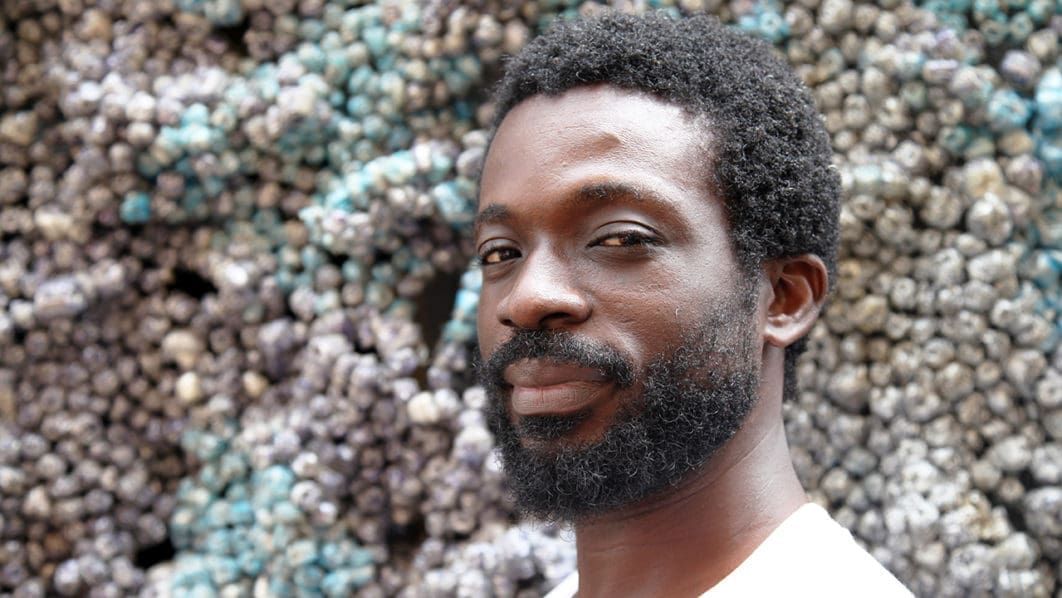
My connection to Olumide isn’t new. We were fellow residents at Arthouse Foundation in 2016, part of a cohort of artists pushing boundaries and redefining what Nigerian art could be. I remember reading The Guardian newspaper’s piece (by Tajudeen Sowole, 23 April 2017) on that “new dawn” at Arthouse, where his experiments with discarded paper, nylon, and foil were already refusing the colonial lie that African art must look a certain way to be taken seriously. To see him now at Soto, commanding space with such philosophical clarity, felt like watching a seed we once saw planted together become a forest.

“Ká”: The Rolling of Memory Into Matter
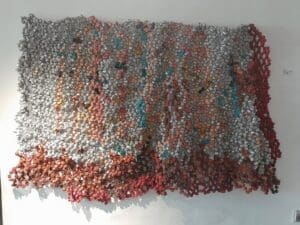
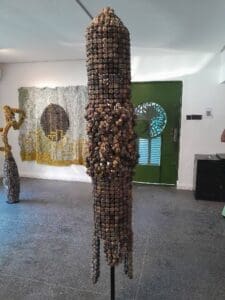
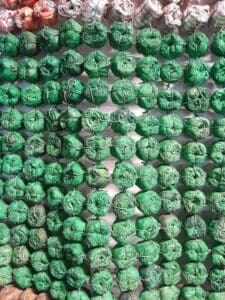
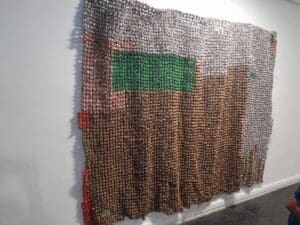
You enter the exhibition and immediately understand “ká”. Onadipe rolls newspaper, fruit juice foils, plastic bags, cargo wraps, water sachet bags, among others into thousands of small, corn-seed forms. He “ká” what society spreads and discards – yesterday’s headlines, drink foils, nylons – into dense, topographical scapes. These are not sculptures. They are rolled-up histories.
In “Ancestor Series” (Mixed Media, 2022/2025), the gallery wall becomes a family compound. Each rolled element is a name the earth has held. You see lineage “ká” into form: the individual swallowed but not erased, the collective made visible. Politically, this is what Nigeria refuses to do. We scatter. We throw it away. Onadipe rolls us back together. He reminds us that nationhood, like art, is the discipline of gathering fragments until they speak.
“The Split” (Mixed Media, 2022) does the opposite work, then the same work. A form divided, yet each half “ká” so tightly it holds. The piece is Nigeria after every election, after every “jápa” flight, after every EndSARS. We are split, yes. But Onadipe shows that even the split can be rolled, carried, and made whole again. “Ògún dá ọ̀nà, ó yí padà, ó ká ọ̀nà pọ̀” – Ògún turned back and rolled the roads together. That is what this work demands of us.
“Yí”: The Turning of Bridges and Heads
If “ká” is consolidation, “yí” is revolution – the turning. “Eko Bridge” (Mixed Media, 2024) is not just a hairstyle rendered in rolled foil. It is Lagos “yí” itself. The work braids “ayé” and “ọ̀run”, mainland and island, departure and return. The feminine figure becomes the portal, her head a crossing point.
Here Onadipe makes physical the teaching of “Ori”. The curatorial text says: “The head is therefore not treated as ordinary; it is honoured as the seat of awareness, intuition, and alignment with purpose.” In the gallery, I stood before “Ori” and felt my own head “yí” (not negative turning o!). To be in harmony with one’s “Ori” is to live in accordance with destiny. To be in harmony with a city’s “Ori” is to live in accordance with justice. Lagos has been turning “yí” for decades – military to democracy, oil to tech, naira to dollar. But without “ká”, without rolling that motion into meaning, we only grow dizzy. “Eko Bridge” asks: what if we turned with intention? What if the bridge didn’t just carry traffic, but carried us back to ourselves?
“Dí”: The Binding of Authority and Responsibility
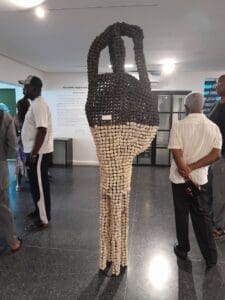
Then you meet “Opa Ase I” (Mixed Media, 2025). A staff and throne merged, vertical and grounded. This is “dí” – to bind, to seal, to set boundaries. Yoruba political theory says, “Dí ohun tí kò yẹ kí á rí, kí ilé lè rọjú” – Bind what should not be seen, so the home may have peace.
Onadipe’s “Opa Ase” binds power to responsibility. The galvanised wire that “dí” his newspaper coils is the same ethical wire that should “dí” corruption. But the work knows what we know: in Nigeria we “dí” the wrong things. We “di ẹnu’ – seal our lips – before truth, and refuse to “dí” illicit flows. The staff here is not just for the Ọ̀ba Aládé – Crowned King. It is for us. Ìrẹtẹ̀ Méjì asks: what will you bind? The work answers: bind the throne to the people. Bind sovereignty to accountability. “Dí” is sacred only when it shields the compound, not the thief.
“We”: The Wrapping of the People, The Earth, The Name
Finally, “we” – to wrap, to cover, to protect. Onadipe’s technique is all “we”. He wraps the discarded until it becomes precious. He wraps the earth’s memory until it becomes a name. The muted yellow ochres, reds, earth tones in his pieces are not colours. They are cloth. They “we ọmọdé pẹ̀lú ìfẹ́” – wrap the child with love.
The entire exhibition “we” us. In a country where the state refuses to ‘we ènìyàn’ – wrap the people – with dignity, where palliatives suffocate instead of protect, Onadipe shows another way. “Ancestor Series” wraps the dead so they are not forgotten. “Eko Bridge” wraps the living so they can cross. “Opa Ase” wraps power so it does not run naked and mad.
Ọ̀rọ̀ as Àṣẹ: The Word, The Work, The World
Standing in Soto Gallery, I remembered: ‘Ọ̀rọ̀ ní ń kọ́ ilé, ọ̀rọ̀ ní ń wó ilé’. Word builds the house, word destroys the house. Onadipe’s materials are discarded words – newspapers. He “ká” them, “yí’ them, “dí’ them, “we” them, until they become àṣẹ. This is why the exhibition is not just art. It is an embodiment of values inherent in Ifá. It is socio-political philosophy made tactile.
Since 2016, when Arthouse Foundation gave him space to experiment, Onadipe has been practising what The Guardian newspaper called a “new dawn”. Yesterday (May 2) I saw that dawn break. He is not just a “keeper of space,” as the curatorial statement says. He is a keeper of verbs. He reminds us that Nigeria’s crisis is linguistic before it is political. We have forgotten how to “ká” ourselves into one mat. We “yí” without direction. We “dí” truth instead of corruption. We refuse to “we” each other.
“The Earth Holds Our Names” because Onadipe “ká” them from the dirt, “yí” them toward the light, “dí” them with wire and will, and “we” them for us to carry.

Jelili Atiku
I left the gallery thinking of Òtúrúpọ̀n Méjì: “lé tí a kò ká, ìjì á wó ọ” – A house not rolled up will be scattered by the storm. The storm is here. But so is the mat. Olumide has rolled it out for us in Ikoyi. Our work now is to sit on it. Together.
Àṣẹ wà nínú ọ̀rọ̀. Àṣẹ wà nínú iṣẹ́ Olumide – There is power in the word. There is power in Olumide’s work – Let us choose our verbs. Let us choose our artists. Let us choose to be worthy of the names the earth holds.


- Jelili Atiku, performance artist, writes from Ejigbo, Lagos
- https://web.facebook.com/jeliliatiku