
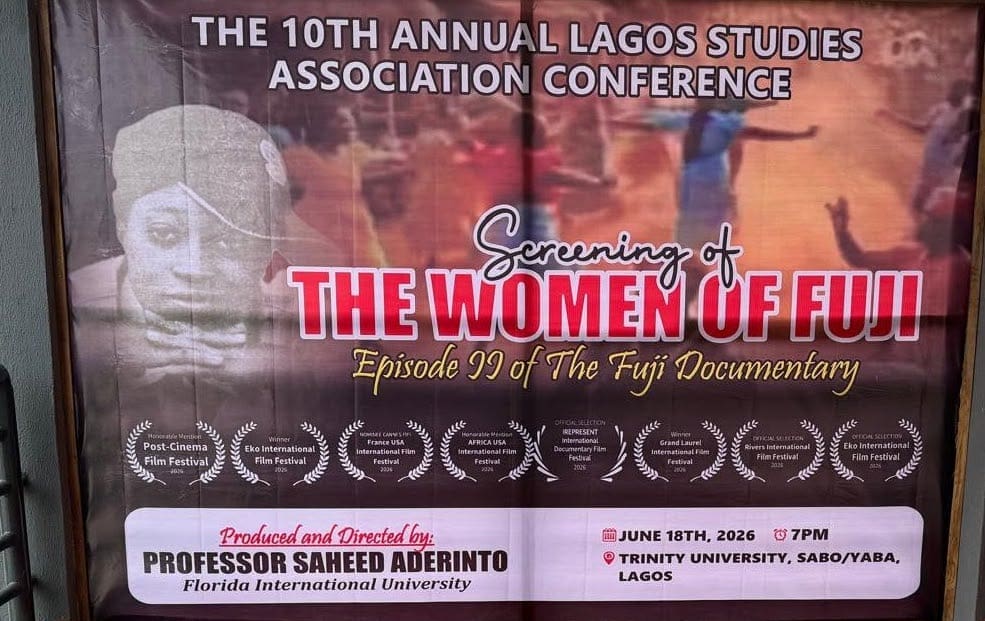
Divided into eight parts -the screening will hold on June 18 from 7pm at the Trinity University located in Sabo Yaba area of Lagos. The eight parts of the documentary are: Part I: Music, Gender, and Colonial Legacy | II: Early Women Fuji Artists | III: “The Salt of the World” | IV: The Art of Women| V: Lust, Love, and Sexuality | VI: Nollywood Meets Fuji | VII: Mothering Fuji| VIII: 21st century Women Fuji Artists

WOMEN of Fuji: Episode II of The Fuji Documentary series, produced and directed by history scholar and archivist, Saheed Aderinto, is one of the highlights of the 2026 Lagos Studies Association, LSA, which runs June 16-20. It is the 10th anniversary of the LSA, which Is reputed as the biggest of such a multidisciplinary conference in Nigeria, and perhaps Africa.
Divided into eight parts -the screening will hold on June 18 from 7pm at the Trinity University located in Sabo Yaba area of Lagos. The eight parts of the documentary are: Part I: Music, Gender, and Colonial Legacy | II: Early Women Fuji Artists | III: “The Salt of the World” | IV: The Art of Women| V: Lust, Love, and Sexuality | VI: Nollywood Meets Fuji | VII: Mothering Fuji| VIII: 21st century Women Fuji Artists
In his introductory remarks to the documentary screening, Aderinto, of the Florida International University, who is also the lead Convener of the LSA, wrote:

Fuji, a major popular culture of the Yoruba of Nigeria and the global African diaspora, emerged in the 1970s. Today, it is the most dominant of the Yoruba musical expressions.
In this episode of the Fuji documentary, we turn our attention to the place of women in Fuji. From artists, wives, lovers, daughters, and mothers, to patrons, fans, spiritual advisers, and everything in between, women’s place in Fuji goes beyond the conventional frames of entertainment to include a wide range of identities that intersect deeply with virtually every component of African cultures.
The Documentary, which has travelled around major festivals and academic circuits in the West, but premiered in Lagos early in the year, has attracted, positive commendations from eminent scholars and culture observers. Some of these are captured below:
*********
The Women of Fuji’s analytical rigor is matched by its emotional resonance, offering both historical context and contemporary urgency. Its interdisciplinary approach—drawing on musicology, gender studies, and cultural history—enriches our understanding of how power, creativity, and exclusion operate within artistic traditions. The result is more than a music documentary. It is a reclamation project that insists women be recognized not as muses or followers, but as visionaries who have shaped Fuji music from its inception…The film doesn’t merely tell us that women matter to Fuji—it proves they are indispensable to its past, present, and future. –Professor Mojubaolu Olufunke Okome, Brooklyn College, City University of New York
——
This tour-de-force is a must-watch. The second installment of creative historian Saheed Aderinto’s dazzling kaleidoscope about one of Nigeria’s most popular musical genres, dances away from the frying pan and into the fire of women singing, playing and wryly critiquing men, love, family and society. Respect! —Professor Teresa Barnes, University of Illinois, Urbana-Champaign
——
Produced and directed by Professor Saheed Aderinto, a prolific and distinguished African historian, storyteller, and filmmaker, this documentary brilliantly accentuates the voice of women in Fuji musical tradition…It captivatingly tells the story of how women in Fuji music assertively and artfully navigated the complex layers of cultural expectations, patriarchy, love, romance, marriage, motherhood, and intergenerational and gender dynamics to become trailblazers and musical icons in a music genre dominated by men. A must-see… –Professor Gloria Chuku, University of Maryland, Baltimore County
—–
Aderinto’s The Women of Fuji is a brilliant, highly engaging and beautifully produced documentary that enables us to understand the agentive roles of Yoruba women singers and performers in appropriating the Fuji sound technology…The Women of Fuji offers an insightful timely historical and visual narrative methodology that inscribes the centrality of women in the capacious archives of Fuji music across secular and religious boundaries in Nigeria and worldwide. The Film must be seen by everyone across academic disciplines and beyond interested in a new understanding of the significant roles of African women in society. ––Professor Ousseina Alidou, Rutgers University, New Brunswick
—–
Professor Saheed Aderinto’s The Women of Fuji is a masterful tribute to the women who have enlivened the popular music genre of Fuji… A well-resourced project with the rigor one would expect of a scholar of Prof Aderinto’s calibre, The Women of Fuji is a grand tribute to the women who made the music that made a generation but have hardly received their due credit. –Associate Professor Abimbola Adelakun, University of Chicago
—–
Precisely, Professor Aderinto’s directorial lens unmutes enduring African-womanist agency in Fuji music by combining musical, cinematic, and Indigenous human archives. Mobilising these through a poetic editing style securing structural aesthetics, the film memorialises women whose artistic, economic, metaphysical, anti-chauvinist, and diasporic capital generate the precolonial foundations and postcolonial continuities of Fuji. –Dr. Samantha Iwowo, University of Bournemouth
—–
In this important, vibrant, and captivating documentary, Aderinto highlights the overlooked stories of the women at the heart of Fuji music culture. It traces their artistry, resilience, and struggle for acceptance in a male-dominated industry, revealing how they shaped/changed/influenced sound, performance, and social identity in contemporary Nigeria. It is the art of storytelling at its finest. —Dr. Olúwábùnmi Bernard, Ghent University
—–
“The Women of Fuji” is an engaging, informative documentary that exposes the overlooked roles of women in Fuji and affirms that there is no Fuji without women. With vibrant visuals and mellifluous sounds, it highlights various themes ranging from critiques of the coloniality of gender to the ways women shape Fuji’s culture and political economy.”–Associate Professor Grace Adeniyi-Ogunyankin, Queen’s University
—–
In “The Women of Fuji” Professor Saheed Aderinto gives us a complex portrait of the role that women play in Fuji music as artists, creators, fans, and more. Drawing on historical, sociological, and literary perspectives, the film brings together scholars, musicians, and those who were present throughout the history of the genre to document and celebrate how women contribute to Fuji… A must-see documentary for anyone interested in gender and popular culture in Nigeria!” –Associate Professor Vicki Brennan, University of Vermont
——
“Congratulations. The Women of Fuji is a fascinating film. It’s not often you watch a documentary about which you have no prior knowledge of and yet find it absolutely enthralling. Professor Aderinto’s film seeks to remind us of the importance of the work of these women and viewed through today’s lens we can better appreciate how they soared above the twin constraints of traditional misogyny and colonial paternalism. –Aduke Gomez, Writer, Culture Advocate, Lawyer
—–
The Women of Fuji Documentary unearths salient, but silenced artistry. It invites us to explore the dusty, rusty archives that kept the labors and nurture-based resilience of Nigerian women within the malestream Fuji Music industry. Aderinto simplifies herstory and connects the fading dots, re-establishing how these women navigated both private and public spheres. This important, well-researched and captivating work feeds into the continuing task of documenting women in contemporary easy-to-access and concise to engage formats. –-Associate Professor Sharon Adetutu Omotoso, University of Ibadan
- https://www.facebook.com/groups/431357430001497