
PRESIDENT Bola Tinubu has ordered the immediate strengthening of security at the National Institute for Policy and Strategic Studies (NIPSS) in Kuru, Plateau State, following a recent attack on the institution that resulted in the deaths of two soldiers and a police officer.
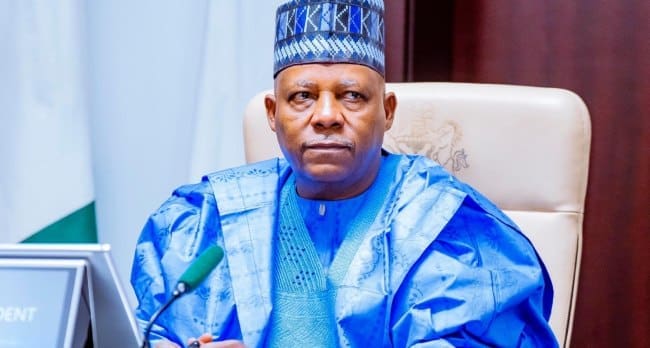
The directive was delivered today by Vice President Kashim Shettima during a visit to the institute, where he addressed participants of the Senior Executive Course (SEC) 48 on behalf of the President.
According to Shettima, the incident has reinforced the Federal Government’s determination to safeguard critical national institutions, provide support for security personnel, and prevent a recurrence of such attacks.
Expressing the government’s sympathy, the Vice President conveyed condolences to the families of the slain officers, as well as the military and police authorities, assuring them of continued federal support.

Speaking during the visit, Shettima described the loss as painful, noting that the government shared in the grief of the affected families while honouring the sacrifices made by the fallen security personnel in service to the nation.
He announced that President Tinubu had directed the immediate implementation of emergency security measures at NIPSS.
The institute’s Director-General has been instructed to collaborate closely with the Armed Forces, the Nigeria Police Force, and the Department of State Services (DSS) to strengthen security around the facility.
The Vice President further disclosed that a detailed action plan outlining permanent security enhancements must be submitted to his office within 72 hours.
The proposed measures are expected to cover surveillance systems, personnel deployment, access control mechanisms, and emergency response structures.
Weekly progress reports will also be required until the project is fully completed.
“No future attack must catch us unprepared,” Shettima stated.
Describing NIPSS as a strategic national institution and a hub for policy development and leadership training, the Vice President stressed that protecting the institute remained a matter of national importance.
He noted that while the attackers may have intended to instill fear and disrupt activities at the institute, the response of staff, participants, and security personnel demonstrated resilience, discipline, and courage.
Reassuring those at the institution, Shettima said the safety of staff and participants remained a top priority for the Federal Government.
He added that the welfare of the families of the deceased officers would receive government attention and support.
The Vice President also maintained that those behind the attack would not be allowed to undermine the institute’s mission of developing future leaders.
Commending participants of SEC 48, he praised their calm and responsible conduct during the incident, describing their actions as reflective of the qualities expected of national leaders.
He equally lauded the Director-General of NIPSS, Ayo Omotayo, for his leadership and swift engagement with security agencies, which helped secure the institution and facilitate the rapid deployment of reinforcements.
Shettima also acknowledged the efforts of the Director of Studies, Barrister Nima Salman Mann, for coordinating the safety of participants and staff throughout the crisis.
Earlier, Caleb Mutfwang thanked the Federal Government for its support and commended the Vice President’s visit, describing it as a strong gesture of solidarity following the attack.
The governor approved requests from NIPSS management for the creation of a buffer zone around the institution, as well as the installation of security lighting and other protective infrastructure to improve safety in the area.
Mutfwang paid tribute to the fallen officers and praised the efforts of security personnel, staff, and course participants who helped prevent the attackers from gaining further access to the institute.
In his presentation, Omotayo submitted an incident report to the Vice President and appealed for additional security measures, including increased personnel deployment and the installation of surveillance equipment such as CCTV cameras.
He said the attack highlighted the vulnerability of key government institutions and underscored the need for stronger security arrangements across the country.