“Ososfisan has practically given us the tools to discuss these things (failings in society). His drama is a sustained critique of the Nigerian condition. His drama attempts to critique the Nigerian condition in postcolonial state. But Nigeria is still plagued by bad leadership, inequality, his works expose the contradictions in the polity; his works are radical. Osofisan frowns at people who are suffering but remain silent. He proposes a radical, revolutionary action for the oppressed to liberate themselves.”
“Osofisan uses satire to enrich the work. He also uses riddles, proverbs and songs, which make his works not to be boring. He’s true to the art. He uses a lot of drumming and songs. His works help to deconstruct society generally; his works talk to the masses, who should come together and work for their own liberation. What Niyi Osundare is to poetry is what Osofisan is to drama. His works entertain you but also make you think about the current condition and what can be done to change it for the better.”
By Anote Ajeluorou
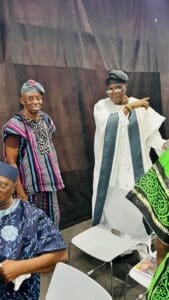
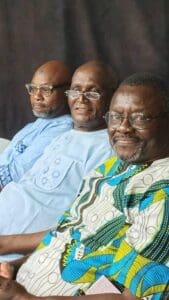
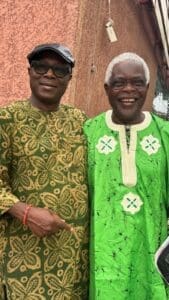
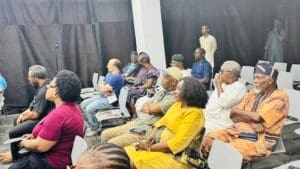
EVER self-effacing, soft-spoken and possessed of a humility so rare for a man of his genius, colleagues, former students and his creative family turned up for his 80th birthday roundtable in Lagos on Saturday, June 14, 2026.
At the J. Randle Centre for Yoruba Culture and History at Onikan, Emeritus Professor Femi Osofisan showed why he is so loved by his creative family. Accolades poured in from all sides, but he took a moment to remark that his literary and theatre journey wasn’t all his alone, but a joint effort. This was after music producer, Sir Semoore Badejo of Concrete Studios spotlighted Osofisan’s 100 songs he is producing out of the lot in his many plays.
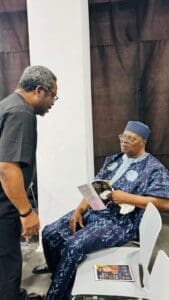
“The idea to do these songs isn’t mine,” Badejo said. “Ropo Ewenla did. What we did was to provide a platform for the songs. What we want to do is legacy, to ensure that these works do not die and the person who created them should live forever and let the global audience have access to them. And it’s always at a pro bono level. Only those who create these works benefit.

Sir Badejo further provided reason for embarking on making 100 songs in Osofisan’s plays into songs outside of the plays, “At Concrete Studios, we will continue to so this. We only took 100 songs from 10 of Osofisan’s plays. It’s a symbolic work, it’s still a work in progress. Women of Owu, Once Upon four Robbers, etc. I can tell you that the songs in his repertoire are over 400. Concrete Studios is ready to push for more. What we intend to do is liaise with his family to ensure that all streaming platforms – Spotify, Audiomark – have them and Osofisan’s family benefits. We want to ensure students and others have access, for people to appreciate the depths of his thought.”
Badejo also remarked on the similarity between the song compositions in Herbert Ogunde’s plays and Osofisan’s, saying, “I was seeing the deep meanings between the two. There are a lot of tracks I’ve worked on and I was seeing the influence of Ogunde in Osofisan’s songs in the 100 songs we are working on.”

Tomoloju
ALSO in his opening remarks, culture producer and fellow writer, dramatist and culture communicator,. Ben Tomoloju had told his audience how he knew Osofisan right from his secondary school days in his native Ekiti through one of Osofisan’s yet-to-be published plays he performed back in 1975. Tomoloju said he later encountered Osofisan in person at the University of Ibadan after he was admitted to study English and Literature. He poured encomiums on Osofisan for his prodigious talent as a playwright and the revolutionary bent of his creative vision.
“Meeting Osofisan in person, my first impression about him was that he was not one to announce himself by his carriage and individual ego,” Tomoloju said. “His reputation loomed large enough to bring such annunciation into effect for whatever it was worth in the life of a genius, be it as a literary figure or a scholar-critic bristling with revolutionary fervour.
“One of my earliest experiences of Osofisan’s radicalism fell within my first few months as a freshman in the university. A literary event was being held at Trenchard Hall. It had to do with problems besetting academic publishing vis-a-vis the publishing industry in Nigeria. The event was a town-and-gown affair. It enjoyed the august presence of publishing executives and scholars, including some firebrand radical authors like our celebrant who seized the opportunity provided by the occasion to protest against the discriminatory and unfavourable disposition of publishers towards young writers with the right aptitude and evidently creative outputs.
“At the centre of the raging fire of the protest was the poet Odia Ofeimun, then a postgraduate student of Political Science who was the most visible victim of the attitudinal disincentive from the publishing sector at that time. As a landmark intervention in the history of literary development in Nigeria, the verbal assail launched by Osofisan and his compatriots like Biodun Jeyifo, Omafume Onogie and G.G. Darah, was an intellectual liberationist move that opened the vent for new voices to be heard in the Nigerian literary firmament.”
Tomoloju said the outcome of that exchange made it possible for Ben Okri to be published in 1980 (Flowers and Shadows) and 1981 (The Landscapes Within) by Longman and the subsequent liberalisation of publishing that took place.
Osofisan’s one of those who, for my generation, theatre in Nigeria has passed through different stages, starting from Wole Soyinka era. Those of us who came into theatre post-military, we have the opportunity to reinvent what theatre is.”
Onikeku
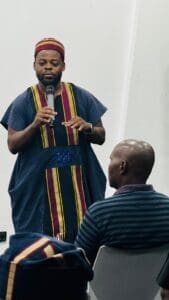
ALSO acknowledging Osofisan’s influence on younger creatives was the Director/CEO of JRandle Centre for Yoruba and History, Qudus Onikeku, who described Osofisan as “one of my heroes”. While studying in France, Onikeku said he was already “starting to look at the reality of performance in Nigeria and how different it was studying in France”, and had begun to ask: ‘Do we need Coca Cola to dance?’ By which he meant having to perform for expatriates or foreigners working in Nigeria rather than his fellow country men and women and how to model dance to suit that taste.
“I wrote to Osofisan in 2007, after he’d just left the National Theatre,” Onikeku recalled. “He prefers more access to education in students’ enrolment numbers as it is now than in his days when only a few persons entered university to study with all the pecks that came with it. He’s one of those who, for my generation, theatre in Nigeria has passed through different stages, starting from Wole Soyinka era. Those of us who came into theatre post-military, we have the opportunity to reinvent what theatre is.”
“All the positive things said by Tomoloju, good to give me credit but without them it wouldn’t have been possible. People who have worked with me, who inspire me. Without Ben T and the others, it’s because of them that I’m, because of the encouragement, the ideas that come from them. Nobody grows alone. I want to thank them – all my actors, musicians, all of them. I want to say that FO is all of these people!”
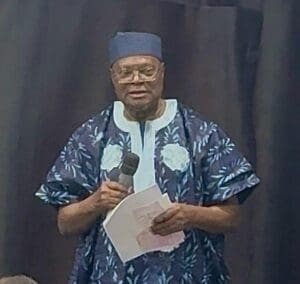 OSOFISAN‘s response to all these was typically ‘Osofisanesque’, laced with humour, as he gave credit where it was due, showing how much he valued his creative family with whom he’d worked collaboratively over the years.
“It’s funny that I’m being spotlighted as a musician,” he said with his usual chuckle. “The credit goes to Tunji Oyelana. Most of the songs were Oyelana’s lines. I would give him ideas what I wanted and he would work on them. I want to give him a lot of credit. Not just me but many of Soyinka’s songs. He deserves an applause.
“All the positive things said by Tomoloju, good to give me credit but without them it wouldn’t have been possible. People who have worked with me, who inspire me. Without Ben T and the others, it’s because of them that I’m, because of the encouragement, the ideas that come from them. Nobody grows alone. I want to thank them – all my actors, musicians, all of them. I want to say that FO is all of these people!”
“I want to thank Osofisan for giving me the opportunity to share in his works. He has given me so much materials and inspiration to work with. If you find yourself in Osofisan’s study, nobody will find you in a month or more. It’s a safe refuge. Thank you for enriching my life and journey as a filmmaker.”
BabaAgba Kelani
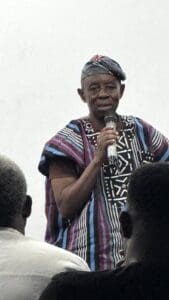
VETERAN filmmaker BabaAgba Tunde Kelani was no less effusive in eulogising Osofisan for his works from which he’d made several film adaptations. Kelani is perhaps the one exception, who has found Nigerian fiction ready materials for his filmic creative vision. Maami and Cordelia are two of his film adaptations from Osofisan’s works.
“Osofisan writes so well and inspires me all the time,” the notable filmmaker confessed, noting the loss of the actor Kola Oyewo with whom he’d worked collaboratively. “This occasion has been marred by the loss of the actor, Kola Oyewo. Only last week, I had the idea that I would visit him, but I never did.”
Kelani marvelled at the creative depth of Osofisan’s work, when he said, “I want to thank Osofisan for giving us your books. The first one I found was Cordelia. My own filmmaking is to read widely. When somebody brought Cordelia to my attention, I quickly went to Ibadan (to see Osofisan). His imagination is so vivid. I sat down with him. He has a way of talking, never loud. He brought Maami. I took Cordelia but shelved it for 10 years. As soon as I showed interest in Maami, he showed me another, Pirates, an espionage, not something you’d expect Osofisan to do. And it was clearly beyond my scope, a nationalistic film for the future, Pirates.
“I want to thank Osofisan for giving me the opportunity to share in his works. He has given me so much materials and inspiration to work with. If you find yourself in Osofisan’s study, nobody will find you in a month or more. It’s a safe refuge. Thank you for enriching my life and journey as a filmmaker.”
“Osofisan uses satire to enrich the work. He also uses riddles, proverbs and songs, which make his works not to be boring. He’s true to the art. He uses a lot of drumming and songs. His works help to deconstruct society generally; his works talk to the masses, who should come together and work for their own liberation. What Niyi Osundare is to poetry is what Osofisan is to drama. His works entertain you but also make you think about the current condition and what can be done to change it for the better.
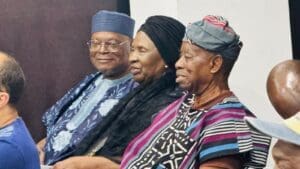
Prof. Osofisan (left); Prof. Ebun Clark; and Tunde Kelani during the first Roundtable
THEREAFTER, four theatre academics and one practitioner – Prof. Mabel Ewvierhoma, Dr. Onyekaba Cornel-Best, Prof. Razinat Mohammed, Prof. Ifure Ufford-Azobo and Mr. Israel Eboh – started the Roundtable focusing on ‘Femi Osofisan’s Drama and Deconstruction of the Nigerian Postcolonial State’. All five panel members joined the session virtually.
Prof. Ewvierhoma of Theatre Department of the University of Abuja started with an oriki or ode in Yoruba in praise of Osofisan. She based her abstract on ‘Postcolonial deconstruction of the political space and the need to excise the appendages or adjuncts that continue to tie us to the imperial powers’ the play. One Legend Many Seasons was the play she focused on, noting that “from the political references to activism through music, Osofisan starts by referencing Fela’s music through Rotimi, the nephew of Alowolodu.”
Ewvierhoma then highlighted the political behaviour of Alowolodu as mirroring what is prevalent in today’s Nigeria, where the leader strangulates those around him or her and becomes the sole beneficiary of democratic dividends. They also stifle the economy such that there is lack of presence of governance in the lives of the people. And like in most of Osofisan’s works, there is usually a rallying cry for the people to unite and forge a common front to liberate themselves from the stranglehold of their oppressors.
She also spotlighted economic and political exploitation in the play with Alowolodu committing the seven deadly sins known to man. However, Ewvierhoma wasn’t happy with male dominance in the play as in the political sphere at the expense of women, arguing that “it’s like the male dominance in Nigerian politics, and it’s a source of query for Osofisan, because the female characters in the play are economically subordinated, they are more or less handicapped in the face of challenges.”
The university don also amplified what she called “elite capture in the play as being real,” as can be seen in Nigeria’s public life, where a few have cornered the commonwealth to themselves at the expense of the vast majority. And in deconstructing the play, Ewvierhoma raised certain pertinent queries on the socio-economic introspection of the play: Is it when people are hungry or feasting? Is poverty destiny? Should exploitative wealth attract the governed or followers and citizens or should they in turn question how this wealth arose? What caused hunger in Alowolodu community? Was it laziness or bad governance? In Nigeria today, why are people hungry? Are we hungry because we are lazy or as a result if bad governance? Is the government present in the people’s lives?
Ewvierhoma submitted that in One Legend Many Seasons, Osofisan “tries to teach us about oppositional hierarchy or subversion by displacement…”
She concluded by arguing that it’s no “mean feat to clock 80 years, and we shall gather to celebrate you at 100. The little we do here today is just to say thank you. It’s not mute, but active followership that we need to create a great society.”
Dr. Cornel-Best of Theatre Arts Department of the University of Lagos focused on Altine’s Wrath, where he gave credit to Osofisan for giving women space to vent and to deliver his message. He stated that keeping the people poor in today’s Nigeria is reminiscent of colonial oppression, which sadly was yet to abate, noting, “Our leaders are using our disability, like Altine’s, to fuel and enhance their own empire. Altine has to go into quiet self-education” to be able to liberate herself from the oppression she faces at home from the one who claims to love her.
Cornel-Best said in postcolonial Africa, there is need for self-awareness and self-improvement among the people, and the need to use that improvement to fight for the people. “Those who fight for change in Africa find it hard to unite the people for progress,” he stated, arguing that silence has its place in revolt, “The power of silence. There’s so much power in silence. A philosopher said silence is the most powerful weapon. Altine is a band of revolution waiting to happen.”
The university don also commended Osofisan for “using the double-ending option” for his plays, since “in postcolonial architecture, the struggle is continual. Those who give their lives for the struggle become the sacrificial lamb. Citizens must learn how to unite. Altine was acting alone and so suffered. There’s a shift from a theatre that makes people think to that of entertainment. It’s time for us to begin to wear our thinking cap.”
Also for Prof. Mohammed of English Department of the University of Abuja, Osofisan’s body of work promotes women’s voices and references historical past as anecdotes for the present and future. Mohammed based her submission on Morountodun and Women of Owu, arguing that “Osofisan is one of first generation of Nigerian writers, who invested in portraying women in positive light. In an article I wrote, I glowingly paid tribute to his presentation of women in his works. He gave voice to women in his plays. He is one of those writers who promote women’s voices, and this template can be found in his work, and I recognise this in some of his works. He makes frequent reference to historical past in his plays. He revisits historical facts and brings some kind of acceptable agency. His theatre is one of resistance, as a way to challenge the high-handedness of leadership (prevalent in our society). His drama questions the leaders on their performance.”
Mohammed also highlighted that Osofisan’s satire serves as a social commentary tool that he uses to convey meaning in his works, adding, “He uses theatre for social criticism and the need for society to resist oppression and the need for social reform through collective action. In virtually all his works, when he offers resistance, (as means to subvert oppression) he balances it by proffering solutions, and drawing the attention of leadership to the suffering by the poor.
“Osofisan uses satire to enrich the work. He also uses riddles, proverbs and songs, which make his works not to be boring. He’s true to the art. He uses a lot of drumming and songs. His works help to deconstruct society generally; his works talk to the masses, who should come together and work for their own liberation. What Niyi Osundare is to poetry is what Osofisan is to drama. His works entertain you but also make you think about the current condition and what can be done to change it for the better.”
But Mohammed was not particularly enthused by society’s unenthusiastic response to literary productions like those by Osofisan, arguing that society still remains the same even after watching some of his plays that should motivate them to effect positive changes for their own good.
“So, what have we done with these information in his works as a society to make changes in our lives for the better in Nigeria?” she asked. “Have we really listened or taken note of some of these things that Osofisan has consistently brought to our attention? We haven’t, because we haven’t been able to come together to resist what Osofisan has been talking about.”
Mohammed’s damning verdict about society’s failure to put the revolutionary intent of Osofisan’s creative vision into practice is at the heart of high culture and its failure to engender needed social change and reform. Who takes the blame for this? Should the artist do more advocacy outside his work? Why is society impervious to the message of the town-crier? What more can the town-crier do to wake a society that seems deadened to its suffering and unable to act in self-preservation? Should he or she give up on it?
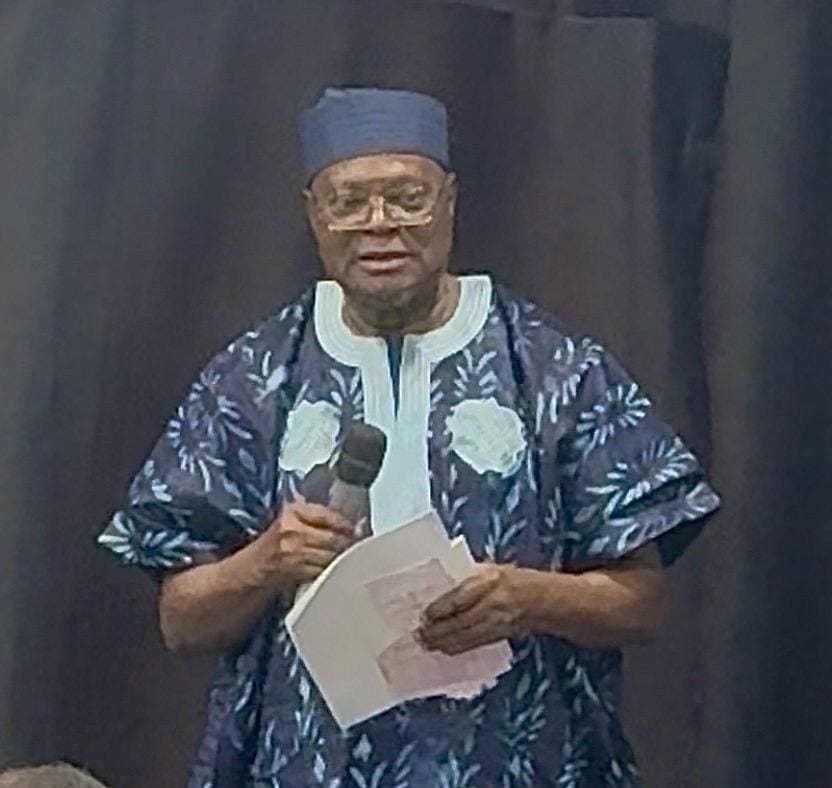
Prof. Ufford-Azobo of the University of Uyo argued that Osofisan “has practically given us the tools to discuss these things (failings in society). His drama is a sustained critique of the Nigerian condition. His drama attempts to critique the Nigerian condition in postcolonial state. But Nigeria is still plagued by bad leadership, inequality, his works expose the contradictions in the polity; his works are radical. Osofisan frowns at people who are suffering but remain silent. He proposes a radical, revolutionary action for the oppressed to liberate themselves.”
Ufford-Azobo frowned at society’s inability to take up the gauntlet provided by Osofisan to act in manners to liberate itself, choosing instead to hide behind the cloak of silence.
“In Women of Owu, we see the examination of war and violence. Silence perpetrates oppression,” she said. “Society must not sacrifice individuals for unjust systems. He questions official narratives. How drama attacks military regimes, patriarchal structures. These questions pose possible solutions to the Nigerian problems. Nigeria has moved from military to civil rule, but we still see corruption. His plays provide alternations, offer possibilities for transformation. Class reconciliation and social justice are possible. He reimagines alternatives.”
Theatre maker and administrator, Israel Eboh, who approached the roundtable conversation from a director’s perspective, argued that Osofisan’s plays “are more for production than for academic engagement. His works are what can be classified as total theatre – music, dance, songs; he uses these elements to realise his message, for the people not to be passive but to act to liberate themselves from oppression. The facts that we (Nigerians) have gained independence doesn’t mean the problems have gone away. Six decades on, we are still addressing those same challenges. His works are timeless, because as the problems still persist, the issues raised continue to be relevant.
“Osofisan doesn’t want his listeners to leave the theatre hall without reflecting on the issues raised in his works in that performance. Midnight Hotel is a microcosm of Nigeria itself and all the issues that bedevil the country. Religion, citizens, politician, military are all represented. The height of lawlessness, corruption at all levels are represented. Religion is abused, and what should be a point of succour and hope is abused and raises doubt in the minds of the people. The music used in the hotel is not just for enjoyment; it’s a critique of society. We see bribery, how people bribe and circumvent the whole process at the expense of development and national renewal.”
Eboh further argued that Osofisan “is a theatre activist; he won’t give you solutions, because he believes we all should find solutions. At the end of Midnight Hotel, the songs challenge us to find solutions to the change that we desire. For him theatre or music is not just to entertain. His is total theatre. Another level is the adaptability of his works to any given time and place. Osofisan is unique in a way. His language is very simple yet the message is deep. He uses satire and paradox in his works.”
Eminent African history scholar, Prof. Toyin Falola of the University of Texas, Austin, US, who joined virtually, also praised Osofisan for shining a light on critical aspects of Nigerian life through drama. He expressed dismay at the level of insecurity in Nigeria, but stated that “Intellectual activities will continue, creativity will continue.”
Culture activist and columnist, Tunde Fagbenle, could only “marvel at Osofisan’s creativity; he’s an enigma. I watched the Love’s Unlike Lading production at Ibadan a few days ago, and it was very reverting. Osofisan sat beside me and he was looking so innocent, as if he wasn’t the writer!”
Thereafter, the evening was capped off with a film show. Kelani’s adaptation of Osofisan’s work Maami graced the big screen. Professors Ebun Clark, Duro Oni, Sola Adeyemi, Bunmi Adedina, and Grace Adinku; as well as Lekan Ajia (who came al the way from the US), Francis Onwochei, and Jahman Anikulapo, who moderated the roundtable session and compered the celebration, among others, were in the audience
• https://thearthubng.com/femi-osofisan-80-its-because-of-my-creative-colleagues-that-i-am/