
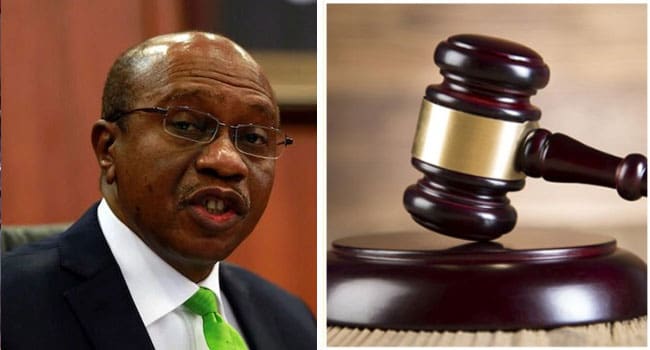
THE Former Governor of the Central Bank of Nigeria, Godwin Emefiele, has asked the Lagos State High Court to reject a series of statements the Economic and Financial Crimes Commission (EFCC) is seeking to present as evidence in his ongoing trial over an alleged $4.5 billion and N2.8 billion fraud, as well as abuse of office.
Appearing before Justice Rahman Oshodi today, Emefiele’s lead counsel, Olalekan Ojo (SAN), argued that the statements were obtained under coercive conditions while his client was in EFCC custody.
According to the defence, Emefiele was held incommunicado for more than 157 days before making the statements, rendering them involuntary and therefore inadmissible.
Ojo told the court that the objection was based on provisions of both the Evidence Act and the Anti-Torture Act. He maintained that Section 4 of the Anti-Torture Act bars the admission of confessions or statements obtained through torture, inhumane treatment, or any form of oppression.

The senior advocate argued that the prosecution must establish that every statement it intends to rely on was made freely and without undue pressure.
He insisted that the disputed statements were allegedly extracted while Emefiele was subjected to prolonged isolation and circumstances designed to compel him to make admissions against his will.
The issue arose after the Director of Public Prosecutions of the Federation, Rotimi Oyedepo (SAN), attempted to tender the statements through the fourth prosecution witness, Alvan Ikoku.
During his testimony, Ikoku informed the court that the EFCC had invited Emefiele for questioning and recorded statements from him on several dates, including October 26 and 27, 2023.
Following the witness’s evidence, the defence requested that the court conduct a trial-within-trial to determine whether the statements were voluntarily made before deciding on their admissibility.
In response, the prosecution withdrew the statement dated October 26, 2023, explaining that it contained only Emefiele’s personal identification details. With no objection from the defence, Justice Oshodi struck out that statement.
However, the prosecution opposed holding a trial-within-trial for the remaining statements, arguing that they were not confessional in nature and therefore did not require such proceedings.
Oyedepo also submitted that the Evidence Act, being the principal legislation governing the admissibility of evidence, should take precedence over the Anti-Torture Act on procedural issues.
He urged the court to dismiss the defence’s application and allow the trial to proceed without further delay, citing the public interest surrounding the case.
Ojo, however, maintained that the question of voluntariness must first be resolved before any of the statements could be admitted into evidence.
He argued that the prosecution had not addressed the defence’s claims that the statements were allegedly obtained through torture, oppression, and other degrading treatment, insisting that only a trial-within-trial could properly determine their admissibility.
After hearing arguments from both parties, Justice Oshodi reserved ruling on the admissibility of the statements until July 9, 2026.
The court also adjourned the substantive hearing of the case to October 6, 7, 8, and 9, 2026.