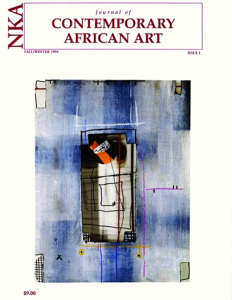

The many pieces in the two volumes also trace the way Enwezor expanded the canon alongside larger trends of the times, especially the globalization of the art world and the evolution of biennials, which are essential to understanding that world today. Enwezor’s own perspective evolves from a more hopeful, sanguine view of a gathering world in the ’90s into one that lucidly analyzes the crises of this new neoliberal era and the partly technological problem of “intense proximity” (his words) that prompted the rising authoritarianism and creeping nihilism of the 2010s
It is bittersweet to read these essays while wishing this searing, contrarian mind were still with us, still world-building, as we hard pivot into a new post-global, post-liberal era. But the collection shows that “his legacy remains an open work in progress, across multilayered platforms, for the many worlds to come, all of them postcolonial,” as Terry Smith, Enwezor’s close collaborator and editor of these collected writings, puts it in his introduction in the second volume
By Lauren Cornell
WHAT does it mean to be a world-builder? This term is used to describe artists, especially ones with innovative visual and conceptual vocabularies that create fictional alternatives to the world as it is. But the term could be applied in a different sense to Okwui Enwezor, who is among the most important architects of today’s art world as we know it. The poet, writer, curator, theorist, educator, and museum director mobilized new ways of seeing and living in our times. He was born in Calabar, Nigeria, in 1963, and his propulsive life was cut short in 2019 by illness. Now, the most recent contribution to his manifold legacy—a remarkable two-volume edition of his collected writings numbering just over a thousand pages—allows readers to follow his ideas as they evolve across his life and trace a pivotal time in art history, from the turn of the 20th to the early 21st century, when Enwezor was a major protagonist.
Throughout these pages, across catalog essays, exhibition reviews, and deep analyses of the work of individual artists, Enwezor’s expansive arguments frequently contract into lean summaries of intent: “My key interest has been rooted in the examination of artistic differencing through a form of curatorial counterinsurgency,” he wrote in 2007. “I have been examining contemporary African art through exhibitions, as specifically decisive places in which the idea of the contemporary can be constituted, and, as such, a place for the creation of its meaning in relation to an enlarged global public sphere.” This public sphere he described was rooted in experiences that curator Hoor Al-Qasimi describes as “beyond the purview of Western colonial epistemologies,” and in subject positions marked not by rigid categorization but by the fluidity and hybridity of a globalizing world on the move, one negotiating postcoloniality alongside the acceleration of capitalism and neoliberalism.

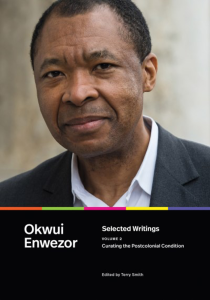
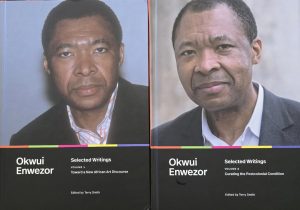
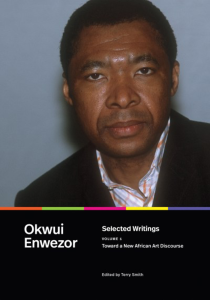 Enwezor: Selected Writings, Volume 1: Toward a New African Art Discourse and Volume 2: Curating the Postcolonial Condition, edited by Terry Smith; Durham, Duke University Press, 2025.Courtesy Duke University Press, Durham