
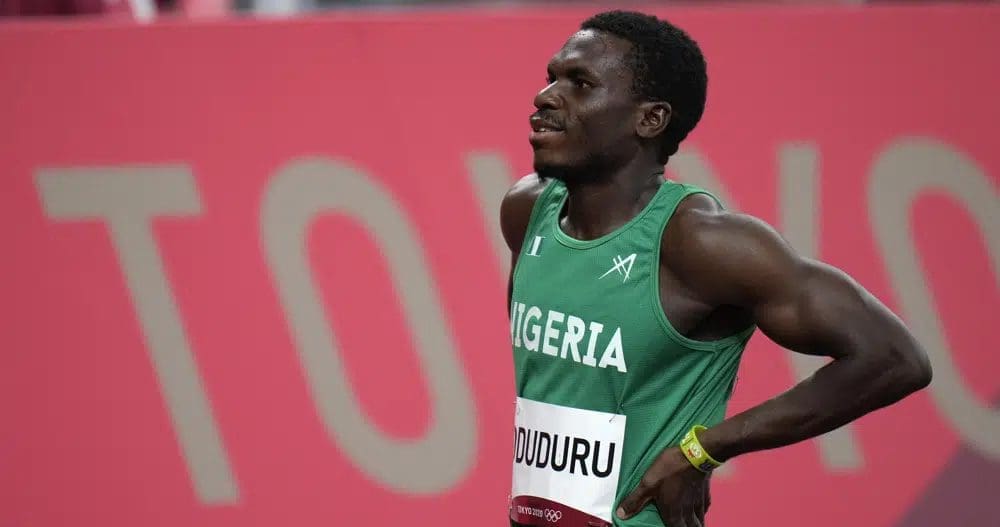
TRACK AND FIELD anti-doping body, the Athletics Integrity Unit, has charged Nigerian sprinter Divine Oduduru with using banned performance-enhancing substances and is seeking a long-term ban for the Olympian.
The four-time American national collegiate 100m and 200m champion’s alleged cheating was uncovered in the first case brought by United States of America authorities under a law designed to fight widespread doping by athletes across the world.
“The Athletics Integrity Unit (AIU)
has notified Divine Oduduru of two potential Anti-Doping Rule Violations (ADRVs) and is seeking a six-year ban against the Nigerian,” the AIU, an independent body working with World Athletics, announced today.
“The sprinter has been notified of potential ADRVs for possession (Rule 2.6 of the World Athletics Anti-Doping Rules; ADR) and/or use or attempted use of
multiple Prohibited Substances
(Rule 2.2 ADR).”

The AIU added that 26-year-old Oduduru, who represented Nigeria at the 2016 and 2020 Olympics, has been provisionally suspended immediately.
The body said the alleged violations were uncovered from an AIU investigation based on information in a criminal charge brought against US-based ‘naturopathic’ therapist Eric Lira in January last year by the US Department of Justice under the Rodchenkov Act.
Lira is alleged to have supplied
performance-enhancing drugs to
athletes before the Tokyo 2020 Olympics in 2021, the AIU added.
The AIU clarified Oduduru, who won 200m men’s silver medals in the African Games in 2015 and 2019, was the sprinter labelled “Athlete 2” in a complaint against Lira.
“Athlete 1” has already been identified as Nigerian Olympic medallist Blessing Okagbare, who is serving an 11-year ban.
Federal investigators in the US used hundreds of texts between Okagbare, Lira and others as evidence to charge the therapist, who was based in El Paso, Texas.
They accused Lira of distributing drugs, including human growth hormone and the blood-building hormone erythropoietin, “for the purpose of corrupting” the Tokyo Olympics.
They charged Lira under the Rodchenkov Act, a law named after Grigory Rodchenkov, the former Moscow anti-doping lab director who blew the whistle on Russia’s scheme to help athletes get away with cheating ahead of the 2014 Winter Olympics in Sochi.