

In this book, Fabowale has indirectly shed light on stories he had written in the past and also given readers a closer look at the personalities involved, a pastime that his job as a reporter had not given to him before. His portrait of personalities was not restricted to politicians, he also did the same of some of the leaders of the newsrooms. Those who had worked and met some of these newsroom leaders would tend to agree with his portrayal of most of them. It is a very rich source material for upcoming journalists to learn from one of the masters of news reporting
It’s a journalist’s job to be a witness to history. We’re not there to worry about ourselves. We’re there to try and get as near as we can, in an imperfect world, to the truth and get the truth out – Robert Fisk
JOURNALISM is often referred to as a draft of history written in a hurry. This is perhaps because before an event is published or broadcast, another has broken out almost drowning the first in its magnitude. The reporter therefore finds him/herself racing from one deadline to another to serve the audience the latest happenings in a way that is not stale. In the process of satisfying the reading, listening, or watching public, the reporter is thus consumed by the tyranny of deadline and thus unable to sit down and pore over events and engage in writing a detailed history of events covered.
However, this is fast changing in Nigeria as journalists have begun to seize the initiative and chronicle events and places for future generations. Nigerian journalists are now writing books on their experiences and about people, politics, politicians, and momentous stories they have been part of shaping. They are also writing about people who have held commanding posts in the nation’s affairs.

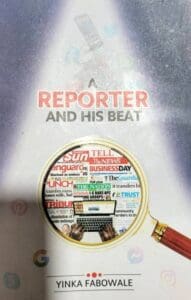
It is perhaps in a bit to fill this void that Yinka Fabowale, who has covered all the big and not-so-big stories in his three decades of professionalism, decided to take a sober look at the issues he had covered in the past and reflect on them. In his book A Reporter and His Beat, he gives the reader the benefit of following his trajectory in the profession and see his growth and development from his tentative and hesitant steps as a cub reporter to an editor and master in the field of reporting and analysis of events and issues.
He chronicles his struggle trying to understand what it means to be a reporter and be good on his beat. From his humble start as a youth corps member who was lucky to be given automatic employment and be deployed to the Ministry of Information as an Information officer in Lagos to “A dour routine of pushing files in the civil service with its red tape culture,” which was not his idea of eking out a living as a journalist. The opportunity came with the establishment of Lagos Horizon, to which he was seconded. This was to be the beginning of a glorious career that spanned several states, beats, and leading media houses in the country.
The name Yinka Fabowale surely rings a bell in many minds who were avid readers of newspapers and magazines published in the country in the late eighties to the nineties and the thousands in the country. The life of a reporter is judged by the number of bylines he/she is able to earn and the prominence with which this is done. That is why in the days of yore, reporters struggle to have their bylines on the front page of their medium. This then was the epaulet with which reporters announce their arrivals as masters of the game of reporting. For those who worked in newspapers, the number of times your byline appears on a story on the front page in a week or month matters more than the money you have in your pocket. For those who worked in magazines, so was the number of times you could write a cover story or be part of the bylines that accompany such a story.
The headmaster was once a pupil, is a common joke here. It is the same for a rooky reporter when you have your first byline. Fabowale was also caught by this bug when his first story hit it big in the defunct Lagos Horizon. According to him, “I felt tall as the heavens at seeing my byline for the first time below the headline of the lead story on the day Lagos Horizon debuted on the newsstands.” However, what he initially thought was a feat worth celebrating he later considered as just a normal routine as he continues, “Years later though, when I had come into my own as a reporter, I no longer thought it called for much pride or excitement because it was merely an account of an open event.” (p7)
More of such is to come later as he became good at his job and was a hot cake across media houses in the country. In writing these interesting accounts of his life as a journalist, Fabowale takes the reader through the rudiments of the profession, his faltering steps in learning the ropes, getting to cultivate sources, and making his job a part of his life. The interesting and wonderous life of a reporter is captured in graphic details in this memoir that many a reader is tempted to want to exchange his life with his. Is it the journey from one part of the southwest, where he mostly plied his craft, to another or the momentous times he shared with men and women who had held the rein of power?
In this book, Fabowale has indirectly shed light on stories he had written in the past and also given readers a closer look at the personalities involved, a pastime that his job as a reporter had not given to him before. His portrait of personalities was not restricted to politicians, he also did the same for some of the leaders of the newsrooms. Those who had worked and met some of these newsroom leaders would tend to agree with his portrayal of most of them. It is a very rich source material for upcoming journalists to learn from one of the masters of news reporting.
However, on page 224 there is an error that escaped the scrutiny of the writer, proofreader, and editor. He writes, “Where is Mo Abudu who declared Africa and its people sick and doomed for always electing people at the departure lounge of earthy existence as its rulers and leaders, when the most developed nations in the world were run by young people?” The credit for that belongs to Mo Ibrahim, the business mogul and billionaire who founded Celtel and sponsor of Mo Ibrahim Prize for Leadership. On the other hand, Mo Abudu (wrongly credited with the statement) is a Nigerian media entrepreneur.
This does not, however, take away the many merits of the book, hoping that the error would be corrected in a reprint.