
Book Review
Pat Utomi’s The Art of Leading is a compelling overview of leadership—thoughtful, humane, and highly relevant. It challenges leaders and aspiring leaders alike to consider not only what they do but also who they are, why they lead, and the values they establish. It is a valuable addition to leadership literature and a significant contribution to Nigeria’s ongoing debate on governance, ethics, and national renewal.
RENOWNED Nigerian scholar, public intellectual, and political economist, Professor Pat Utomi, turns seventy this week. To mark the milestone, colleagues and collaborators have organised a five-city series of events focused on intellectual engagement, civic discourse, and national reflection—an apt tribute to a life devoted to ideas, values, and public service.
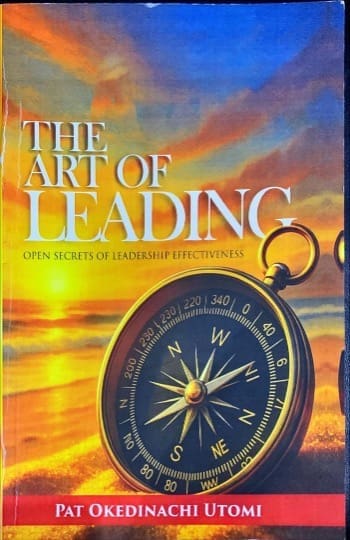
An important aspect of the celebration is the renewed focus on Utomi’s scholarly work. Ahead of the 6 February events, the author revisited several of his key works, producing improved second and third editions of three important titles. Among them is the second edition of The Art of Leading: Open Secrets of Leadership Effectiveness, a book that directly addresses one of Utomi’s lifelong concerns: leadership as a moral, strategic, and developmental endeavour.
Utomi brings impressive credentials to the subject. He is Professor of Political Economy and Management, founder of the Centre for Values in Leadership (CVL), and a highly published authority on leadership, governance, policy, and institutional reform. The Art of Leading reflects both his academic foundation and his extensive real-world experience across business, government, civil society, and faith communities.
Leadership, Values, and Purpose

At its heart, The Art of Leading explores the “how” and “why” of effective leadership in a fast-changing world. Utomi frames leadership not just as positional authority but as purposeful influence rooted in values, character, and social intelligence. He argues that leadership remains essential in the modern era—and, importantly, that leadership ability can be learned, improved, and developed.
Utomi poses a provocative question: “What happened to leadership in the twentieth century?” His response is both analytical and normative. Leadership, he writes,
“is the exercise of goal-directed influence in as cost-effective a manner as possible through the deployment of assets of confidence in the one who leads, such that the cooperation which results in attaining that which we thought impossible crystallises.”
This definition captures the book’s core message: leadership revolves around trust, legitimacy, and the effective mobilisation of people and resources to achieve common goals.
Structure and Content
The book is organised into nine substantive sections, covering:
- The Leadership Challenge
- Models and Styles of Leadership
- Leading with Purpose
- Attributes of Leadership
- Champions of Strategy
- Leadership and Nation-Building
- Leadership Role Models
- Social Intelligence and Leadership
- Finding the Grit for Knotty Challenges
Nation-building serves as a consistent theme throughout the text. In the section on Leadership and Nation-Building, Utomi examines the moral responsibilities of leaders in diverse, unequal, and fragile societies—an especially relevant theme in modern Nigeria.
The Leadership Role Models section profiles figures drawn from diverse domains:
- Dr Christopher Kolade (business leadership),
- Reverend Sam Adeyemi (faith leadership),
- Aung San Suu Kyi (political leadership), and
- Nelson Mandela (values-driven political leadership).
These profiles are not hagiographic; instead, they serve as analytical lenses through which Utomi examines character, conviction, sacrifice, and ethical consistency.
Social Intelligence and Character
One of the book’s strongest sections explores Social Intelligence and Leadership, with subsections such as Character Matters, Understanding Emotional Intelligence, Building Social Intelligence Muscles, Groupthink, and The Toxicity of Insult. Here, Utomi combines behavioural science with lived experience, emphasising how poor emotional regulation and toxic discourse can weaken institutions and hinder leadership effectiveness.
A notable addition in this second edition is the final chapter, Finding the Grit for Knotty Challenges, which is essential reading. It examines resilience, moral courage, and perseverance in situations where formal authority provides little protection and the costs of leadership are high.
A Personal Pivot on Values
An especially powerful moment in the book is Utomi’s reflection on the origins of his lasting interest in values and character. He recounts an encounter with a former schoolmate after delivering a lecture as a guest of a governor in a South-West state. Recognising his friend behind a security cordon, Utomi called out to him by his old nickname, Iwe—the Yoruba word for “book” or “knowledge”—a nod to his exceptional intellect.
Yet this brilliant man had risen only to the rank of director in the civil service, and the governor appeared displeased that his distinguished guest would acknowledge him so warmly. Utomi writes:
“The moment was not lost on me. He should be entitled to more social prestige for how smart he was and how hard he worked, I thought. But the system apparently did not think so in our significantly socially stratified society.”
Watching his classmate retreat meekly, wary of breaching protocol, prompted Utomi to question how systems reward power over merit and how character, intelligence, and emotional capacity intersect—often imperfectly—with leadership opportunities.
Assessment
Deceptively slim but intellectually dense, The Art of Leading blends foundational theory, practical frameworks, and timeless insights. It belongs comfortably on the shelf alongside classic leadership texts such as:
- Good to Great — Jim Collins
- The 21 Irrefutable Laws of Leadership — John C. Maxwell
- The Leadership Challenge — James Kouzes & Barry Z. Posner
- The One Minute Manager — Ken Blanchard & Spencer Johnson
- True North — Bill George & Peter Sims
Utomi references several of these works, situating his arguments within a global leadership canon while grounding them firmly in African and Nigerian realities.
Honourable mentions in this intellectual ecosystem include:
- How to Win Friends and Influence People — Dale Carnegie
- The 7 Habits of Highly Effective People — Stephen R. Covey
- Dare to Lead — Brené Brown
- Leaders Eat Last — Simon Sinek
- The Five Dysfunctions of a Team — Patrick Lencioni
Conclusion
Pat Utomi’s The Art of Leading is a compelling overview of leadership—thoughtful, humane, and highly relevant. It challenges leaders and aspiring leaders alike to consider not only what they do but also who they are, why they lead, and the values they establish. It is a valuable addition to leadership literature and a significant contribution to Nigeria’s ongoing debate on governance, ethics, and national renewal.

