

For years, governments across Africa have encouraged young people to pursue higher learning with the promise that diligence and discipline would lead to stability. Yet the reality for many graduates is a labour market that cannot absorb them. The result is a generation that has done everything asked of it but still finds itself locked out of meaningful work.
Many universities prioritise enrolment numbers over relevance, prestige over preparation, and theory over application. The result is a growing mismatch between what students are taught and what the economy can sustain. This mismatch leaves graduates highly educated yet structurally unprepared for the realities of the job market.
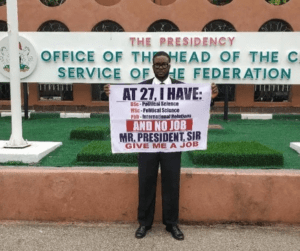
THERE are images that stay with the viewer long after the moment has passed. The photograph of a young man standing before the Office of the Head of the Civil Service of the Federation is one such image. He holds a placard that lists his academic achievements with stark clarity: a Bachelor’s degree, a Master’s degree and a doctorate, all completed by the age of twenty seven. Beneath these accomplishments sits a plea for employment addressed to the President. The contrast between the weight of his qualifications and the vulnerability of his appeal is unsettling.
This scene speaks to more than one individual’s frustration. It reflects a wider crisis in which education has ceased to function as a dependable route to opportunity. For years, governments across Africa have encouraged young people to pursue higher learning with the promise that diligence and discipline would lead to stability. Yet the reality for many graduates is a labour market that cannot absorb them. The result is a generation that has done everything asked of it but still finds itself locked out of meaningful work.
The young man’s choice of location is deliberate. By positioning himself at the heart of the federal bureaucracy, he directs attention to the state’s responsibility in shaping employment pathways. His protest is peaceful and respectful, yet it carries a quiet indictment. A society that invests in producing highly trained citizens must also create the structures that allow them to contribute. When that link breaks, the consequences are not only economic. They touch on dignity, morale and the sense of national purpose.

There is also a symbolic dimension to this moment. Public appeals of this kind are becoming more common as young people seek visibility in a system that often overlooks them. These acts are not simply cries for help. They are attempts to force a conversation about fairness, accountability and the value placed on human capital. They remind us that unemployment is not an abstract statistic. It is a lived experience that shapes identity and future prospects.
The crisis, however, is not solely the responsibility of the state. The university system itself must also answer difficult questions. Institutions continue to produce graduates in fields where demand is limited, often without offering the practical training, industry partnerships, or career guidance that would help bridge the gap between academic achievement and employability. Many universities prioritise enrolment numbers over relevance, prestige over preparation, and theory over application. The result is a growing mismatch between what students are taught and what the economy can sustain. This mismatch leaves graduates highly educated yet structurally unprepared for the realities of the job market.
Ultimately, the young man’s plea is not a request for charity. It is a call for inclusion. He seeks the chance to serve and to participate in the life of his country. His presence outside a government building is a reminder that talent is abundant, but opportunity is not. A nation that fails to harness the potential of its youth risks undermining its own future.
[Readers should confirm political information with trusted sources.]
- Dr Adeyemi teaches at the University of East Anglia, UK.