
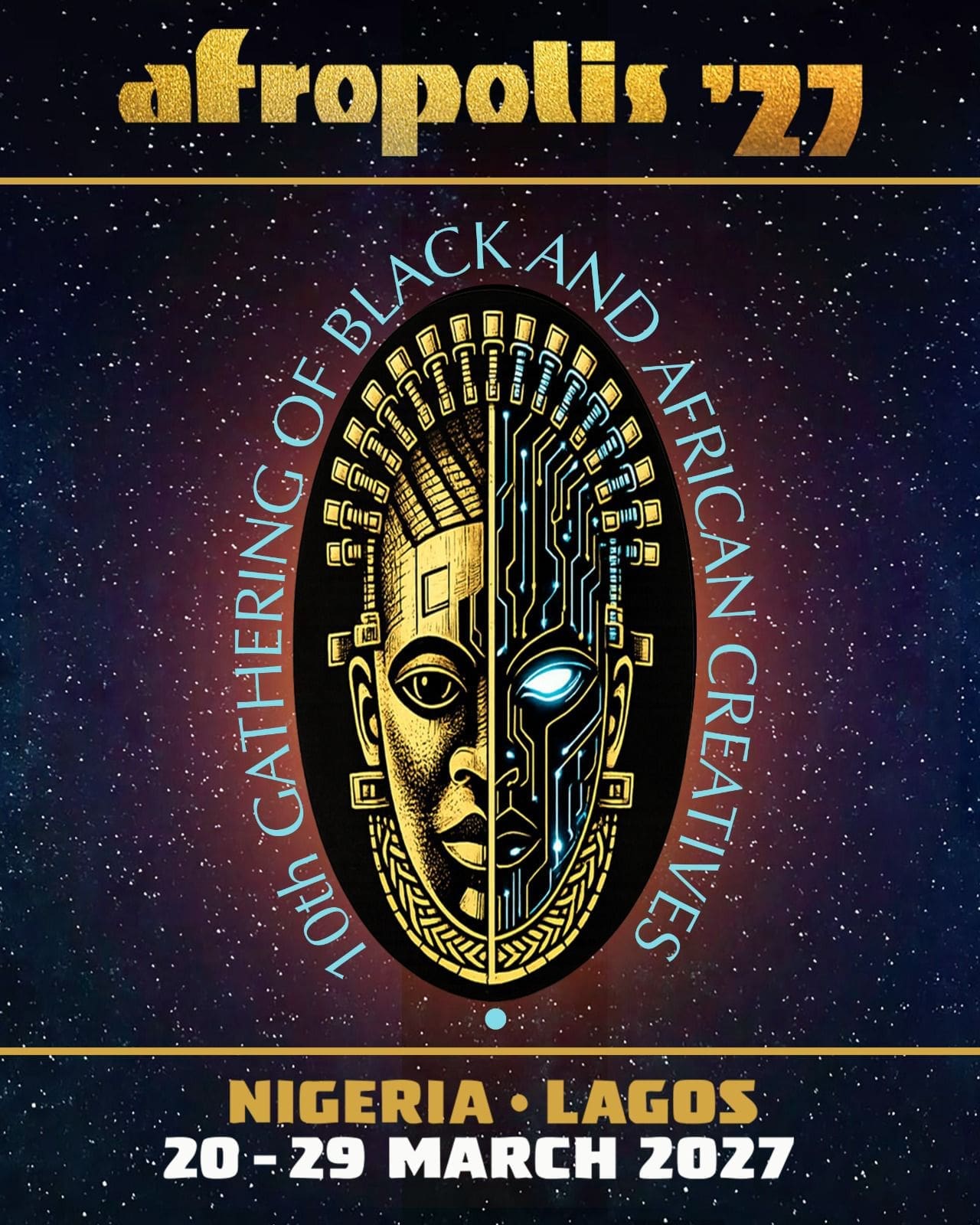
…the theme of afropolis 2027 bears, Re/Membering The Future. To re-member is an attempt to put back together the membranes that has been scattered all over the place. To restore connection. To rebuild the body. Not as it was. But as it must become. The measure of this work is not spectacle. It is not numbers. Not volume. Not noise. It is subtler: Do people feel seen? Do communities hold under pressure? Does it hold space for diversity, multiple access points and ultimately, for chaos? Does culture make complexity navigable? Does it help us remain human inside systems that move faster than we do?

Afropolis 2027 is therefore, a remembering forward, that the African futures may not arrive as monument or a unified spectacle. It is about sustaining right relationship, with each other, with memory, with the futures that have always been pressing against us
FESTAC ’77 marks a defining moment in the Afrotopian imagination. The Second World Black and African Festival of Arts and Culture can be remembered as a monumental spectacle. A moment when Black and African peoples gathered at planetary scale to imagine themselves otherwise. Fifty years later, it remains an event whose scale has proven difficult to reproduce, whose blueprint we cannot replicate, whose archive remains dispersed and whose memory resists full recovery. It’s meaning, still unfolding. What may seem like a limitation is perhaps the very condition of its power.
FESTAC was not designed to be repeated, but to be remembered as possibility. In the decades since, we have searched for language. Blaxploitation. Afropessimism. Afrofuturism. Postcoloniality. Decoloniality. Afrotopia. Each, in its own way, attempts to frame the question: Who are we becoming now? These frameworks do not converge on a single answer; rather, they reveal the complexity, tensions, and contradictions within the idea of African and diasporic unity. Beneath all these frameworks, something quieter has been shifting. Culture itself, quietly reconfiguring how societies organise meaning, memory, and belonging.
For a long time, culture was treated through two dominant logics: preservation and production. We preserved monuments. We produced contents. Value was measured through belonging, allegiance, and attendance. We measured exports. We chased visibility. Ticket sales and streaming metrics. Heritage on one side. Creative Industry on the other. But something has shifted. Over the past ten years, from DanceGATHERING to Afropolis, we have been quietly rehearsing a different question: What if culture is not representation, but infrastructure? What if culture is not what we show, but what we build together?
FESTAC ’77 was configured within a model we may now describe as Culture 1.0, a system of patronage in which authority flowed from centralized power: state, military leadership, intellectual elites. Culture was assembled, edited, curated, and presented to the people. It operated across the ideals of nationalism, next to a national flag and a national anthem. It was flagship monumentalism, but not distributed. Its limitation was not its vision. It was its architecture. Afropolis has been an experiment in a distributed, networked, iterative model, one capable of continuity and adaptation. Not a moment. A system in progress. And lately we’ve been seeing this shift in institutions too.

The rise of Nollywood, and more recently, Afrobeats, introduced a different paradigm. Culture escaped the royal court. Instead it multiplied. It travelled. It scaled. This was Culture 2.0. This model demonstrated that culture does not need permission to circulate. But even here, something remained incomplete, because circulation is not the same as connection. Visibility is not the same as belonging. For all its success, it still operates largely within capitalistic and extractive logics: attention economy, commercial interests, and in service of the highest bidder.
Now we find ourselves in another threshold that collapses the distance between producer and audience. A time when culture is no longer being asked to perform, but to organise, to hold, to stabilise, and to sustain. This is Culture 3.0. Where value is not what culture produces, but what it changes. How it connects beyond a succession of productions. How it carries people through complexity. You can feel it in the way Governments are quietly reorganising their bureaucracies. You can see it in Culture ministries merging with digital policy, youth development, sports, creative economies, tourism, and knowledge production.
The signal is clear. Culture is no longer ornamental. It is operational. Museums are becoming convening nodes. Theatres are becoming civic spaces. Archives are coming alive again. We see it in audiences. A generation raised within algorithmic abundance is no longer seeking more content, it is seeking coherence, presence, and meaning that persists beyond endless scrolling. In a century defined by acceleration—ecological, technological, political—culture is emerging as a stabilising force. Because data can inform. Technology can scale. But culture interprets. Culture contextualises and provides meaning. Culture teaches a society how to feel together within a distributed ecosystem.
As we traverse FESTAC @50, we ask a different question, in order to not recreate it, but to listen differently. This time not to its spectacle, but to its absence. What did it open that we have not yet sustained? afropolis 2027 isn’t invested in a nostalgic attempt to rebuild the monument. We work with fragments; with gatherings that emerge when systems fail, with archives that anchor us in times of acceleration, with embodied practices—dance, sound, ritual—that restore trust in one another faster than any policy.
If FESTAC sought African Renaissance through scale, our interest is not in repeating that ambition as grandeur, we seek coherence through relation. Between artists and thinkers. Between Africans and her Diaspora. Between the living and the ancestral. Between memory and what is yet to come. History can offer a useful analogy. The European Renaissance did not emerge from nostalgia for antiquity, but from the recombination of ancient texts with new technologies. The printing press did not simply reproduce knowledge, it reorganised society. Our time carries a similar vibration. The past is no longer somewhere to return to. It is material. A vocabulary. A tool. Something to work with. Not nostalgia. Not revival. But recombination.
This is what the theme of afropolis 2027 bears, Re/Membering The Future. To re-member is an attempt to put back together the membranes that has been scattered all over the place. To restore connection. To rebuild the body. Not as it was. But as it must become. The measure of this work is not spectacle. It is not numbers. Not volume. Not noise. It is subtler: Do people feel seen? Do communities hold under pressure? Does it hold space for diversity, multiple access points and ultimately, for chaos? Does culture make complexity navigable? Does it help us remain human inside systems that move faster than we do?
Renaissances are rarely recognised as they unfold. They are named in retrospect, when their consequences can no longer be ignored. But if one listens closely—in the emergence of cross-sector alliances, in the renewed seriousness of archives, in the shift from content to context—one can hear the early chords of this engagement within the archives of FESTAC 77. Afropolis 2027 is therefore, a remembering forward, that the African futures may not arrive as monument or a unified spectacle. It is about sustaining right relationship, with each other, with memory, with the futures that have always been pressing against us. And that may be the most radical cultural project of all.