

This presentation argues that Osofisan’s oeuvre provides a uniquely productive lens through which to examine African drama’s historical foundations, its contemporary civic engagements, and its future trajectories. His plays draw deeply from indigenous Yoruba performance traditions, yet they are unmistakably modern in their political urgency and dramaturgical experimentation. They converse with the works of Wole Soyinka, Ola Rotimi, Bode Sowande, Zulu Sofola, and JP Clark-Bekederemo, while also engaging the narrative worlds of D. O. Fagunwa and Chinua Achebe.
 Introduction
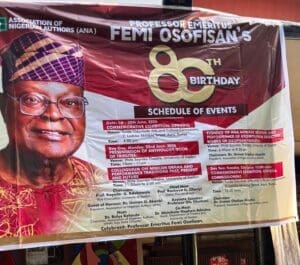
I stand before you today to speak on African Drama and Performance: Past, Present, Future in the Works of Femi Osofisan, or so it appears. But, truly, and in reality, I am going to speak about the work of an individual who has influenced my work and career in more than thirty years, in a way that is almost existential, in all its essence. So, I pray that you indulge me, for I may take some time.
Now, let’s start.
TO speak of African drama across past, present, and future is to enter a field shaped by ritual memory, political turbulence, and the restless search for new aesthetic forms. Few playwrights embody this continuum as completely as Femi Osofisan. His work stands at the confluence of Yoruba cosmology, postcolonial disillusionment, and a persistent hope for social transformation. Born in 1946 and emerging as a dramatist in the politically charged decades following Nigerian independence in 1960, Osofisan has produced a body of work that interrogates the failures of the postcolonial state while insisting on the regenerative possibilities of collective action. His dramaturgy is both a critique and a proposition, a theatre of warning and a theatre of hope.

This presentation argues that Osofisan’s oeuvre provides a uniquely productive lens through which to examine African drama’s historical foundations, its contemporary civic engagements, and its future trajectories. His plays draw deeply from indigenous Yoruba performance traditions, yet they are unmistakably modern in their political urgency and dramaturgical experimentation. They converse with the works of Wole Soyinka, Ola Rotimi, Bode Sowande, Zulu Sofola, and JP Clark-Bekederemo, while also engaging the narrative worlds of D. O. Fagunwa and Chinua Achebe. Through these intertextual and intercultural dialogues, Osofisan positions African drama as a dynamic field that continually reworks its past in order to confront its present and imagine its future.
The argument proceeds in three movements. First, it examines how Osofisan reclaims and reconfigures indigenous performance traditions, situating his work within a lineage that includes Soyinka’s mythopoetic dramaturgy and Rotimi’s historical excavations. Second, it analyses Osofisan’s theatre as a form of civic intervention, comparing his political satire with the social critiques of Sowande, Sofola, and Clark-Bekederemo. Third, it explores the future-oriented dimensions of his dramaturgy, including his adaptations of Fagunwa, his engagement with Achebe’s narrative ethics, and his anticipation of new performance ecologies in digital and diasporic contexts. The conclusion synthesises these strands to argue that Osofisan’s work constitutes a bridge across temporal horizons, offering a model for understanding African drama as a living, evolving practice.
- The Past: Indigenous Performance Traditions and the Reclamation of Memory
Yoruba Ritual and the Politics of Memory
Osofisan’s plays frequently draw upon Yoruba cosmology, masquerade traditions, and festival performance. In Morountodun (1983), he reimagines the Moremi legend through the story of Titubi, a privileged young woman who infiltrates a peasant uprising. The play invokes the ritual structure of the Moremi myth but subverts its ideological implications. Rather than celebrating aristocratic sacrifice, Osofisan uses the myth to expose class oppression and to advocate for solidarity with the marginalised. Titubi’s transformation into a figure of empathy reconfigures the mythic past as a site of political awakening rather than elite heroism.
This approach contrasts with Soyinka’s The Strong Breed (1963, 1964), which presents ritual as cosmic necessity. Osofisan’s response to that play, No More the Wasted Breed (1982), shifts the emphasis from metaphysical tragedy to human agency, portraying gods as figures who can be challenged or dismissed. This reflects his commitment to a theatre that empowers audiences rather than overwhelming them with fatalism. Where Soyinka often emphasises inevitability, Osofisan insists on possibility, or what Harry Garuba calls ‘the poetics of possibility’.
Historical Excavation and the Rewriting of Tradition
Osofisan further goes into archaeological excavations to rewrite our tradition. While Ola Rotimi’s historical dramas such as Kurunmi (1971) and Ovonramwen Nogbaisi (1974) explore leadership and colonial encounter, Osofisan approaches history with sharper political revisionism. In Women of Owu (2006), revised from Euripides, he relocates the narrative to nineteenth-century Yorubaland, interrogating cycles of violence and vengeance. The play suggests that historical memory must be reinterpreted to break cycles of cruelty, which unlike Rotimi’s more historical focus, end with gestures toward communal renewal.
Ritual, Gender, and the Reclamation of Female Agency
Apart from ritual and historical focus, Osofisan also uses his drama to reclaim female agency. Zulu Sofola’s Wedlock of the Gods (1972) highlights patriarchal constraints within ritual, but when Osofisan interrogates gendered power relations, he does so through satire and political urgency. In Tegonni: An African Antigone (1994), he reframes Sophocles’ tragedy to foreground female agency against colonial and patriarchal oppression. Tegonni’s defiance becomes a symbol of radical resistance, situating women at the centre of anti-colonial struggle. By reworking classical tragedy into an African context, Osofisan demonstrates how ritual and myth can be reclaimed to empower marginalised voices.
Through these engagements with ritual, history, and gender, Osofisan constructs a dramaturgy that honours the past while refusing to be constrained by it. His work exemplifies a mode of African theatre that reclaims indigenous performance traditions as tools for contemporary critique and social transformation. The past, in his plays, is not a burden but a resource, not a static inheritance but a dynamic field of possibility.
- The Present: Civic Intervention and the Theatre of Social Critique
If the past in Osofisan’s work is a site of reclamation and reinterpretation, the present is a terrain of urgent political engagement. African drama since the mid twentieth century has been shaped by the challenges of postcolonial governance, economic inequality, and social fragmentation, with playwrights such as Bode Sowande, and JP Clark-Bekederemo using theatre as a medium for civic intervention, exposing corruption, critiquing authoritarianism, and advocating for social justice. But Osofisan’s theatre is distinguished by its insistence that audiences are not passive observers but participants in civic dialogue.
Satire and the Politics of Accountability
Osofisan’s political satire is among the most incisive in African theatre. Once Upon Four Robbers (1980) exemplifies his use of performance as civic critique. [The play centres on a group of armed robbers subjected to a public trial orchestrated by the state.] Through song, dance, and direct address, the play exposes the hypocrisy of a government that condemns petty criminals while protecting powerful elites. When Alhaja declares that the robbers are products of a corrupt society, the play shifts focus from individual culpability to systemic injustice. This insistence on structural critique is central to Osofisan’s dramaturgy.
While other dramatists use satire to critique dysfunction, such as Bode Sowande in Farewell to Babylon (1979), Osofisan grounds his satire more explicitly in collective action and mobilisation rather than idealistic paradigms. His plays frequently end with calls for audience participation, blurring the boundary between performance and civic engagement; and you can see this most recently in the production of Medaaye whose run paused over the weekend (to be resumed later this week). This participatory ethos distinguishes his theatre from satire that remains purely representational.
Language, Style, and Accessibility
I’ll quickly move to Language, Style and Accessibility in the plays of Osofisan.
Unlike Soyinka’s compressed, intricate, and layered language, Osofisan cultivates accessibility through the use of idioms, humour, proverbs, and everyday speech, aligning with Chinua Achebe’s philosophy that African writers must fashion a language reflecting African realities. Osofisan’s theatre embodies this principle by creating a linguistic environment in which audiences recognise themselves, their communities, and their struggles.
In Aringindin and the Nightwatchmen (1992) for instance, Osofisan uses humour, punning, and anecdotal storytelling to expose authoritarian absurdities. Aringindin, a self-appointed guardian of morality, speaks in bombastic rhetoric that parodies political strongmen. His proclamations are filled with comic exaggerations and distortions that reveal the hollowness of his authority. At one point he declares that he alone can save the town from moral decay, only for the chorus to puncture his pretensions with a sardonic aside that the only thing he has ever saved is his own pocket. The humour arises not merely from content but from linguistic play that undercuts his self-presentation. Osofisan’s repeated pun on “nightwatchmen”, as both protectors and predators, creates comic tension that exposes duplicity.
The play also demonstrates Osofisan’s skill in using anecdotal storytelling as a political tool. Characters recount short, humorous tales that illuminate broader social truths. These anecdotes function as miniature parables, offering audiences ways to interpret unfolding action. They also create communal intimacy, as if the audience were gathered around a fireside listening to familiar stories. This technique reinforces the play’s democratic ethos by positioning audiences as participants in shared cultural conversation rather than passive spectators.
A similar linguistic vitality animates Twingle-Twangle: A Twynning Tayle. Its playful orthography and musical dialogue announce a dramaturgy that delights in excess and punning. Characters slide between serious commentary and frivolous joking, so that jokes become vehicles for critique. Exchanges that begin as teasing often turn into commentary on broken promises or failed leadership. The comic surface carries a sharper political edge, inviting audiences to enjoy wit while recognising the intertwining of love, power, and politics. Songs further illustrate Osofisan’s commitment to accessible language, drawing upon popular styles and refrains that audiences can easily remember. When the chorus sings that the people must tune their own instruments rather than wait for a conductor, the metaphor is clear: political agency belongs to the community, not to self-appointed leaders.
These linguistic strategies reflect Osofisan’s broader political philosophy. He believes theatre must function as a space for civic dialogue and social critique. Accessible language ensures that messages are not confined to an educated elite. His plays are open, participatory, and responsive to ordinary concerns. This approach distinguishes him from Soyinka, whose linguistic density often requires specialised knowledge, and aligns him more closely with Achebe, who sought to create a literary language that could speak to both local and global audiences without sacrificing cultural specificity.
Theatre as Civic Reckoning
Through satire, chorus, idioms, puns, and anecdotal storytelling, Osofisan positions theatre as a space of public reckoning. His plays invite audiences to laugh, reflect, and question structures of power. They exemplify African drama’s present as civic engagement, where performance confronts injustice and imagines alternative futures. His theatre insists that language must be accessible, that audiences must be empowered, and that performance must serve as a catalyst for social transformation. In this sense, Osofisan’s linguistic choices are not merely stylistic preferences but integral components of his dramaturgical vision. They enable him to create a theatre that is both aesthetically vibrant and politically resonant, a theatre that speaks to the people in their own language and invites them to participate in the ongoing project of social transformation.
III. The Future: Adaptation, Decolonial Aesthetics, and New Performance Ecologies
While Osofisan’s work is deeply rooted in the past and engaged with the present, it also anticipates the future of African drama. His adaptations of Fagunwa, his engagement with Achebe’s narrative ethics, and his openness to new performance forms position him as a forward-looking dramatist whose work offers insights into the evolving landscape of African theatre. The future in his dramaturgy is not speculative fantasy but a continuation of his commitment to reworking tradition, interrogating power, and imagining new possibilities for collective agency.
Adaptation as a Future-Oriented Practice
Osofisan’s adaptations reveal a playwright who interrogates and reanimates tradition for new audiences. His engagement with D. O. Fagunwa is instructive. In Adventures in the Forest of a Thousand Daemons (2008), Osofisan reimagines Fagunwa’s fantastical world of spirits and enchanted forests for modern audiences. He retains the richness of allegory but infuses it with political resonance, turning supernatural encounters into metaphors for Nigeria’s moral and social challenges. When Akara Ogun declares that courage is meaningless without justice, Osofisan introduces a political ethic absent in the original. His subsequent adaptation Ireke Onibudo (2009) explores carnival and comedy, using episodic encounters to expose greed and hypocrisy while maintaining playful tone. These works suggest that African drama’s future may lie in combining political critique with imaginative exuberance.
Osofisan’s adaptation of Achebe’s Arrow of God (2014) reaches its fullest expression of communal vision. Achebe’s novel centres on the tragic rigidity of Ezeulu, but Osofisan expands the role of the chorus, allowing the people of Umuaro to articulate anxieties and hopes. This shift reframes the tragedy as communal crisis rather than individual downfall. By doing so, Osofisan aligns with Achebe’s insistence that African literature must restore dignity to cultural heritage, extending this philosophy into performance. His adaptation becomes a meditation on leadership, responsibility, and the dangers of absolutism, themes resonant in contemporary Nigeria.
Taken together, these adaptations reveal Osofisan’s belief that the future of African drama lies in creative reworking of indigenous literary traditions. Adaptation is not derivative but a mode of critical engagement, ensuring that African theatre evolves while remaining rooted in heritage. His dialogues with Soyinka, Fagunwa, and Achebe demonstrate that African drama is a living tradition, continually renewed through reinterpretation and innovation.
[Digital and Diasporic Performance
Osofisan’s dramaturgy has proved adaptable to digital ecologies shaped by technology and diasporic audiences. Nigerian filmmaker Tunde Kelani’s screen versions of Maami, Cordelia, and Yeepa Solarin nbo illustrate how Osofisan’s narratives migrate to film without losing ethical force. Kelani’s adaptations amplify emotional stakes and critique political opportunism, reaching new audiences through digital platforms. In Maami, the intimate mother–son relationship is rendered with visual tenderness, while Cordelia becomes a meditation on loyalty and betrayal. Yeepa Solarin nbo heightens farcical energy, juxtaposing public spectacle with private scheming. These films demonstrate how African theatre can reach new audiences through cinema and digital circulation.
Student productions of Osofisan’s plays uploaded to YouTube further extend his presence. Universities and theatre collectives across Nigeria regularly stage works such as Morountodun, Once Upon Four Robbers, and The Chattering and the Song, recording and uploading performances for public viewing. These productions vary in scale but share commitment to keeping Osofisan’s theatre alive within youth culture. The digital archive that has emerged constitutes an informal repository of performance practice, revealing how young performers interpret his themes of justice, corruption, and communal responsibility. Diasporic communities and scholars abroad increasingly rely on these recordings, creating a dispersed but interconnected audience. This circulation suggests that African drama’s future will be characterised by transnational dialogue and intercultural exchange, with Osofisan’s work serving as a model of adaptability and collective authorship.]
Conclusion
Femi Osofisan’s work demonstrates how African drama can serve as a bridge across temporal horizons. His dramaturgy reclaims indigenous traditions, interrogates the failures of the postcolonial state, and anticipates new performance ecologies. By reworking myths and rituals, he transforms the past into a resource for critique and renewal. Through satire, accessible language, and civic engagement, he positions theatre as a forum for accountability in the present. His adaptations of Soyinka, Fagunwa, and Achebe, along with his openness to digital and diasporic performance, reveal a vision of African drama that is future-oriented, adaptable, and communal.
Osofisan’s plays insist that theatre must be participatory, accessible, and politically resonant. They challenge audiences to reflect critically on their conditions and to imagine alternatives. His emphasis on collective agency, gender inclusivity, and decolonial aesthetics situates him within a broader movement to redefine African performance as a living practice. The migration of his work into film and digital platforms further underscores its capacity to reach new audiences and sustain relevance across generations. In this way, his theatre is not confined to the stage but extends into classrooms, communities, and diasporic networks, becoming a tool for cultural transmission and civic dialogue.
The significance of Osofisan’s contribution lies in his ability to balance continuity and innovation. He honours Yoruba cosmology and indigenous storytelling while refusing to be constrained by them. He engages with canonical figures such as Soyinka and Achebe but reworks their texts to foreground communal voices and political urgency. He embraces fantasy and allegory yet insists on their relevance to contemporary struggles. His theatre is deeply Nigerian but also transnational, resonating with audiences across Africa and the diaspora. This breadth of vision ensures that his work remains vital in multiple contexts.
African drama, as seen through Osofisan’s oeuvre, is not a static tradition but a dynamic practice. It is a theatre that remembers and reclaims, that confronts and critiques, that imagines and anticipates. It is a theatre that speaks to the people in their own language, that invites them to participate, and that insists on their agency. Osofisan’s plays remind us that drama is not only an artistic form but also a civic practice, a means of shaping consciousness and community. His legacy is therefore not confined to the stage; it extends into the broader cultural project of envisioning Africa’s past, present, and future as interconnected dimensions of a living tradition.
In synthesising the past, present, and future, Osofisan offers a model for African drama that is both rooted and restless, grounded and experimental. His work demonstrates that theatre can be a site of memory, a tool of critique, and a space of imagination. It can reclaim tradition, confront power, and envision futures. In this sense, Osofisan’s oeuvre is not only a contribution to African drama but also a challenge to all who believe in the transformative power of performance. It asks us to see theatre as a living practice, one that evolves with its communities, speaks to their struggles, and imagines their possibilities. That is the enduring gift of Osofisan’s drama: a theatre of warning and hope, of critique and renewal, of memory and imagination.