
Taiwan is a place of vibrant hybridity. A place that no more belongs to the West than to China, but needs to be understood on its own terms – Kerry Brown
Brown has written a compelling book that opens the eyes of the world to the intricacies of Taiwan and how it stands in the comity of nations and what needs to be done to keep the Taiwan strait from turning into another Ukraine in the hands of the world as this may spiral into a terrible experience beyond the Asia-Pacific region. Policy formulators, foreign affairs analysts, academics, researchers, journalists and general affairs readers will find Brown’s book to be goldmine of information and nuggets of wisdom on this important but ‘small island that will dictate the global future’.
TO many Nigerians, Taiwan connotes “fake products” until recently. In fact, not many could point out to you on the world map where the country is situated. Do not blame them. However, of recent many Nigerians are beginning to know and understand that “Made in Taiwan” no longer means “fake”. Thanks to the fact that although the country does not have diplomatic relations with Nigeria, many are beginning to know more about the island through visits by Nigerians and the openness of Taiwan in her relations with the country and other African countries.
Nigerians may not be alone in their limited knowledge of this “small island” which many have described in various terms. Some call it a “jewel island” others “an unsinkable aircraft carrier” or a “shrimp caught between two fishes” according to Kerry Brown (P xx) in his book. And as one of Nigeria’s immortal writers Prof Chinua Achebe observed in one of his books, “You don’t watch a masquerade dancing by standing in one place.”, in the same vein, you cannot understand or know Taiwan by reading only one book.
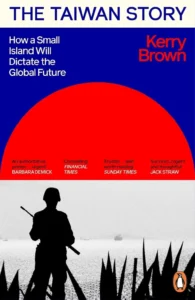
In The Taiwan Story – How a Small Island will Dictate the Future, Kerry Brown, with the eyes of a dispassionate writer and academic has told the story of this ‘jewel of an island’ in a manner that is compulsive and gripping. It is a story backed with deep research from the archives and mixing and talking to the people concerned. In just eight chapters and in 252 pages, he has been able to write a history of centuries in a capsule easy to swallow and digest. It gives the reader and panoramic view of the issues involved right from 230 CE to the Dutch and the Spanish before the Ming and Quing Dynasties of 1644.

In Chapter One where he tackles the issue of identity under the title Taiwan Life, Brown gives a very detailed account of what distinguishes a Taiwanese from a Chinese, while agreeing that the line may be tiny and blurred, they are surely there for those who care to look between the lines. He writes “As I have travelled back and between these two environments over the years, I have had to acknowledge more and more that Taiwan is indeed different – though the crucial issue is to what extent” (P2). From experience what Taiwan has going for it is the fact that is the opposite of China in all spheres: it is democratic, values diversity and pluralism and has allowed civic societies to grow without any restrictions thus making its democracy and multi-party system grow unlike in China that is a one party state under Communism! According to Brown, “Whatever else the island might be, one thing is indisputable: it is a place of huge variety in terms of what people believe and the Gods they worship” (P22).
Coming to Chapter Two: How it started, how it’s going: Taiwan’s History. In this chapter, the history of Taiwan unfolds before the reader in such a way that one is gripped by the manner it is told; from the waves of migration, rebellion wars and fight for freedom and autonomy that characterized all human societies from creation. The place of the Shung Ye Museum of Formosan Aborigines and that of the National Place Museum and how the two reflect the history of the island are vividly captured as well as the arrival of Manchu rulers, the Dutch, the Japanese and so on.
To better understand why Taiwan is where it is today in terms of international relations, one might need to read this chapter with special attention. This would allow one to ponder over whether the decision by Chiang Kai-shek (the then leader) was not its undoing. When in 1971, Taiwan lost its seat in the UN with the recognition of China, Chiang’s reaction ‘scattered everything’ as we say in Nigeria. He ordered his country to cut all relations with the organization and its members.
According to Brown, “There was nothing wholly inevitable about the outcome of each of the events for Taiwan (that is losing the permanent UN seat.) In the case of the first, Chiang did have the option of continuing Taiwanese representation at the UN, just as South and North Korea both had seats there. The main effect of the UN vote was Taiwan’s loss of its prized permanent slot on the Security Council. Despite this, a new seat for Taiwan in the General Assembly was a possibility. But so offensive did Chiang regard the suggestion of sharing any space with the people he called the ‘Communist bandits’ that he labelled the UN a ‘shameful organisation’ and a ‘den of iniquity’. He ordered the Taiwanese delegation in New York to withdraw from UN membership.” (P48). A case of my foe’s friend is my enemy!!
How Taiwan gradually became the darling of the rest of world even without diplomatic relations with many is tackled in the third chapter. The magic wand is nothing but democracy and a good economy. It is unarguably true that if Taiwan had progressed along the line of China without a democracy, the world would not have cared much about her as it does today. Strong and viable democracy and accountable leadership and the economy have ensured that the world does not want to leave it alone and allow it fall back into dictatorship. “Democracy showcases the variety and vitality of Taiwanese society; it is increasingly its greatest soft-power asset. A non-democratic Taiwan would be ignored. A democratic one cannot be sacrificed.” (P62).
Brown’s chapter four goes justifies the second title of the book as to “How a small island will dictate the global future.” The question most may ask is how could a tiny country with a population of just 23 million (something almost like that of Lagos in Nigeria) dictate what happens globally in the nearest future? The answer is simple: the dynamics of the world has since changed, population, mineral resources and other natural endowments have seized to dominate how the world moves. Intellectual resource and human capital today dictate what happens. “This place (Taiwan) sits at the centre of global economy, a beating heart that pumps out the chips and semiconductors that power everything from coffee makers and drones to smartphones and artificial intelligence systems… the amazing fact was that if the rest of the world relied on getting its high-tech semiconductors from Taiwan, that included China. Indeed, despite many attempts to catch up, Chuna was even more dependent than others. It was the largest manufacturer of electronic goods in the world. And for many of them, components sourced from its neighbour across the strait were crucial.” (P 95-96). This chapter also contains the story about the founding of the semiconductor factory; it is a story of determination and resilience.
The remaining four chapters explore why Taiwan is important to the world and why the country is at a strategic position to dictate the global future. But as Brown observes, “China’s attitude towards Taiwan comes across as coercive and intolerant, accepting only a very narrow definition of what it means to be Chinese and how Chinese culture can be shared.” (p205). In concluding his massive study of the two countries, Brown is of the opinion that the two have to agree to tread with caution and not put the world at the tipping point.
There is no doubt that Brown has written a compelling book that opens the eyes of the world to the intricacies of Taiwan and how it stands in the comity of nations and what needs to be done to keep the Taiwan strait from turning into another Ukraine in the hands of the world as this may spiral into a terrible experience beyond the Asia-Pacific region. Policy formulators, foreign affairs analysts, academics, researchers, journalists and general affairs readers will find Brown’s book to be goldmine of information and nuggets of wisdom on this important but ‘small island that will dictate the global future’.
Happy reading.