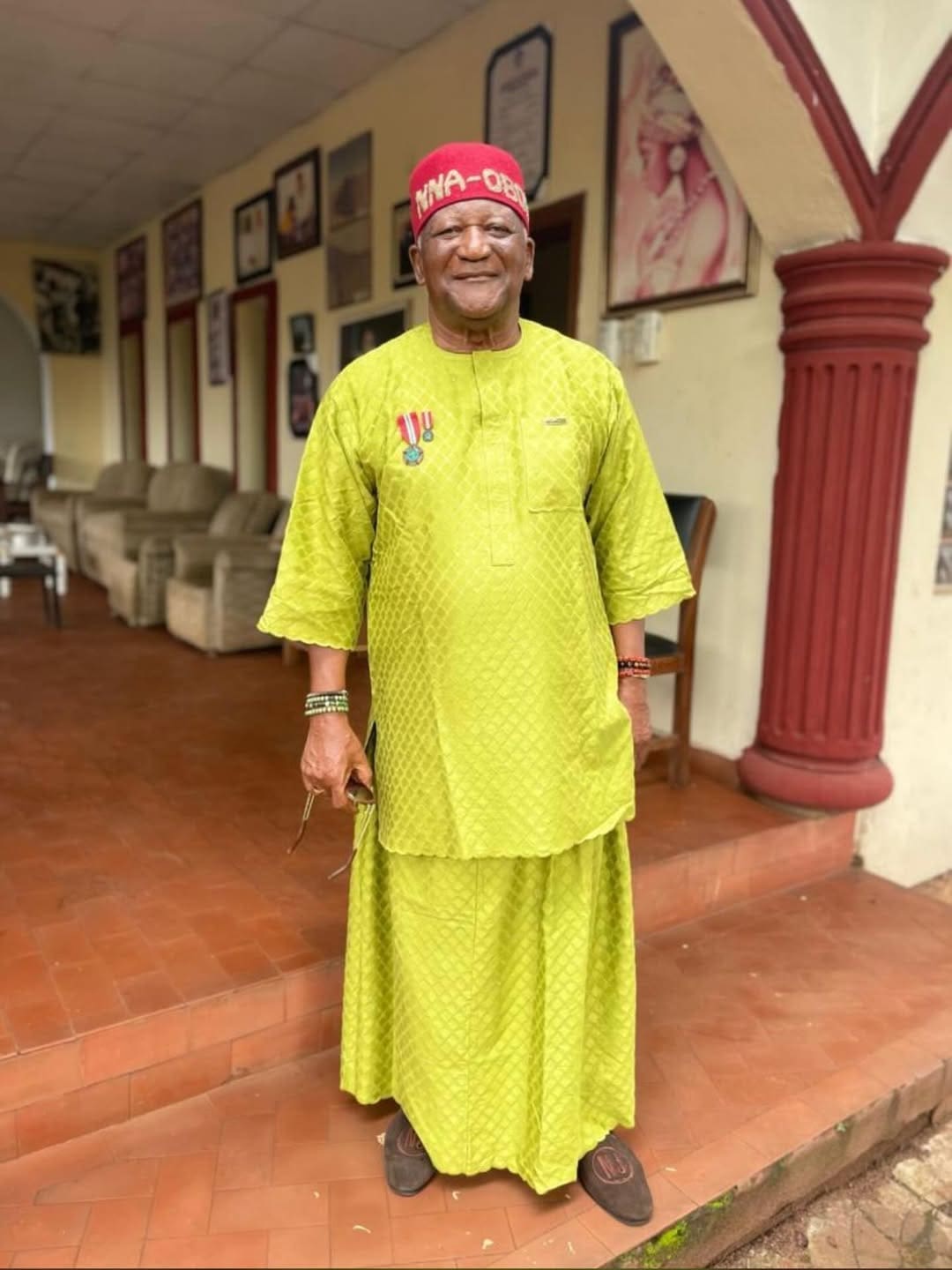
Long before the world found the language of climate change, Newton Jibunoh had already driven, alone, across the burning expanse of the Sahara, from Lagos toward the heart of Europe, so that the world might see what the advancing desert was doing to our land. He undertook this journey not once, but three times. He did it as a young man of twenty-nine, when most of his peers were just beginning their careers.
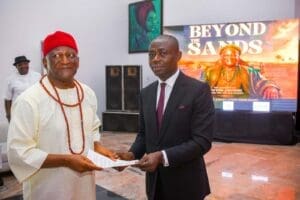
He refuses to be defined by his age, by his retirement, or by the achievements already behind him. He treats every New Year as an invitation to begin again. He has lived enough lives to fill several biographies: engineer, builder, explorer, environmentalist, museum founder, hospitality entrepreneur, and statesman. And he wears each of them lightly, as a man who is still becoming.
YOUR Excellencies, traditional rulers, members of the diplomatic corps, captains of industry, the leadership of FADE Africa, members of the Jibunoh family, distinguished guests, ladies and gentlemen.
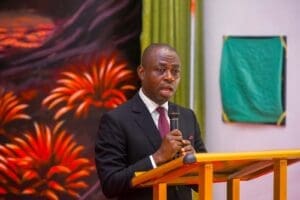
I count it a rare privilege to stand here today, not merely as a guest, but as one of the many who have been shaped by the life of the man we have gathered to honour.
Chief Newton Jibunoh is, to me, a mentor and a friend. I have admired him from my youth, and I have remained close to him through the seasons of my own life. He belongs to that rare company of elders whose example does not lecture you; it simply raises the standard of what a life can be.
To know Newton Jibunoh is to be quietly challenged to do more, to build better, and to leave behind something that will outlast you. There are men whose counsel improves a single decision. There are men whose presence improves an entire life. He is, for me and for many in this room, the second kind.

Consider, for a moment, the sheer breadth of one man’s work. As Chairman of Costain West Africa, he helped raise the skyline of modern Lagos. In the seventies and eighties, when our young nation was still discovering what it could become, his firm built the NITEL Towers, NICON House, the BP offices, and many of the structures that have since become familiar landmarks of our commercial capital. These were not merely buildings.
They were statements of a young nation’s ambition, and his hands were on them. To walk through certain corridors of Lagos is, in a quiet way, to walk through his career. Where most men of his standing would have been content to retire into comfort, he chose instead to keep building.
He built for our culture. In 1983, long before private patronage of the arts became fashionable in Nigeria, he founded the Didi Museum, our country’s first private museum. He understood, ahead of his generation, that a nation that does not preserve its memory cannot author its future.
The Didi Museum stands today as a sanctuary for African art and heritage, a gift to generations who will never meet him, but who will be the richer for his vision. With the Didi Museum Annex now within the walls of this very centre, that gift comes home to Delta State.
He built for our planet. Long before the world found the language of climate change, Newton Jibunoh had already driven, alone, across the burning expanse of the Sahara, from Lagos toward the heart of Europe, so that the world might see what the advancing desert was doing to our land. He undertook this journey not once, but three times. He did it as a young man of twenty-nine, when most of his peers were just beginning their careers. He did it again at sixty-two, when most men consider their adventurous years behind them. He has crossed the Sahara more times than most Africans have crossed the Niger Bridge.
Through FADE Africa, accredited by the United Nations Environment Programme and the United Nations Convention to Combat Desertification, he turned a personal crusade into a movement, planting living walls of trees where there had been only sand. They call him the Desert Warrior. The title is well earned.
It is not by accident that this centre opens today, on the seventeenth of June, the World Desertification and Drought Day. Every detail of Newton Jibunoh’s life carries intention. He has chosen to make even the opening of a building into an act of advocacy for the land.
And now, in his 88th year, when many of his contemporaries have long surrendered to the comfort of rest, he is still building. He gave us Nelson Mandela Gardens, endorsed by the Mandela family, a place of dignity and beauty within the grounds of Asaba International Airport.
Today he gives us more. The Newton Jibunoh International Convention Centre, with its capacity of one thousand, its world-class exhibition space, and its meeting halls, signals a new era for Delta State as a hub for commerce, culture, and international dialogue. It is, in my honest assessment, one of the finest event facilities in this region, and I have seen many.
But this centre is not, for him, a closing chapter. I know this man. The Newton Jibunoh International Convention Centre is the newest beginning of a life that simply refuses to end its sentences. It will host the international conferences, the cultural exhibitions, the strategic dialogues, and the gatherings of young minds that will help shape this region for decades to come. When the Niger Delta convenes to discuss its future, it will increasingly do so here. When Africa convenes to debate the questions of environment, of heritage, of sub-national investment, it will increasingly find a home here.
This is the enigma of the man.
To the young people in this hall, I say this: study this life closely. Newton Jibunoh teaches us that legacy is not what you accumulate, but what you build for others. He teaches us that age is not an excuse, and that comfort is not a destination. He teaches us that a man who plants trees he will never sit under has understood something the rest of us are still learning. And he teaches us, perhaps above all, that one life, lived with conviction, can build cities, preserve cultures, and turn back a desert.
Chief Jibunoh, my mentor and my friend, on behalf of all who admire you, and personally, as one who has been the better for knowing you, l congratulate you. Thank you for refusing to stop. Thank you for raising our standard of what a Nigerian life can mean. Thank you for showing us, in every decade of your remarkable life, how to live a life of legacy.
It is now my honour to join all of you in celebrating the official opening of the Newton Jibunoh International Convention Centre.
May this house, like the man it is named after, stand for many generations.
Thank you, and God bless.
- Prof. Emmanuel Ibe Kachikwu, former Honourable Minister of State Petroleum Resources, former GMD, NNPC