
Uche Onyebadi’s Fada’s Pikin reads like a familiar story to anyone who grew up in Eastern Nigeria and parts of the old Mid-West Region during the pre- and post-colonial eras, up to the late 1970s, particularly in predominantly Catholic communities. The title itself evokes a social reality that was commonplace in those years, and even beyond. “Fada” was the indigenised pronunciation of “Father,” the term by which Roman Catholic priests were commonly addressed. In many communities, the word became so culturally embedded that it effectively replaced the formal title “Reverend Father.”
The Catholic Church occupied a prominent place in the social and cultural life of the Igbo, Annang, Atam and Anioma areas in those days, sharing religious space with the Anglican, Presbyterian and Qua Iboe Churches, which also maintained strong footholds in various parts of the former Eastern Region. Yet, the Catholic Church was especially visible in many hinterland communities owing to its extensive investment in schools, hospitals and other social services that accompanied its evangelising mission. Although many of the priests of that era were European missionaries, indigenous clergy were becoming increasingly visible in the years leading up to, and following independence.
Given this background, Fada’s Pikin is more than a title; it is a conversational pull into a world defined by faith, community, education and the peculiar social impetus associated with the Catholic priesthood. This new book provides different scenarios for people of different era and orientations. For those familiar with the pre and immediate post-colonial eras, the novel immediately evokes some nostalgia. For the younger ones, it offers a valuable insight into an important chapter of Nigeria’s social and cultural history. In essence, it is about how the author grew up and how he and his contemporaries thought about the world at the time bordering the 1960s and early 1970s.
The book is primarily a recollection of the author’s childhood and an exploration of the major influences that shaped his early life. And, this includes his father, who was known for his legendary long prayers. For him, growing up with the Bishop of Okigwe meant surviving prayer sessions that tested even the most patient soul. Another significant influence was his older half-sister, Bibi, with whom he lived at different times while attending elementary schools, where she served as teacher and headmistress. Bibi’s guidance helped to shape his early understanding of the world. And then, Reverend Father Donatus Abiamiri, the catholic clergyman who became his father figure and guided him through his formative years into adolescence. Father Donatus left indelible footprints on his life’s journey. It was largely the experience under Father Donatus’ tutelage and his eventual understanding of the happenings in the larger society where he grew up, that inspired the title of the book, Fada’s Pikin.

His understanding of the happenings in the larger society seem to have conflicted seriously with his experience in the catholic mission environment, in fact, in the larger religious ecosystem. That conflict, based on some hurtful personal experiences, including the circumstances surrounding the death and interment of Sister Bibi, who so much influenced his childhood, may have been instructive in the author absconding from priesthood. More so, he did not see himself as a good candidate for “the constrained and unquestioning spirit and life of the clergy in those days.” While at the junior seminary he went into a deep reflection, trying to find out if it was worth it – going into priesthood. Was that the only avenue to be of service God? He advised himself: “Why not leave the seminary at that early stage, instead of going through the motions and charade, becoming a priest, only to leave at some point when it would be a bit scandalous to do so?” He bolted!
For him, there were issues about religion. It was weaponised during the Nigeria-Biafra war which raged when they were kids. As kids they did not know or understand the real imperatives that led to the war outside what they were told or read, but they were excited by two words – “genocide” and “pogrom” repeatedly used to describe the travail of Igbos in the hands of northerners. “Those highfalutin jargons – genocide and pogrom – reverberated like the sound of thunder in our ears. It was a privilege and exciting to learn those big words at such a young age.” Giving a perspective narration of incidents, the author summited that the idea of using religion to ignite anti-North sentiments among the South Easterners appeared to have succeeded. “Indeed, the use of religious animosities was perhaps the only effective way the entire sordid scenario could make sense to us.”
Though on the surface the book highlights the experiences of a young boy growing up in that epoch, a deep dive reveals the complexities of childhood, family life, religion, education and social expectations within a traditional Nigerian community. It paints a picture of how these factors influence the evolution of a child who is born in that socio-cultural milieu; and explores topics of identity, parenthood, education, morality and social transformation. In a storytelling format, the author, mirroring personal experience, reviews the trajectory of the challenges encountered by many young Nigerians navigating cultural expectations and modern influences as they travel life’s road, from childhood innocence to self-awareness. He weaves autobiographical perspectives with imaginative reconstruction to offer fundamental insights into Nigerian culture, values and social experiences.
The book has many faces. Ordinarily it comes as a contextual novel, taking the format of a memoire, but then it has an extensive play of embedded social commentary. It largely straddles between a memoire and an autobiography. It carries the mix of a social novel, because it interrogates the influence of religious and parental influence on a child’s progression, the contentions between traditional and modern forces in a typically cultural society, the transitional experiences from innocence of childhood to resilience of adulthood, the role of education and social mobility and religious and cultural values of everyday life. In his foreword to the book, Professor Charles Okigbo noted that “there is extensive coverage of such adult content as the causes and courses of the Nigeria-Biafra War, Catholic theology, missiology, African worldviews, immortality, death, birthing, marriage, reincarnation and choice of careers, among many others.” The blend of all these into an easily readable copy is helped by the narrative style. The author infuses humour into a solid sense of reflection and renders an otherwise complex conversation in a rather familiar storytelling format.
The first-person narrative approach gives it autobiographical feel, even if not full-bodied. The reflective and conversational tone of presentation gives it a novel insignia, and the rich use of local expressions and cultural references portrays the author as a home-boy with vast knowledge of the issues and environment at play. Playing along with both formal and Pidgin English extends the title profile into the main body narrative, which creates realism and cultural authenticity.
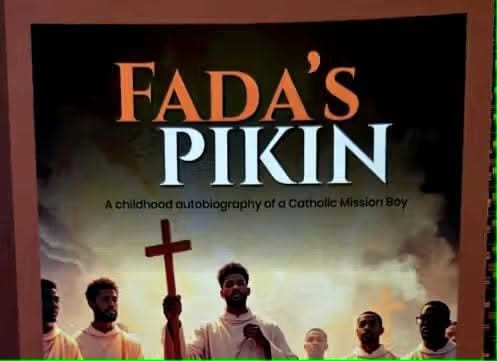
The design of the book is simple but reflective of the storyline. Set against a dark, albeit coffee-brown background, an ecclesiastical light beam reveals a convex triangular procession of Reverend Fathers led by a cross-bearing altar boy. The title is boldly printed in two colours – red-orange and white, which are in sync with the colours of the attire worn by the priests on the cover illustration. The rider to the title is in black, with a complementary summary and the author’s name in white, sitting at the bottom of the page to provide layout balance. The back page also reflects the dominant colours of the cover page with a brief on the author. The 228-paged book is published by FairDeal.
It is a book that should be read! Professor Okigbo observes that many historical, dramatic and poignant incidents make it a difficult book to put down once you start reading it. I agree. Its deep spiritual interrogation is likely to leave the reader with the same position as Okigbo, who submitted that we cannot know the mind of God. He noted: “Long after you put the book down, you cannot help but continue to think about fate, faith and the inevitability of death that continues to lurk and lay ambush to humanity at every corner.”
Uche Onyebadi, is a professor of Communication at Texas Christian University, Fort Worth, USA. He has traversed the communication landscape in many climes, from his days as a journalist in Vanguard Newspapers in Nigeria, through his sojourn in Kenya, Bangladesh, China and elsewhere around the globe, from where he studies, teaches, interacts and gathers materials for empirical research studies and his pet project, Cross-Cultural Experience productions. Onyebadi’s research interests focus on political communication, media and politics, mass communication theory, media ethics and international communication. Although he is often associated with Imo State, where he grew up, Onyebadi is from Issele Uku, in Aniocha North Local Government Area of Delta State, Nigeria.
- James, a communication artist and Fellow of the Nigerian Guild of Editors, lives in Abuja, Nigeria