
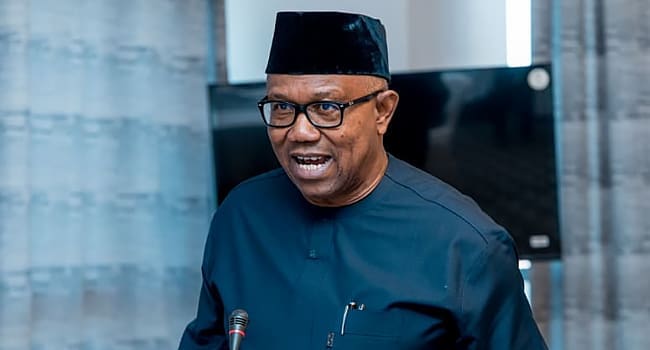
THE National Democratic Party (NDC) presidential candidate Peter Obi has criticised the Federal Government over what he described as poor management of Nigeria’s education sector, arguing that the challenges facing the system stem from inadequate funding and weak leadership rather than flaws in existing education policies.
In a post shared on X today, Obi reacted to the Federal Government’s decision to discontinue the policy separating junior secondary schools from senior secondary schools after officials admitted it had failed to improve learning outcomes.
According to him, the government’s acknowledgment reflects years of poor management of the education sector.
He cited recent examination results, noting that only 38.32 per cent of candidates passed both English Language and Mathematics in the 2024 West African Senior School Certificate Examination, while approximately 32 per cent passed the computer-based WASSCE in 2025.

Obi described the situation as evidence of a deeper crisis, stressing that education remains the foundation of human capital development and economic growth.
He argued that Nigeria cannot effectively address unemployment and poverty without making education, healthcare, and job creation top national priorities.
The former Anambra State governor also criticised the level of government spending on education, noting that the sector received ₦3.52 trillion in the 2026 budget, representing just 6.17 per cent of total expenditure.
He said the allocation falls significantly below UNESCO’s recommended benchmark of 15 to 20 per cent and reflects a lack of commitment to education as a driver of national development.
He further expressed concern over reports that Nigeria failed to sponsor students to international science competitions due to inadequate funding, describing the development as disappointing.
Obi maintained that the country’s education crisis is not a result of the structure separating junior and senior secondary schools but rather the government’s inability to properly fund and effectively implement the policy.
Drawing from his experience as governor of Anambra State, he said sustained investment in school infrastructure, technology, internet connectivity, and learning resources helped transform educational outcomes in the state.
He added that Anambra’s large-scale procurement of laptops for secondary school students received recognition from HP Africa.
Obi urged the Federal Government to significantly increase investment in education, healthcare, and job creation, warning that continued neglect of these critical sectors would have lasting consequences for the country’s future.
His remarks followed the announcement by the Minister of Education, Dr. Tunji Alausa, that the Federal Government would phase out the junior and senior secondary school separation policy after data showed that more than 20 million pupils dropped out before reaching senior secondary school.
The minister said the policy had failed to achieve its objectives, citing the shortage of junior secondary schools and the resulting overcrowding and high dropout rates.