Western-style education has largely conditioned many of us to seek employment rather than to create employment. It often prepares us to become excellent employees instead of entrepreneurs… Selling akara is not merely selling akara. It is participating in the fast-food industry — a sector worth hundreds of billions of dollars annually in countries such as the United States. Every successful food chain began with someone selling a simple meal…
IN 1980, when I was a graduate student at the University of Benin, I learned a lesson that has stayed with me for over four decades.
At the time, I was living with my friend, Rufus Orisayomi (now deceased), a newly appointed lecturer at the university. As part of his employment package after returning from the UK, the university gave him money to furnish his apartment.
Like many new lecturers, Rufus was directed to a well-known furniture maker along Ugbowo Road in Benin City. I accompanied him to the showroom.
The furniture maker sat majestically on a throne-like sofa overlooking his gallery while we were invited to sit on a lower level.

He pointed to one section of the showroom and said:
“Those are the furniture sets for university lecturers. Don’t look at the other side. Those are for businesspeople.”
Seeing our surprise, he continued.
“I receive lecturers here all the time. They all have PhDs. They are intelligent people, but they come with very little money. Even my domestic staff have better furniture than what many lecturers can afford.”
Before Rufus could respond, the man continued.
“I don’t understand why educated people don’t start businesses of their own instead of working for someone else. Within five years of serious work, you could be employing others.”
Then came the unforgettable line:
“If all you do is pee in a bottle, you can still find someone to buy it. It all depends on how you market it. It makes no sense to me to have a PhD and spend your life working for someone else.”
That conversation has remained with me ever since.
Recently, Nigeria’s First Lady, Senator Oluremi Tinubu, reportedly advised young people — including university graduates — to consider trades often regarded as beneath the dignity of degree holders, such as selling akara.
I am not writing to defend the First Lady.
My immediate reaction was that someone who occupies such a position of privilege may not fully appreciate the harsh realities confronting millions of Nigerians today. I also understand why many people dismissed her remarks.
Yet I think there is another way to read her message.
Western-style education has largely conditioned many of us to seek employment rather than to create employment. It often prepares us to become excellent employees instead of entrepreneurs.
Selling akara is not merely selling akara. It is participating in the fast-food industry — a sector worth hundreds of billions of dollars annually in countries such as the United States. Every successful food chain began with someone selling a simple meal.
The issue is not akara.
The issue is whether we are willing to rethink entrepreneurship, dignity, and the value of creating opportunities instead of waiting for them.
That old furniture maker in Benin City understood something that our educational system still struggles to teach.
Perhaps it is a lesson worth revisiting.
______
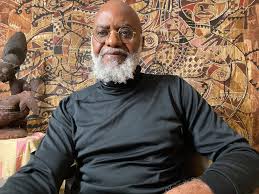
Picture shows me standing next to Dotun Popoola, an artist who started his studio immediately after completing his studies at the Obafemi Awolowo University–just a couple of years ago.
He worked hard and has cultivated one of the most productive and inspiring art centers in Nigeria — all within a short period of time.
This aggressive sense of entrepreneurship, in my belief, is what the First Lady is advocating.
It will be challenging at first, but will ultimately prove rewarding.
- https://web.facebook.com/moyo.okediji
- Dr. Okediji, visual artist, writer, philosopher, is a professor of Art and Art History at the University of Texas, Austin, USA