(A conversation with DR. Obadiah Mailafia, Part 3)
(This is the first report on the interview with Dr. Obadiah Mailafia on August 15, 2021. Well attended, the number of a live audience was 1.3 million on six platforms. For part of the transcript, see Facebook https://fb.watch/7q9qf8tqEd/ Or YouTube: https://youtu.be/vskrSktBGJY).
THE interview with Dr. Mailafia during the Toyin Falola Interviews furnishes the audience with much information that helps to grasp the idea of failed leadership and state and problematize the concept of a failing state. The truth is laid bare for anyone confident enough to accept that the conversation around a failed state is a byproduct of the narrative of us versus them, civilized versus uncivilized, barbaric and modern, dated back to the 19th century as a prelude to the colonization of the less technologically advanced groups of people in Africa and other victims of colonialism. The binary prism generated around this characterization found the expansionist imperialists on the side of the coin where they are associated with modernity, civilization, and greatness, which, therefore, became the motivation for their expeditious colonialism embarkations on all of their colonies.
As it was then, the measures for civilizations and others did not have a universal appeal because it appeared that the moral and political requirements for being civilized represented a jaundiced view of the colonizers. Although this would help to drive an objective conversation when dealing with the mountainous challenges that have gripped the African, especially Nigerian, leadership by its jugular, it does not by any means undermine the importance of having common denominating factors with which it can be decisively concluded that a country is failing or has failed. In essence, one needs to address the issues of a failed state not exclusively by considering the factors erected by the Western world but by definitions given by the rational members of colonized societies who are impartial in their evaluation and examination of events.

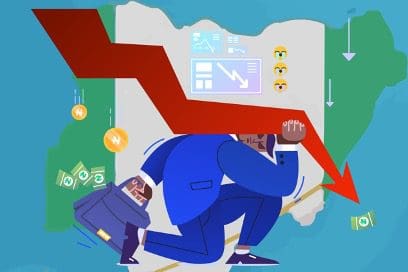
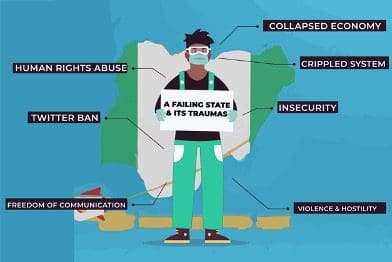
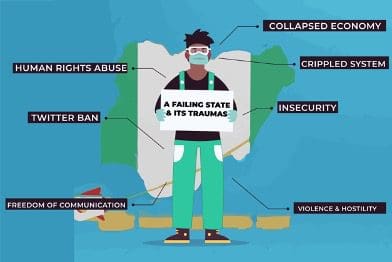
One of the most compelling characteristics of a failing or failed state is a collapsed economy that is immediately trailed by widespread poverty. These two factors define the current topic of engagement because no civilization can claim modernization in its remote sense if its economy has collapsed. Therefore, it is challenging to avail Nigeria of this quagmire tagged “failed state” when one realizes that its economy has declined in recent years for reasons that are not unconnected to its excessive concentration on a single source of revenue. Such dependence, among other things, has killed the nation’s urge for creativity and diversification. And because the government has refused to be pluralistic in its economic approach, the political structure has been facing constant declination of values and worth.
It is difficult to compare the Nigeria of today and that of four or five decades ago. The declining economy has become the source of many existential challenges in which the country is currently circumscribed. Essentially, this has weakened its importance in the region of West Africa and Africa generally because not only has the country become the proverbial leaches of the international organizations that oversee the financial rescue of less economically viable countries and then serve donor countries that contribute to face-save them in time of crisis, the citizens have also been reduced to a diminished group of people who would retain no particular regard outside of their political and geographical outreach.
Various countries have emerged in recent years because they diversified their economies and concentrated intensely on ways to redeem their financial status in the comity of nations. However, Nigeria is stuck in the pit of economic debauchery because the government is too reliant on mono-economic sources of financial and economic income. This would not have been a problem if people’s economy does not affect their cultural and social systems. As Karl Marx argued in the past, when the economy, which is the basis for political engagement, collapses, there are usually devastating consequences that would be felt in other areas; hence the widespread poverty that Dr. Mailafia talked about in the Toyin Falola Interview Series.
Widespread poverty is one social problem that has faced Nigeria currently because its economy is in decline. The country’s economy is so weak that it cannot provide the necessary job security for the people, and the lack of employment opportunities has invariably increased the poverty level of Nigerians. Nigerians are embattled with the multiple problems of economic decline and poverty, which have inevitably increased the challenges they face day in and day out. Malnutrition and the inadequate health systems pervasive in the country are evidence that it has crossed the line and sunk into an abyss of terror. A few years ago, Nigeria was dubbed the world’s poverty capital because its citizens are said to live on a dollar per day. Such statistics are dumbfounding, not mainly because many people suffer from poverty, but also because Nigeria, which used to be the beacon of hope for the African continent, especially at the economic front, has now been labelled the poverty headquarters of the world in just four to five decades. This speaks to the lack of foresight in the political domain. The lack of visionary leaders at the echelon of power is a strong reason behind the accelerated increase in poverty and deprivation.
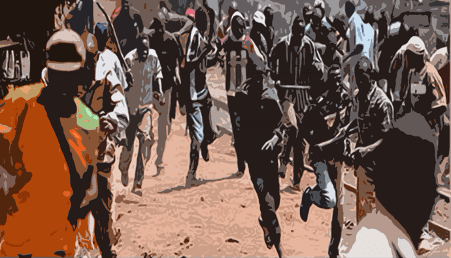
A failed state does not stop with these challenges. A famous proverb among the Yoruba people says that when big challenges overcome individuals, smaller ones would feast on them; the rising level of insecurity in the country is another signal of its serious condition. Nearly in all the corners of the country, there is no safe place for individuals to conduct their activities freely without nursing the fear that they may be rounded up by groups of criminals who believe in their guns as the decider of people’s fate. Insecurity is so widespread that people cannot be absolutely confident of their safety whenever they step outside their confines. Even in the comfort of their homes, there are growing instances of attacks on people. Insecurity in Nigeria is pervasive and deadly, and this is one of the reasons the country cannot escape the profiling it has experienced in recent times.
Undoubtedly, if the situation of a country mirrors that of Nigeria, its challenges would grow in leaps and bounds. For example, the security crisis has taken a comfortable seat in the country, which scares potential investors away for obvious reasons. Business investors worldwide are known to pick interest in places where they are confident of financial returns. When this is threatened, they will look elsewhere to invest. To this extent, insecurity is a disease that silently kills people and provides them with no actual possibility of an antidote that may give them the relief needed from time to time. Candidly, there are limitless opportunities in Nigeria so much that if they had been confronted with increased unemployment, there would be an opportunity to turn the situation into something desirable through investments in the economy. But when insecurity is added to the challenges facing the people, they have little chance of attracting the right business people who would elevate their status by investing in their moribund economy.
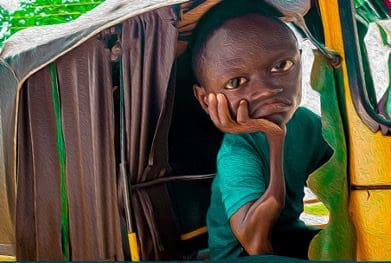
One would think that Nigeria has demonstrated the highest of its shortcomings in its failure to function as a great country until one realizes that it is embroiled in many struggles. In essence, Nigerian problems are interwoven and interconnected. Apart from the fact that attracting the right people is problematic where the security challenges are pervasive, the realization that individuals are too psychologically weak to pursue any economic dream adds to the said problems. Sadly, the combination of these factors is grossly affecting Nigerian citizens in the contemporary world.
More appalling is that the Nigerian state cannot deliver the essential public goods expected of a state. One of the public services expected of a functional government is protecting human rights; however, it is more benumbing that the Nigerian government has been unable to protect these fundamental human rights. Now the country seemed to have slipped into anarchy in some states, notably in Zamfara and Borno. The freedom of communication, on which mandate the government of the day rode to power, has been carefully and methodically infringed upon so much that the people exercise conscious restraint in discussing issues that affect them in public or social spaces. The gross disrespect for human rights and the abuse that comes from such attitudes give the impression that the protection of the citizens no longer takes a particular interest in the hearts of emerging political leaders.
Positions of power have been ambushed by individuals using power to enhance their selfish interests. The media houses responsible for the government’s victory are now feeling the heat of totalitarian policies targeted at their operations. For example, the ban placed on Twitter reflects only one thing–the absolute disregard for human rights. Including, but not limited to this, is the clamp down on the freedom of association that is getting to the heart of the political system. Free association with others has experienced similar treatment. One cannot associate with groups without feeling insecure because the ongoing security challenges that have engulfed the country continue to scare people from being involved with others on issues that affect their social networking. If these are part of the indices used to measure a failing state, Nigeria cannot be exempted from the list. The country has failed to protect its citizens, which is a major contribution to the pervasive insecurities in the land. While the government continues to increase the level of funding dedicated to the procurement of arms and ammunition, the results do not complement the monies spent. Budgetary allocation for security increases annually with little or no results to show for it. In other words, people have taken the insecurities pervasive in the country as an opportunity to perpetuate corruption on a larger scale. Meanwhile, the administration of justice has equally been complex.
At the interview session, Dr. Mailafia hinted that although everyone believes that peace can follow the absence of all violent activities and criminal engagements, the fact remains that when there is no justice, there can be no claim to peace, primarily as the current state of affair in the country does not support justice. For instance, it is readily impossible to have justice in situations where security operatives have constituted themselves as a parallel government where they carry out activities that naturally defy the ethics of their calling. On an occasion where the representatives at the political system are siphoning the public resources for their provincial gains, displaying an opulence got from the sweat of the public, it is difficult to ascribe any form of justice to such a political behaviour. Thus, there would be problems in collectively advancing the objectives and goals of such a country. In a recent exposition by the United States of America, the scandalous involvement of Nigeria’s Deputy Commissioner of Police with a popular cybercriminal, Hushpuppi, demonstrates how institutions in the country have been taken over by overzealous individuals who would pursue their ambition even at the expense of the state. This is corroborated by the actions of Nigerian politicians with unexplainable wealth, who gallivant the globe on the citizens’ wealth.
It gets exciting when we realize that Nigeria is a heterogeneous country with different people and varying cultural orientations who, upon the understanding that there is a perceived lopsided nationalist treatment, could consider seceding from the country to become independent. When Ms. Bamidele Ademola-Olateju asked Dr. Mailafia if the country truly deserves to remain a corporate entity or has the potential to remain one in the nearest future, we should understand more about the political possibilities of the country remaining indivisible. Dr. Mailafia considered the question a two-fold one, and he approached them differently yet educatively. He answered the first part of the question in the negative, not being preposterous in his prediction but by considering several trends that have become synonymous with the country. The first is the country’s demographic which doubles its numbers every thirty years. Coupled with the diminishing social and infrastructural services, pervasive insecurities, rising injustice, and widespread corruption, the possibility of the country surviving the next phase of its national identity is uncertain. Nearly all the countries that have dissolved their colonial identities have experienced what Nigeria is going through in the current time. The fact that they eventually broke up to form new states explains why a similar condition awaits Nigeria.
On the second question about if Dr. Mailafia would want the country to collapse so that different nations would emerge from its decay, he responded that it is not his wish to see the c collapse of Nigeria. He argued that one of the reasons for his position is that apart from his nationalist spirit, he has grown so fond of the country and believes it can achieve an incredible potential if only the leaders take very decisive steps to salvage it. Whether the country deserves to survive or not is another thing entirely. Dr. Mailafia was unpretentious when he said he does not, in good conscience, think that the country deserves to survive, considering the numerous evils that have been perpetrated by the people in whose hands the country’s management is kept. This evil persisted beyond the corridors of power. The people who are nudged on by the leaders’ silence committed grave crimes and misgivings that are naturally irreconcilable and incompatible with progress. Civil strife in the 1960s and 1970s led people to kill others who were considered different from their ethnic identity. This civil war in the country between 1966 and 1970 was another offence against humanity. The fact that the blood of the innocent was used as the sacrifice to keep the country as one contradicts natural order, and for this reason, it is difficult to say if the country is deserving of remaining indivisible. Ethnic cleansing, religious killings, banditry, among others, characterize the Nigeria of the current time, making it difficult to say it deserves to remain one.
Security challenges and the political theatre that prepared the stage for the proliferation of violence cannot be dissociated from the socioeconomic conditions that necessitated the horrible development in the first instance. Suppose by luck, a country is given a pass mark of credibility irrespective of the pervasive and constant violence and hostilities. In that case, there cannot be redemption for countries that have failed in their economic prosperity, for they would be vulnerable to all manners of threats that would potentially come their way. The Nigerian situation is exemplary of this condition strictly because the decline of its economy in recent years has reached an unprecedented scale.
To understand the relationship between a failing state and those whose financial oxygen has been infiltrated by particles and pebbles that are disastrous to the country’s health, a question was raised about the causes and effects of the continually reduced value of the country’s currency. By his age and experience, Dr. Mailafia qualifies as a historian on issues that border on Nigeria’s past events, especially from the 1960s onwards. His mind-opening input would enthuse us. According to him, the devaluation of the Nigerian currency is a product of many factors that need to be studied or appropriately contextualized for us to grab the knowledge of its status. For a currency that was far ahead of the American dollars in the 1960s and that was giving the British pounds a run for its money in the same period, one needs to address emerging situations that suddenly led to the surprising displacement of the values less than seven decades after.
However, the point of waterloo to the Nigerian Naira came in 1985 during the regime of General Ibrahim Babangida, under whom the Structural Adjustment Programs (SAP) sapped the values that the currency had managed to enjoy for a considerable number of years. As argued by a technocrat, the program was geared towards the de-industrialization of the country and the despoliation of their economic systems. The Nigerian currency began to drastically lose its values against the European and American currencies from that period. As if it was in a self-competition to outdo itself in the areas of value erosion, the Naira has been witnessing rapid declination from that period to the current time. This, according to Dr. Mailafia, is caused by several factors.
First, the high inflation rate in the country has predominantly affected the way the Naira presently stands, among other currencies. Also, the excessive dependence on importation accounts for the devaluation of the Nigerian currency. This particular variable resulted in a deficit in the country’s account balance and a trade deficit. Misguided economic and financial policies created by people unaware of how their government’s activities influence the Naira and thus act rashly also harm the country in this area. It is nauseous to be educated on the devaluation of the currency and then know the people who brought the calamity on their people. For example, the dollarization of the Nigerian economy, apart from the oil industry that was not covered by the sanction of the Central Bank of Nigeria (CBN), also contributes to the devaluation of the nation’s currency. Coupled with the fact that some top politicians in the country have also been engrossed in the cultural tradition of using dollars above their currency, the devaluation of the country’s money does not always concern them. They have made a substantial amount of money through their deliberate act of disobedience to the standard regulations by the government. As such, they have more purchasing power when the Naira loses value.
All these factors combine to tell us that Nigeria is failing the test of being a solid state. To Dr. Mailafia, Nigeria lacks the power to control its profound contradictions and infractions. Where does Nigeria go from here?
*******

…The Parameters of a Failing State
(A conversation with Dr. Obadiah Mailafia, Part 4)
(This is the second report on the interview with Dr. Obadiah Mailafia on August 15, 2021. Well-attended, the number of live audiences was 1.3 million on six platforms. For part of the transcript, see Facebook https://fb.watch/7q9qf8tqEd/ Or YouTube: https://youtu.be/vskrSktBGJY).
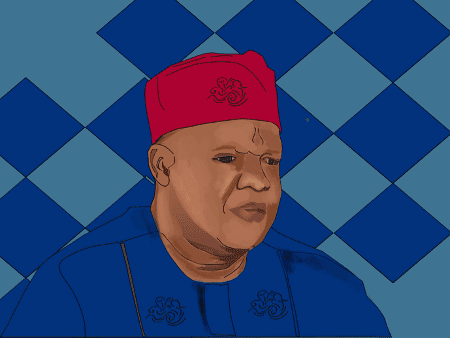
THIS occasion of the Toyin Falola Interviews featured as a guest of honor, the erudite scholar and accomplished development economist, Dr. Obadiah Mailafia, to field questions on whether or not Nigeria is a failing state. We might agree that this is one query that sits securely in the minds of many a Nigerian, no thanks to the poor state of affairs in the nation’s economic, security, and governance aspects, which has won it the label of a failed state in some intelligent circles.
As it stands, even the very notion of Nigeria as a nation continues to generate dispute given the rising instances of crises developing along ethnic and religious fault-lines. According to some people, the rising expressions of loyalty to sub-national identities over any national sentiment that has characterized Nigeria’s slow but sure decline into utter chaos and predictable disintegration can be blamed on the nation’s arbitrary origins. Nevertheless, whatever problems Lugard might have visited on Nigeria through the 1914 amalgamation, there were periods in the nation’s development history when it showed great promise and competed favorably with the best economies of the world. How then has Nigeria fallen to such depths of socio-economic crises and severe insecurity?
The recent Toyin Falola Interviews provided the platform for stakeholders and concerned citizenry—in very uncertain and unsettling times—to participate in a discussion aimed at adequately identifying the Nigerian situation, how it developed, and the possible ways to come out of it. Thus, the interview opened with a welcome address and introductions delivered by the chief host and moderator, who also set the agenda for the day’s interview by presenting its theme: “Is Nigeria a failed state?”
Ms. Bamidele Ademola-Olateju, an accomplished media personality and the first interviewer, set the ball rolling with questions on why Dr. Mailafia would refer to Nigeria as a failing state when many others might call it a failed state; whether Nigeria as a corporate entity will survive, and if it deserves to; why the naira is failing so “precipitously,” and what can be done to bolster it; and how meritocracy can be taken seriously in the country to make it count?
In his response, Dr. Mailafia noted that the development of the concept of “failed states” has not yet been fully concluded, surrounded as it still was by controversy. He, however, went ahead, after some description of the deplorable state of affairs in the country, to elucidate that, as it were, Nigeria exhibits most of the identified symptoms of a failed state, including long periods of violence and the lack of state monopoly of the instruments of violence, the collapse of the economy and state intuitions, widespread poverty, the failure of the state to deliver public goods, civil liberty, the rule of law, protection of human rights, and administration of justice. And that his decision to use the phrase “failing state” in describing Nigeria’s current situation was only due to his optimistic nature and some “residual nationalism.”
According to Dr. Mailafia, Nigeria cannot survive as a corporate entity based on the current trajectories of decaying infrastructures, poor governance, grand corruption, climatic changes, and lack of government capacity. And on whether the nation deserves to, he accedes that given the number of atrocities and bloodletting committed against innocents across the country, it ordinarily should not. However, the teachings and injunctions of his Christian faith make provisions for grace and redemption, but with one caveat: Nigeria must not continue to tempt faith.
Speaking on the falling value of the naira, Dr. Mailafia provided a historical account of the currency’s decline, from its days of advantage over the dollar till the present, where it is fast losing its value as a legal tender. These progressive stages of decline, he said, started perceptibly with the Structural Adjustment and currency devaluation of the Gen. Ibrahim Babangida regime and have been maintained by high inflation, the deficit in the balance of trade, lack of faith in the Nigerian system, misguided policies, and what he called “the dollarization of the economy.” He also alleged that vested interests have captured the country’s apex bank (CBN). To reverse this trend, a development strategy is needed, likewise a genuine interest in saving Nigeria.
Concerning the restoration of meritocracy, Dr. Mailafia talked about the difference in the standards set for educational performance (cut-off marks) across the country’s regions. He claims that not only does this undermine the entire purpose of education, but it also affects service performance where underdeveloped and unqualified personnel occupy positions of public service. For him, instead of engaging in nepotism, the regions affected should invest in mid-way schools to help struggling students come up to par.
The next set of questions were posed by Dr. Lasisi Olagunju, a distinguished scholar and editor with The Tribune. These touched on Dr. Mailafia’s thoughts on the North exporting crises to other parts of the country, the reintegration of “repentant” terrorists into society; why as a contestant to the country’s top position he felt Nigeria deserved him and vice versa; what the next president of Nigeria should do regarding the country’s designation as the “poverty capital of the world,” the role of the North in the situation, and whether Nigeria should be restructured, dissolved, or if it should just be business as usual. In response, Dr. Mailafia conceded that the North is plagued by insecurity, featuring rampant killings by insurgents and terrorist groups like the Boko Haram and ISWAP.
Furthermore, he pointed out the extent of social decay in the country, especially in Kano State, the high divorce rates, rampant drug addiction, large number of out-of-school children (Almajirai), and high levels of deprivation. According to Dr. Mailafia, the morally bankrupt elites have intentionally turned a blind eye to all of these social evils, choosing instead to perpetuate ignorance among the masses while attempting to drag other regions down to their level. However, he requests that the North must be looked upon with compassion and that any (new) administration intent on resolving these issues must first endeavor to look at the North with objectivity as the North is “deprived.” Additionally, such an administration must also reconcile the warring parties, return the out-of-school children to class, and employ more teachers to cater for their education, as the former has the potential of becoming a ready army in the hands of mischief-makers.
On the reintegration of alleged “repentant” insurgents, the guest of honor pointed out that there is nowhere in the world where that is obtainable, especially where such insurgents are integrated into the armed forces after just two weeks of rehabilitation. He alluded that this has adversely affected counter-insurgency efforts, with hostages being privy to sensitive information before they are executed. He also spoke against the practice of giving all such intervention attention to “repentant” terrorists while their victims are left to all manner of hardships. This, he said, was in very bad faith.
Addressing the question of his ambition to become president, Dr. Mailafia revealed that he tried to serve the nation and that it was up to the Nigerian people to decide if he was whom they wanted. He remarked that he was ill-prepared for the last elections he contested and also failed to gain the backing of certain “elders,” without whom one would be “on his own.” Nevertheless, the 2019 Nigeria Presidential election candidate of the African Democratic Congress party promised not to victimize those who have attacked and killed his people should he be allowed to serve.
Reacting to the question on Nigeria’s designation as the poverty capital of the world, the former central banker and development economist agreed that with such levels—over 50 per cent of Nigerians (more than 100 million) living below the poverty line—of poverty, the situation truly deserves to be labelled so. He pointed out that this challenge has been exacerbated by the impact of the COVID-19 pandemic and widespread insecurity. Other contributory factors identified were those of prioritization and the failure to diversify the economy. Therefore, to turn the situation around would require a significant industrial revolution as the only way to employ the vast masses of unemployed citizens. There will also be the need for a comprehensive social transfer network to ensure resources get to those in need; empowerment of people, especially women; access to land and credit, with emphasis on agriculture; and support for Nigerian youths. He stressed support for the youths, explaining that “any nation that ignores its youths is digging its own grave.”
Coming to restructuring, dissolution, or “business as usual” for Nigeria, Dr. Mailafia stated that he stands for restructuring. Even if he does not subscribe to the idea of dissolution, he does not condemn secessionist voices. He explained that he believes Nigeria deserves another try because, despite the historical circumstances around its birth, the country was not a product of chance. He recalled that the peoples of the region had a long history of interaction before any British creation. According to him, Nigeria is worth fighting for because of what it represents to all long-suffering African people worldwide and for black people everywhere. For those who suggest business as usual, Dr. Mailaia called this a mistake.
The third interviewer, Prof. Iheduru Okechukwu, an experienced and widely published political scientist, asked a broad spectrum of questions that were anchored to Nigeria as a failed state and centered on Nigeria’s huge debt profile and who foots the bill; the condition of human rights and the place of the rule of law; if it were smart for the Nigerian diaspora to invest in the country; and if what happened to Jos was emblematic of a failing state, and whether it was reversible. Reacting, Dr. Mailafia noted that the issue calls for sobriety and retrospection. For him, he cannot tell what the loans are used for, citing the 1.3 billion USD loan President Buhari took in 2015 in the guise of rehabilitating the North-East, whereas there is no evidence of rehabilitation. He pointed out that if loans must be taken, measures must be put in place to ensure that such loans have a “calculated guaranteed return on investment;” otherwise, as he pointed out, these loans would be paid for by our children. He also highlighted the condemnable practice of project inflation.
On diaspora investment, Dr. Mailafia said this was critical to Nigeria’s survival and prosperity, given the delicate nature of its economy and the role such substantial amounts of remitted funds have played in the success of the world’s fastest and best economies, e.g., China and Singapore. He also explained that the Nigerian diaspora cannot help but send these monies as they all have dependents at home; moreover, about 70 per cent of the funds remitted are for family use and not direct financial investments. He, however, reiterated the importance of such remittances to the Nigerian economy and the need to devise better means of investing these funds to gain maximum social returns.
Reacting to the infringement of human rights and other freedoms, and why he should not be prosecuted for making unsubstantiated claims. Dr. Mailafia noted that “he who comes to equity must come with clean hands.” He pointed out that the Nigerian National Broadcasting Cooperation (NBC), which was dishing out rules, was embroiled in a corruption issue. He also stated that those concerned about “hate speech” mainly were against voices that contradict their opinions and interests.
Moving on to the human rights issue, the guest speaker avowed that though the human body can be killed, the truth cannot, and nobody can stop an idea whose time has come. As to why he should not be prosecuted for his earlier comments on the nation’s state, Dr. Mailafia responded that his comments were not made-up but were gotten from reliable sources he refused to mention for their safety. He confirmed that he has never recanted any of his comments because it is not his character to peddle tales and falsehood. He added that he only spoke up as a concerned citizen who could not sit back and feign ignorance about the widespread and relentless killings.
About Jos, Dr. Mailafia described the city as pleasant, with a temperate climate and hospitable people. He stated that the change in the city’s temperament resulted from the aggression inflicted on the people. This, he explained, was perpetrated through strangers who were imported into Jos and who have killed, evacuated, settled, and renamed whole villages. Another reason identified for the change of attitude in Jos is the prevalent indigene discrimination around the country, which Dr. Mailafia said the people of the state have been victims of, especially in Hausa-Fulani dominated states like Kano, Katsina, and Sokoto. According to him, these instances of aggression and discrimination against the people of Jos have transformed a peaceful and almost docile community into a relatively harsh one.
Dr. Mailafia agreed that the Jos scenario is symbolic of Nigeria’s status as a failing state. He expanded that this is exemplified in the inability and possible lack of will by the state to check the widespread insecurity and killings in the country, emphasizing the cases of Benue, Southern Kaduna, and Niger State, where people have been killed, villages burnt, and vast chunks of land taken. The guest speaker closed with a prediction that the affected people will yet rise to reclaim their ancestral lands, no matter of long it takes. But, that as a man of peace, he advocates that this should be pursued in non-violent ways.