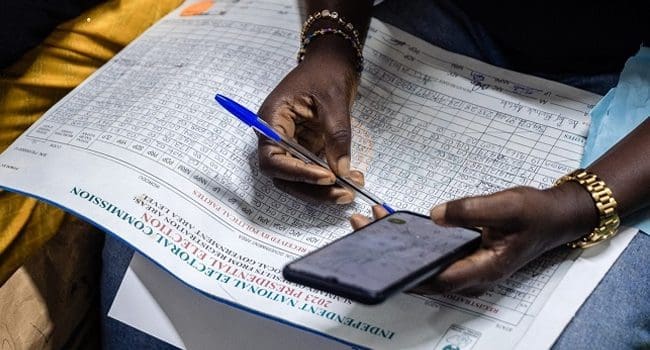
Three Nigerian states went to the polls last Saturday in an off-cycle election and the results were greeted with the usual protests and rejection by those who were not declared winners. This attitude of rejecting results has become a recurring decimal in the annals of Nigeria’s election cycles largely because of the distrust for the system that midwifes the process. The electoral umpire and the security arrangements are always seen to be compromised ab initioand what used to be the last hope, the judiciary has also of late come under the same wave of categorisation.
Shortly before the governorship elections that took place last Saturday in Imo, Kogi and Bayelsa States, there was an uproar over the appointment of some new Resident Electoral Commissioners (REC), another issue that has come under severe criticism in recent times. The REC is in charge of the Independent National Electoral Commission (INEC) and handles the Presidential, National Assembly, Gubernatorial and House of Assembly elections at the state level. Apart from making available all election materials during elections, he supervises the activities of all those involved in the election process and provides for proper verification of election results. The appointment of RECs therefore has serious implications for the electoral system.
Being an umpire in the election process and a critical member of INEC, the constitution requires that the appointment of persons into the office must be subject to confirmation by the Senate. Paragraph 14 of Part 1 of the Third Schedule of the Constitution, as amended by Section 30, Act No 1 of 2010, states clearly that a member of the Independent National Electoral Commission “shall be non-partisan”.
However, in the recent times, the appointment of persons into the office has come under intense criticism because the non-partisan prescription of the statute on such appointments has not been seen to have been adhered to. Known partisan entities have been recommended and in some cases cleared to occupy such offices. Being largely based on trust and confidence, the electoral process in the country becomes suspicious as the umpires are not seen to be unbiased and trustworthy because of their relationship with partisan entities. Nigerian and foreign observation teams alike have documented grievous violations by RECs throughout the Fourth Republic elections, and observers have repeatedly called for reform of the system to insulate INEC from partisan influence.

The REC is part of the foundation of our democracy, so we have to ensure that the right people are in the right place. People with any form of bias or sympathy for any of the parties should not be made to or allowed to occupy such very strategic and important position. The triggers for election disputes are usually pulled by a lack of faith in the process. If we have to build democracy, we have to go back and restore that integrity. If we don’t, we will continue to have problems after every election. Because of the capacity of the RECs to make or mar the election process, as the chief officials on ground, their appointment must be taken very seriously and devoid of any controversy, particularly of partisan inclination.
The office of the REC can rightly be classified under the foundation of our democracy because it is at the grassroots. If we don’t get it right there, we can’t get it right at the national level. This would rarely happen. It is at this level that we should start building and strengthening the hope of everyone. The major problem of the election process is not just about the outcome, it is also about perception. The outcome can be right, but if the perception is not, it will always trump the eventual outcome. So we need to build a convergence between outcome and perception. And that starts with the trust and confidence the electorate has in the electoral umpires. Until we start rebuilding and making sure that our democracy is on solid ground it is unlikely that people will have sustained interest and belief in the democratic process.
Knowing the damage the RECs can cause in an election, if the country truly desires free and fair elections the time is now to prepare for the next major election cycle in four years, by putting in place structures that would inspire confidence and spare the judiciary of carrying the can after the entire process must have been messed up during the election activity. The optics must not just be right but seen to be so. We do not see future elections being regarded as credible if persons with known partisan affiliations are appointed as RECs. The current perception must be dismissed by doing the needful.
Our position is that appointments that have become controversial should be stepped down. Incidentally, the controversy generated in recent times over the appointment of electoral umpires has thrown up another issue: Why should the president elected on a partisan platform be the one appointing electoral umpires? It would be difficult for the president to appoint people he is not at home with, and that ab initio jeopardises the independence of the electoral body. We cannot emphasise enough, that we should be careful of the kinds of people who are given these positions because they are very critical to our electoral process and the re-emergence of a truly democratic society.
Models for reforms are all around us: Ghana has left us behind in the race for election integrity; Kenya is barely visible in the distance ahead of us, and now even post-war Liberia seems to be passing us by. One important reform that would not require a constitutional amendment – but which the National Assembly should back with law – would be to institute a two-stage review process for the RECs. In the first stage, INEC would set up its own internal review committee to identify REC candidates with the proper election management experience to do the job, and to do a “political background check” to ensure that no one on their list has been a senior political party member or candidate for a significant amount of time – ten years at least.
Once INEC has completed its initial identification process and vetting, it should submit its list to a new review board consisting of appointees from all political parties represented at the federal and state levels. The review board would have to approve unanimously anyone on the REC list drawn up by INEC. With representation from both ruling and opposition parties, we can be sure that the political party representatives (on this board) will have every incentive to root out RECs they suspect lean toward any other party. Once these two steps have been taken, INEC can send it to the Senate for review and confirmation.
The president should listen to the people and must adhere to the electoral laws. If people are not qualified, they should not be made to occupy critical positions, especially positions that are supposed to inspire trust and confidence in the people. Not doing the needful does not give the people the hope that future elections are likely to be free and fair. With a more credible list of RECs, as we have outlined here, INEC can stop its self-defeating practice of rotating RECs just weeks before elections.
We note. However, that the RECs are only a tip of the iceberg for election reform. YIAGA Africa in Nigeria, NDI and IRI in the USA and the European Union observation teams are just a few of the helpful reports from the 2023 general elections that include a host of important recommendations for improving INEC, the tribunals and the courts regarding election management. First among these includes (1) absorbing the state elections commissions, which have serious credibility issues, into INEC and having INEC run all state and local elections, (2) having a reformed INEC run all primary elections, which must be conducted in exactly the same manner as general elections, (3) increasing transparency in INEC’s internal workings, especially in regard to technological infrastructure, starting with improvements of the BVAS and IREV, (4) creation of an independent electoral offences commission to prosecute election crimes, and (5) reduction of the judicial review process to ensure that all election challenges are decided before the swearing in date.
Making the right decisions at this stage would set the stage for free and fair elections in the future. It would create an atmosphere where contestants who lose at elections would accept their fate with equanimity and move on. It would create a lesser burden for the judiciary which has now become the butt of criticism and target of suspicion by aggrieved persons who believe rightly or wrongly that it should correct the perceived ills of the electoral process. It would reduce apprehension among the people and tension within the society. Both the electoral body and the government of the day would have a better perception and bolder image if the fit and proper things are emplaced.
We join in condemning appointments of persons with partisan affiliations into the electoral body at every critical stage and insist that the right things be done for the sake of future elections and the sustenance of democracy in our country.