
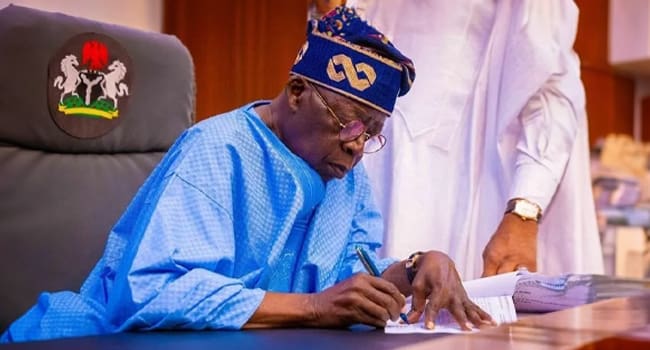
PRESIDENT Bola Tinubu has signed the Electoral Act 2022 (Repeal and Re-Enactment) Bill 2026 into law, following its passage by the National Assembly after months of debate.
The signing took place at the State House today in the presence of Senate President Godswill Akpabio, House Speaker Tajudeen Abbas, and the President’s Chief of Staff, Femi Gbajabiamila, among other senior officials.
Speaking at the ceremony, Tinubu said democracy thrives on strong debate and national consensus.
He urged Nigerians to trust the electoral system and focus on managing the process in a way that avoids confusion or voter disenfranchisement.

Addressing concerns over the transmission of election results ahead of the 2027 general elections, the President noted that while voting and counting remain largely manual, attention should be paid to how results are transmitted.
He stressed the need to prevent technical failures, interference, or hacking, questioning whether the country’s broadband capacity is strong enough to support full real-time electronic transmission.
According to him, voters will still cast ballots manually, with votes counted and recorded before being entered into official forms.
The key issue, he said, is ensuring accuracy and security in transmitting those results.
The bill sparked heated debates in both chambers of the National Assembly, particularly over Clause 60, which addresses electronic transmission of results and the use of manual transmission where network failures occur.
In the Senate, proceedings became rowdy after Senator Enyinnaya Abaribe demanded a division on the clause.
After voting, 55 senators supported retaining the provision allowing manual transmission in cases of network failure, while 15 opposed it.
A similar disagreement occurred in the House of Representatives when a motion to rescind earlier provisions on compulsory real-time electronic transmission was put to a voice vote.
Despite louder objections, the Speaker ruled in favour of the motion, prompting protests and an executive session.
With the President’s assent, the revised Electoral Act 2026 is now law, setting the legal framework for the 2027 general elections.