
Political rhetoric cannot stop water. Only governance reform, enforcement of planning laws, restoration of wetlands and investment in drainage infrastructure can. Research is unequivocal. Flooding in Lagos and Accra is governable, not inevitable. Current governance structures are fragmented and insufficiently enforced. Urban growth without planning has increased runoff and reduced natural attenuation. Atagbon’s poem is therefore not just art. It is a civic intervention…
 SIJI Atagbon’s poem Lagos Island, published in Naija Times on February 28, 2026, is not simply a meditation on rising water. It is a direct and urgent warning about the political and institutional failures that have made Lagos, and increasingly Accra, catastrophically vulnerable to flooding. The poem’s imagery of returning tides, swelling walls, rusting rebar, and tilting skyscrapers is not decorative. It is a formal accusation, an indictment.
When read alongside recent analyses of flood governance in both cities, the poem becomes prophetic. It articulates in cultural form what scientific and policy research now confirms: that disregard for planning laws, unchecked building on flood plains and chronic institutional fragmentation have turned routine rainfall into urban disaster.
Water Remembers Its Rights
Atagbon opens with the line, “The ocean returns like a patient ancestor, persistent, certain.” This is more than poetic flourish. It is a reminder that hydrological systems have long memories. Flood plains, wetlands, and coastal corridors are ecological structures that cities ignore at their peril. When the poem says that water remembers its old rights even when governments forget theirs, it frames flooding as a political failure. It suggests that the crisis is not caused by nature but by a breach of civic responsibility.

Recent research supports this view. Studies of Accra’s flood history show that the city’s recurrent disasters are driven not by unusual rainfall but by systematic physical planning failure. Waterways and flood plains have been occupied without restraint. Political interference allows powerful interests to build with impunity. In Lagos, governance structures are formally aligned with international disaster risk frameworks, yet enforcement remains weak. Centralised authority, poor coordination, and limited local capacity mean that planning laws are often ignored. The poem’s opening stanzas therefore articulate a truth that is now widely documented. Water is not the problem. Governance is.
Cracked Walls and Rusting Rebar
Atagbon’s imagery of walls swelling like lungs learning a difficult truth and rebar rusting like a confession is a metaphor for infrastructural decay, but it is also a moral accusation. The poem suggests that the physical deterioration of the city is the direct consequence of corruption, shortcuts, and regulatory negligence.
This resonates strongly with Lagos’s documented governance gaps. A comparative study published in 2026 shows that although Lagos has formal disaster risk institutions, enforcement mechanisms at the local level are legally underdeveloped. Land use decisions routinely ignore flood risk integration. Accra’s situation is even more stark. The Ghana Land and Property Perspectives report of 2026 notes that drainage is routinely excluded from road construction contracts. Regulatory bodies are under-resourced. Developers occupy waterways with impunity. The poem’s confession is therefore literal. The built environment reveals the truth of institutional failure.
Everyday Adaptation
One of the poem’s most striking features is its attention to ordinary people improvising survival. Vendors lift their stalls onto bricks and crates. Children play in courtyards glistening with tide. Residents stack sandbags like prayers. These images capture what flood risk scholars call community-level adaptive behaviour. They describe the informal, bottom-up responses that emerge when formal governance collapses.
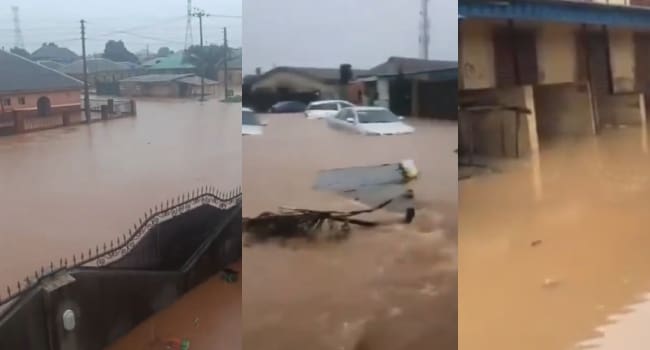
Research on Lagos and Accra confirms that residents have become de facto flood managers. They are forced to adapt because state interventions are sporadic, underfunded, or absent. Accra’s June 2026 floods displaced more 38,000 people. Culverts were overtopped, channels were silted and drainage systems were overwhelmed. These failures were linked to deferred drainage investment and fragmented flood governance. The poem’s portrayal of people who patch walls, raise floors and whisper into the humid air is therefore not romantic. It is sociological. It reflects the lived reality of urban residents who bear the burden of governance failure.
The Illusion of Resilience
Atagbon’s critique of corporate Lagos is sharp. Executives speak of resilience and innovation. They imagine that they can outpace the water by reaching the clouds. Yet the skyscrapers tilt slightly, a bow and a warning. This metaphor captures a dangerous urban myth: that vertical expansion can outpace environmental risk.
Research shows that flood vulnerability is not solved by building upward. Lagos’s corporate districts sit on soft, waterlogged ground. Each tide weakens foundations. The poem’s warning echoes findings that Lagos’s governance remains too centralised and insufficiently integrated to manage flood risk effectively. Accra’s corporate and commercial districts face similar risks. Rapid impermeabilisation, the replacement of soil with concrete, has increased runoff and peak discharge rates. Drainage systems are overwhelmed. The poem’s critique of promises written in steel is therefore grounded in hydrological reality. Resilience cannot be built on compromised ground.
Flooding as Social Sentence
The poem’s line that leaving is a luxury and staying is a sentence passed down by policy is one of its most politically charged. It frames flooding not as a natural disaster but as a socio-economic injustice. Research supports this interpretation. In both Lagos and Accra, flood exposure disproportionately affects low income residents who live in informal settlements on flood plains because affordable housing is scarce elsewhere. Governance failures, weak enforcement, political interference, and fragmented institutions effectively sentence these populations to recurrent disaster. Flooding becomes a structural inequality, not an accident.
Memory and Loss
Atagbon’s evocation of memory, particularly the image of those who remember when the land was firm, aligns with historical flood data. Accra has recorded more than 500 deaths and over $600m in flood damages between 1900 and 2021. Lagos’s flood history is similarly long, with thousands affected annually across West Africa. The poem’s lament that the city was sold piece by piece to the highest bidder reflects the documented encroachment on wetlands and flood plains. This process has been driven by speculative real estate development and political patronage. The poem’s nostalgia is therefore not sentimental. It is environmental history.
The Political Economy of Neglect
Atagbon’s critique of leaders who trade dreams for contracts and ribbon cuttings is a direct indictment of performative governance. It highlights the prioritisation of visible projects over essential infrastructure. This mirrors Accra’s infrastructural latency, where drainage investment has been deferred for decades and stormwater systems operate under chronic exceedance conditions. In Lagos, policy coherence is undermined by poor enforcement and limited stakeholder participation. The poem’s imagery of a state that arrives only to collect taxes and never to build drains is therefore empirically accurate.
Lagos and Accra as Twin Warnings
When read comparatively, the poem’s Lagos specific imagery becomes a regional warning. Research shows that both cities emphasise integration in policy but fail in practice because governance is centralised and local enforcement is weak. Both cities allow construction on flood plains, driven by political interference and speculative development. Both cities suffer from fragmented flood governance, with agencies operating in silos. Both cities face chronic drainage exceedance, where rainfall interacts with degraded infrastructure. The poem’s Lagos becomes a metaphor for Accra and for West African urbanism more broadly.
Literature as Urban Diagnosis
Atagbon’s poem functions as a cultural analogue to scientific analysis. It articulates hydrological truth, infrastructural truth, governance truth, and social truth. Water returns to its plains. Buildings confess corruption. Policy failure produces disaster. The poor bear disproportionate risk. This mirrors the diagnostic frameworks used in flood risk governance research, which emphasise institutional interaction, policy coherence, and stakeholder inclusion. The poem’s imagery of a rumour truer than any press release captures the gap between official narratives and lived reality. This gap was documented in Accra’s June 2026 flood, where rainfall was not extreme, but infrastructure failed catastrophically.
A Future Rising with the Tide
Atagbon ends with a haunting image. The future waits offshore, rising with the tide, a tide no manifesto has ever managed to hold back. This is the poem’s final warning. Political rhetoric cannot stop water. Only governance reform, enforcement of planning laws, restoration of wetlands and investment in drainage infrastructure can. Research is unequivocal. Flooding in Lagos and Accra is governable, not inevitable. Current governance structures are fragmented and insufficiently enforced. Urban growth without planning has increased runoff and reduced natural attenuation. Atagbon’s poem is therefore not just art. It is a civic intervention. It demands that cities remember the rights of water and enforce the rights of citizens to safe, planned, and resilient urban environments.
- Dr. Adeyemi is an associate professor of Drama at the University of East Anglia, UK.