
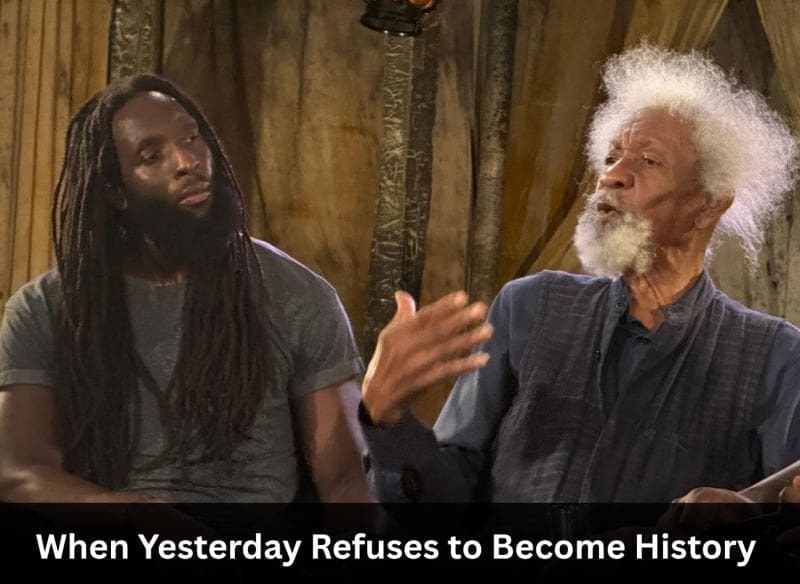
Written in 1958, The Swamp Dwellers feels less like a historical drama and more like today’s headline. Migration, environmental degradation, inequality, broken communities, hope, family, belonging and the endless search for a better life remain the defining questions of our age.
Although set in the Niger Delta, the play resonated deeply with many of us in the audience who have crossed continents in search of opportunity…
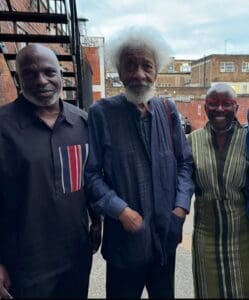
Soyinka, flanked by the author, Teju Kareem (left) and the director, Mojisola Kareem (right)
The evening has also heightened my anticipation for the 17th Wole Soyinka International Cultural Exchange (WSICE @92) under the theme “Culture Beyond Borders,” where another powerful theatrical offering, Esther’s Revenge, will continue this enduring conversation about memory, justice, identity and our common humanity.
And then there are evenings that quietly become part of one’s personal history.
Last night in Sheffield was one of those rare moments.
I had the extraordinary privilege of sitting shoulder to shoulder with Professor Wole Soyinka as Utopia Theatre staged his timeless classic, The Swamp Dwellers.
As the house lights faded and the stage came alive, I found myself completely absorbed—not only by the remarkable performances, disciplined dramaturgy and technical finesse, but by a thought that never left me: every line spoken, every conflict, every silence had first lived in the imagination of the quiet man seated beside me nearly seven decades ago.

From time to time, I stole a glance at the Nobel Laureate. His unwavering attention, the subtle movement of his eyes, and the occasional twitch of recognition spoke volumes. I was not merely watching a play; I was watching a playwright witness his own words come alive through another generation.
What struck me most was the frightening relevance of the work.
Written in 1958, The Swamp Dwellers feels less like a historical drama and more like today’s headline. Migration, environmental degradation, inequality, broken communities, hope, family, belonging and the endless search for a better life remain the defining questions of our age.
Although set in the Niger Delta, the play resonated deeply with many of us in the audience who have crossed continents in search of opportunity. Equally remarkable was how powerfully it connected with a British audience. Great literature, after all, begins in one place but ultimately belongs to humanity.
As Director Dr. Mojisola Kareem beautifully writes in the programme:
“This is not a play about the past. It is a play about now.”
I left the theatre reminded that the greatest works of art do not simply entertain—they challenge, provoke, disturb and ultimately deepen our understanding of ourselves.
The evening has also heightened my anticipation for the 17th Wole Soyinka International Cultural Exchange (WSICE @92) under the theme “Culture Beyond Borders,” where another powerful theatrical offering, Esther’s Revenge, will continue this enduring conversation about memory, justice, identity and our common humanity.
Some evenings, you watch a play.
Some evenings, you watch history speak—and you leave reminded that true masterpieces never grow old. They simply wait for each generation to discover how deeply they still belong to the present.
- https://www.linkedin.com/in/teju-kareem-1839b83b/