
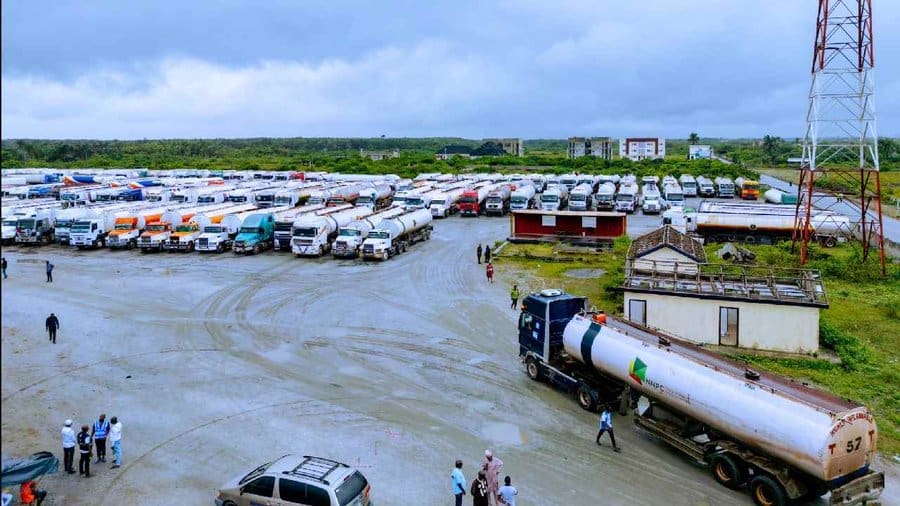
OIL marketers are considering increasing the pump price of Premium Motor Spirit (PMS), also known as petrol, to around ₦1,350 per litre, a move that could further strain households and businesses already facing rising living and transportation costs.
The proposed adjustment comes as Nigeria’s petrol supply continues to rely heavily on the Dangote Refinery, while imported fuel contributes only a smaller share of the country’s overall demand.
According to data from the Nigerian Midstream and Downstream Petroleum Regulatory Authority (NMDPRA), six marketers have received approval to import a combined 720,000 metric tonnes of petrol, equivalent to about 963.5 million litres.
The approved importers include AA Rano, Matrix Energy, NIPCO, Shafa Energy, Pinnacle Oil and Bono Energy.

Industry figures reveal that the approved imports account for only a fraction of the country’s fuel needs, highlighting the growing role of local refining in the downstream sector.
Between January and May 2026, the Dangote Refinery reportedly supplied between 29.4 million and 40.7 million litres of petrol daily, meeting more than 90 per cent of domestic demand during most of the period.
Meanwhile fuel imports, ranged from three million to 24.8 million litres per day, mainly serving as supplementary supply whenever local production declined.
Industry stakeholders attribute the anticipated price increase to prevailing supply costs.
They note that pump prices could climb to about ₦1,350 per litre unless ex-depot prices decline significantly or other market interventions are introduced.
Market participants also point to relatively low import volumes, citing the increasing competitiveness of locally refined products from the Dangote Refinery and global geopolitical uncertainties affecting supply planning.
Although some observers have linked supply concerns to tensions involving Iran and the United States, industry data show that petrol imports have largely remained between four million and six million litres daily in recent months, while Dangote Refinery has consistently produced between 35 million and 40 million litres per day.
The NMDPRA is yet to release its full June 2026 fuel supply report. However, industry sources indicate that no new petrol import licences were issued during the month, with marketers continuing to rely on previously approved allocations.
The development reflects Nigeria’s ongoing transition to a market-driven downstream petroleum sector following the removal of petrol subsidies.
Since the commencement of large-scale operations at the Dangote Refinery, the country’s dependence on imported fuel has reduced significantly, with imports now accounting for roughly 20 to 25 per cent of total petrol supply, compared to about 55 per cent during the first quarter of 2025.
Energy analysts say the expansion of domestic refining has reduced Nigeria’s reliance on imports but caution that any increase in pump prices could trigger higher transportation costs, rising food prices and renewed inflationary pressures.
As of mid-2026, the Dangote Petroleum Refinery is supplying approximately 41.5 million litres of petrol to the Nigerian market daily, according to the NMDPRA.
The refinery has also achieved a crude oil processing rate of 700,000 barrels per day during performance tests, surpassing its original design capacity of 650,000 barrels per day.
The refinery has revealed plans to further increase petrol production as crude oil supply becomes more stable.