
I have always had a great love and admiration for Soyinka. He is the most prolific African writer (over 40 books) and probably the most sophisticated African writer ever— both in terms of stylistic complexity and thematic ambition. He has also written in every conceivable genre, except the short story; that is, drama, poetry, novels, autobiographies, essays, anthologies, and literary criticism.
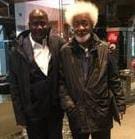
Photo: Tijan and Soyinka last time they met in New York.
I HAVE been thinking lately of my good friend, Wole Soyinka. I was hoping to see him in the U.S. this year but the current U.S. administration’s revoke of his U.S. entry visa signals the world of anomie we are in. I have known Bro Wole (as I call him) for over 45 years.
I knew him before he received the Nobel Prize in Literature in 1986, and we had corresponded from the days of snail mail in the early 1980s to this day by email; from when he was at University of Ife (Obafemi Awolowo University) in the eighties to when he was in the U.S. at various universities (eg, Emory University) to this day. He is the only African writer I have had that consistent interaction and friendship over a continuous stretch of time until his elderly age now of 91 years. And sometimes when he visited the U.S., he will let me know and we will meet, break bread and converse.
My last dinner with him was in New York when he was to give a speech at the UN and he asked for me to meet him to discuss our Africa World Museum and Library project for the Gambia, for which he serves as the Honorary Board Chair. I took the train from Washington, DC to New York and after a lovely lunch, we walked the streets and he showed me a street named after the late Moshood Abiola’s wife (Kudirat Abiola— Kudirat Street it was called) and he said he was once involved in campaigning for that. Moshood Abiola (thek progressive wealthy Nigerian businessman died under suspicious circumstances in 1998 while he was jailed by General Sani Abacha, Nigeria’s treacherous dictator, after winning an election for the presidency of Nigeria, and that same vile Abacha had also targeted Soyinka for elimination. Luckily, and thankfully, Soyinka was always one step ahead of that treacherous scheming tyrant.

I have always had a great love and admiration for Soyinka. He is the most prolific African writer (over 40 books) and probably the most sophisticated African writer ever— both in terms of stylistic complexity and thematic ambition. He has also written in every conceivable genre, except the short story; that is, drama, poetry, novels, autobiographies, essays, anthologies, and literary criticism. His writing has ranged from those with broad appeal, such as his play, The Lion and the Jewel, to those of beautiful but thematic complexity, such as Death and the King’s Horseman. For me, the zenith of his poetic achievement is in his epic poetry collection, Ogun Abibiman, where he wrote beautiful poems, employing heroic language, aimed at the South African liberation struggle against apartheid.
Although the poems message was time sensitive—a poetic grenade aimed at apartheid then, its enduring quality is in the mythic language that he employed. In fact, I find myself even now returning to that book and reading and re-reading it several times because of its majestic, inspiring language.
Consider these elegant lines from Ogun Abibiman where Soyinka captures the challenges in bringing an end to apartheid— from futile dialogue with the proponents of apartheid to advocacy for sanctions against it to protests and the often brutal responses that came from the apartheid regime against black and other non-White protesters, culminating in the Sharpeville massacre, which South African poet, Dennis Brutus, called “bullet-in-the back day.” Soyinka’s lines resonate with alliterative vigor and vibrancy:
Sanctions followed Dialogue, games
Of time pleading.
And Sharpeville followed Dialogue.
And Dialogue
Chased its tail, a dogged dog
Dodging the febrile barks
Of Protest—
Then the poet moves on with his skepticism about the ways the apartheid regime engaged in, what the poet Langston Hughes calls in his American situation of, a “dream deferred” by employing violence and intimidation against those that wanted to transform it. Soyinka’s poem continues:
For Dialogue
Dried up in the home of Protestations.
Sanctions
Fell to seductive ploys of Interests.
Twin to dry-eyed arts of Expediency.
Diplomacy
Ran aground on Southern Reefs…
Pleas are ended in the Courts of Rights. Hope
Has fled the Cape miscalled-Good Hope.
The end of that poem is the most beautiful lines of poetry I have ever read, as Soyinka employs African poetic devices of repetition and homey images to build to a climax:
We speak no more of mind or grace denied
Armed with secret knowledge as of old.
In time of race, no beauty slights the duiker.
In time of strength, the elephant stands alone.
In times of hunt, the lion’s grace is holy.
In times of flight, the egret mocks the envious.
In times of strife, none vies with Him
Of seven paths, Ogun, who to right a wrong
Emptied reservoirs of blood on heaven.
Yet raged with thirst—I read
His savage beauty on black brows,
In depths of molten bronze aflame
Beyond their eyes’ fixated distances—
And tremble!
The employment of the image of the Yoruba god, Ogun (god of war and creativity, of metals, restorer of rights, and the one that goes first) demonstrates Soyinka’s capacity to employ “romantic gloriana”— that mantra of self belief and faith in one’s ancestral heritage, which can be a potent armament to fight against the fleeting and subjugating forces of internal colonialism that was apartheid.
Of course, Soyinka is not the only African who has received the Nobel Prize.
Prior to receiving the award, a white South African physician, Max Theiler had received the Nobel Prize in Medicine in 1951 and the South African Albert Luthuli had received the Nobel Peace Prize in 1960. The significance of Soyinka’s Nobel Prize is that he is the first African (and a black African for that matter) to get it in Literature, an intellectual discipline and not just a peace prize, which is not a trivial achievement. Subsequent “African” receivers of the Literature prize following Soyinka’s footprints has included Nadine Gordimer (South African), Naguib Mahfouz (Egyptian), J.M. Coetzee (South African), and Abdurrazak Gurnah (Tanzanian/Zanzibari).
When Soyinka received the prize, I published the following poem in the African Literature Association Bulletin, Fall 1986, Vol. 12, No. 4 as a tribute in his honor and in celebration:
A Tribute
(For Our First Literary Nobel, Wole Soyinka)
Wole, October has a way of curling in the grass
And commanding the world to see black genius.
You have long been a griot, pedantic in nerve,
With a hands-on-plow view of our history.
You dig deep into the hieroglyphic of Ogun,
That warrior, who mixes metal with creativity,
Who restores rights, whose power overwhelms
Our earth. You have restored one more stone
To our black temple. Now, we must celebrate,
For our earth respects the foot-to-foot
Celebration of life: The celebration of
Birth and Death; of victory and failure;
Of man rising without a wet-eye from
a world
That taxes our continent more than
It spends on its soul-success.
Wole, October does not come to a black soul
With luck. Your genius is not Foreign Aid,
Or the log-rolling behind awards.
You earned your reputation like
A poor farmer earns his yam-crop.
You earned it,
Against the fickleness of the sky,
Against the capricious will of locusts.
You earned it with a mind that is strong
And rich and imaginative as the
Numerous facets of Ogun. You earned it,
Against a sky that has turned white and clear,
Whose myopic eyes can only see
The tallest gods in our literary farm.
On this October, Wole, we celebrate your genius.
In addition to this celebration of his Nobel, in April 1992, the Egyptian polymath, Dr. Ismail Serageldin, then a Vice President for Environmentally Sustainable Development at the World Bank asked me to join his committee to organize a conference on “Culture and Development in Africa.” Ismail asked me to help get Soyinka for the event and I helped bring him in as the Keynote Speaker.
Many prominent African and non African scholars participated in that conference, including Professors Ali Mazrui, Sulayman Nyang, Francis Deng, Robert Putnam, Robert Klitgaard, Ellen Johnson Sirleaf (long before she became president of Liberia) and then Secretary General of the OAU, Salim A. Salim. It was a rich event and papers presented were published subsequently into a book titled Culture and Development in Africa. Soyinka gave a brilliant speech, which kept the audience spellbound and, in the end, to a standing ovation.
Soyinka has had various intellectual debates, sometimes quite acrimonious with Professor Ali Mazrui over his documentary series, The Africans: A Triple Heritage, and over an earlier encounter while both had served as editors of the then Makerere, Uganda based publication, Transition. Mazrui had argued that the contemporary African identity is a synthesis of three influences— Indigenous Africa, Arabo-Islam and Euro-Christianity— this he dubbed Africa’s “triple heritage.” Soyinka had accused Mazrui for denigrating indigenous African religions and privileging foreign religions, such as Islam, in his documentary aired over the BBC and the U.S. WETA channels.
The triple heritage idea, of course, had a longer ancestry in the works of Edward Wilmot Blyden in his book, Christianity, Islam and the Negro Race, and subsequently in President Osagyefo Kwame Nkrumah’s book, Consciencism. More recently, our own friend and brother Professor Sulayman Nyang had harped at the idea in his book, Islam, Christianity and African Identity. Soyinka also challenged Mazrui for his dalliance with the early rule of Idi Amin, providing intellectual rationalizations for a dictator until Mazrui had the brutalities of Amin directed at him, first with the arrest of the Makerere University Vice Chancellor Frank Kalimuzo and then Mazrui had to flee from Uganda for the U.S. Despite their debates— and Mazrui expressing personally to me his frustrations with Soyinka (I recall Mazrui saying to me, “Tell your friend, Wole, to stop abusing me in public…), the two remained cordial in relations when they met, and Soyinka wrote a short memorable tribute in Transition to Mazrui after his passing, noting, “I already miss him.” This showed the humanity of Soyinka.
Soyinka’s humanism and humanity shines also when he spoke out against tyranny in the Gambia and elsewhere in Africa. When President Yahya Jammeh was removed from office by the Gambian people through the ballot box, Soyinka sent me a celebratory note. Jammeh, whose tyrannical rule Soyinka had often spoken against about, reflected his long detestation of African tyrants from Idi Amin, to Jean Bedel Bokassa to Sani Abacha and to Yahya Jammeh. Soyinka’s email to me reflected his elation. The subject title of his email to me was sartorially called “Yammehexit” a play on “Jammeh-exit”—or the more topical then of “Brexit.” His message went:
Needless to state, my mind has remained in your direction over the past few months. No anxiety, no nail-biting, not one scintilla of doubt – this was it, at last! The end of two decades’ nightmare for a people, and yet another lesson for the continent’s tenacious monsters. We’ve done more than merely watch our government for a wrong step, but there was no need. This psychopath was gone, his blustering merely pathetic, his future destined to be Charles Taylor’s companionship in penance. That is next.
How alienated this one pitiably was. Did he really think he stood a chance? After Gbagbo?
I am due in Dakar sometime soon, and I know I shall not resist crossing over to the Gambia, just to get ‘a feel of how it feels’. I share your elation – indeed I vicariously wallow in it. I hope you are well, and your tenacious brother especially. Now to dig up a few things I had written in the past about this hallucinogenic ghoul.
Stay well. Luxuriate in this moment. You’ve all earned it, dearly.
Wole Soyinka
He was in celebrative joy with the Gambian people. In another email, he sent me, in a portion of the email, he noted:
Glad this came through, if only to be able to crow with you over the departure of the Maximum Ruler of Minimum Space. Let’s hope the continent has seen the last of his kind.
WS
He was giving an apt description of Jammeh’s absolutist reign in the Gambia, which he described as “maximus” of “minimum space” but still hopeful that maybe Africa will wisen up and make this type of cancerous leadership a thing of the past.
 I have a lot more to write about my good buddy, Wole Soyinka. Our letter and email exchanges alone, over several decades, is sufficient for a full length article. I will save that for another day. Let this be only an appetizer-narrative to our enduring friendship.
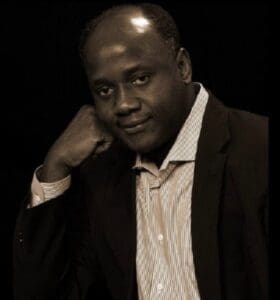
- Tijan Sallah, Gambian poet and prose writer and economist, is award wiring author of several poetry collections, including: When Africa Was a Young Woman, Calcutta, India: Writers Workshop, 1980, and; I Come From a Country, Africa World Press, 2021
———