

Professor Ladiípọ̀ Ayọ̀dèjì Bánjọ (1934–2024) was a Nigerian academic, grammarian, and administrator. I knew him, while I was a student at the University of Ibadan, as a quiet presence whose tall and sturdy frame showed up at the corridors of the Faculty of Arts a few times during the session. He was, I believe, already an emeritus professor by this time, so he only showed up a few times to help PhD students and other administrative duties. Later, I would encounter him as the Chair of the Board of Trustees of the NLNG’s Nigeria Prize for Literature. It was there that I finally got close enough to him to chat with. But his reputation always preceded him, both as an administrator (he’s the only Nigerian, as far as I know, to be the Vice Chancellor of a university more than once). What interested me more about his work, however, was his role in the documentation and codification of Nigerian English as a full variant of the English language. More than any Nigerian I know, he’s done a lot of pioneering work in that space, such that when I worked on the Nigerian English project at Google, his work was quite helpful in our understanding of the Nigerian English phonemic inventory. Sometime during the pandemic, I reached out to him for an interview, and he agreed. The following, slightly abridged, is a result of our conversation on his work, his opinion on the Nigerian educational system and language policy, and his recommendation regarding the Yorùbá language orthography. This continues a series of conversations I’ve been having with people whose work in language interests, inspires, or fascinates me. The conversation is slightly abridged.
Hello Prof, good afternoon sir

Good Afternoon. It’s good to see you.
Thank you for agreeing to this interview at such short notice. I have wanted to talk to you for a long time. It just occurred to me that Covid has kept everyone in one space, it might be easier to just come directly to you via the computer and that is what I’ve done. Thanks for your work over the years.
It’s a great pleasure for me.
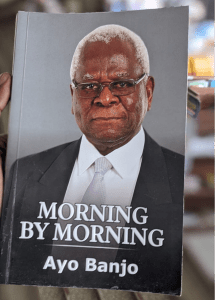
I just finished reading your autobiography Morning by Morning. But your book An Overview of the English Language in Nigeria proved quite useful while I was working at Google on the Nigerian English project. Thank you very much for that. But let me start this conversation from your background. I think you mentioned some of this already in your books. What literature did you read as a child, was it all in Yorùbá or was it all in English before you even went to school.
You mean at the very beginning, primary school?
Yes
Well, I went to a primary school, which as it goes was quite different from many others. Because the primary school was located inside St. Andrew’s College, Ọ̀yọ́. So, everything was properly planned out, education in Yorùbá preceded education in English, as part of deliberate planning. And in fact, I was so lucky that in my first few years of primary school, my headmaster was D.O Fágúnwà.
Oh really?
Yes. So, in the classroom and outside the classroom we followed him around and he told us all kinds of fabulous Yorùbá stories. Later, I found out that one of them, Ògbóju Ọdẹ, was published in Yorùbá.
I started off in Yorùbá, we memorised poetry, Yorùbá Poetry. We would come in front of the class and recite. We did that for the first two/three years, while we were learning English of course. Although, most of us were children of the teachers at St. Andrews College and we already spoke some English but we switched properly into English after two years and we started reading Literature in English.
In those days, of course, we were doing pretty much of what most of our age in England were reading.
That’s similar to what National Policy on Education recommends now which is that children should have access at the earliest stage to learning in their own languages before switching to English. Was the medium of instruction in school just Yorùbá at the time, and was English just a school subject?
It was a long time ago, but I believe it was in Yorùbá before we switched back to English.
In your own opinion, how did that influence your mastery of English at a later stage in life, because many parents today, the excuse they give (even abroad, you hear people say this) is that children who are exposed to different languages from the start or who learning their own language before English might get confused when they are picking up English. The assumption is that teaching them their own language at home will hamper their capability with English.
But your case is not the same, is it? Even the Ṣóyinkás, the Achebes, and people who grew up learning their own language from the beginning and then switching to English ended up being great representatives of English language acquisition and use. How do you think that affected your own acquisition of languages?
I think, and I suppose the aim of the policy on education was to make bilinguals out of Nigerian children. I was brought up as a bilingual, so when we switched over to English, It was all very well with me.
The Yorùbá beginning I’ve never forgotten. Some of the Yorùbá poems, we use to go to the front of the class and recite. I still recite to myself few days ago. I’m grateful for that because many other people were thrown into English from the first day. Of course, they must have lost a lot because I don’t think they would have grasped what was going on as much as they would have done in their mother tongue.
Learning other subjects in the mother tongue as you know is far more effective. Battling with learning a language and battling at the same time in that language that you are trying to master. I imagine it’s a very difficult task for people who have to do that, as they used to say ‘straight for English’, which is a pity.
You are still as capable in Yorùbá as you are in English, as a full bilingual. Today, when we look at children and the way they are being raised, my son goes to a private school in Lagos. They teach them English, the medium is English. Most Nigerians, the middle-class children, already speak some English before they even go to school, the education just becomes straight to English.
But it becomes a problem for them to learn their own language(s) because everywhere they go, at home, we want to speak English to them to provide reinforcement. When they go out, all their friends come from different ethnic backgrounds so to communicate, they need to use English. You realize that these children become disadvantaged in their own languages. You didn’t have that problem. Do you think that is a problem for the coming generation?
I think so. The remarkable thing, again in my own case, was I had a father who was a graduate. We always spoke Yorùbá at home. We never spoke English at home. In fact, some people have asked me, your name is Ayọ̀, I said yes. What does the ‘L’ stand for, and the answer they guess, they say Loyd. I said it’s Ládiípọ̀. They asked, ‘your father never gave you an English name?’. No. My dad didn’t give any of us an English name, none of us.
The duality of culture I suppose has been bred in us from the beginning.
This leads us to a part of our policy and how it has affected education in Nigeria. I read your assessment on the growth of how Nigerian English became a thing; the process and problems over the years, and the perception that the problems of learning English has eventually affected the quality of education in Nigerians.
I’m curious about that, wondering if there’s a link between the problems we have had in the past with the policy on education, the transition we have had from our own language to English, and overall policy on education in Nigeria itself and how you think we can solve it.
Well, you probably will, I’m sure, have heard of the Ifẹ̀ experiment where Mrs Macaulay was employed to teach the experimental class in English while the regular run-on classes went on in Yorùbá.
The group that was taught in Yorùbá was followed through their primary school career, secondary school and the university. Somebody followed them from the Institute of Education here and found out that they performed much better than those who followed the normal run of English.
Of course, there were problems of terminologies in Yorùbá for different things and people have been working on that for a very long time now. There is a Yorùbá Studies Association trying to bring out a dictionary of technical terms. I don’t think they have succeeded entirely because some of the equivalence for English that they suggested in English was a bit clumsy.
Where there was a ready equivalence in Yorùbá, that was alright.
I think the Ifẹ̀ experiment has shown clearly that people who are taught throughout in Yorùbá had superior spoken English to other people because Mrs Maculay spoke very good Nigerian English and there was the only module that they had to copy. The other people were misled by the pronunciation of their teachers.
Definitely, I think it has been proven, that beginning education in all of the primary schools in Yorùbá in this part of the country is superior. We have been telling the Government of Oyo State as it was then (and now split up into smaller states) that they should accept this and impose the policy on schools in Western Nigeria. For some reason, they haven’t done that.
Every time I’ve heard about the Ifẹ̀ project, we hear that it succeeded, but it has never been recreated. It became just a reference point to a good thing we did one time. But if it was successful then, why don’t we bring it up again? Do you recommend that something like that should be done for other parts of the country as well?
I believe that’s what one of the problems is. The slow ones drag back the fast ones. The idea was that if we do this for Yorùbá, what do we do for the Hausas and the Igbos and so on. That actually is the problem.
THE problem is also something I want to get your opinion on. You’ve been the Vice Chancellor of the University of Ìbàdàn for at least two terms. In a country of so many languages, where each region has developed in different ways and different paces, how do we have a national policy that on one hand empowers the local languages and lets them develop and provide education and opportunities for the people who speak them and still maintain a national ideal that we want where people don’t feel left out in any way?
We have tried English as a medium of instruction and then local languages as a way of providing unifying role but it didn’t stop Nigeria from fighting a civil war in the sixties, so the language itself is not the issue in our quest for unity. So how do we make sure that we can still pay attention to the multilingualism that we have and use it as a positive advantage for education especially?
All kinds of suggestions have been made by linguists and other scholars as to how one might approach that. The problems that loom around in the background are that of an indigenous lingual franca within Nigeria itself and indigenous languages. Of course, that is most likely to be resolved because it depends on what criteria you use. Some people would say more Nigerians speak Hausa than any other language by the virtue of the large population of the North. Others ask how developed is this language in comparison with Yorùbá for example.
The Yorùbá have been publishing newspapers from way back and they are used to these things. The rate of people learning a language other than their own, I think with the rate at which this is going on, with Lagos at the center means many more people already speak Yorùbá as their second language.
This runs into politics. What was suggested that I agree with is that we should solve the problem piecemeal. Some of these ideas have filtered into the language in education to say in the first two years when people are supposed to be using their own language. One other language that has been recognized is the language of the immediate environment.
If your language is too small, or you are in a place like Lagos or Ìbàdàn with a small mother tongue of your own, then, you have to learn the language of the immediate environment because nobody is going to create schools for ten/twenty people.
Fortunately, children pick up language more easily than adults. The load is what some people are worried about because of what it means for those who speak these smaller languages. You can not throw out their language altogether.
They already speak it anyway, then, they will master let say, in a case of Lagos or Ìbàdàn, Yorùbá. When, eventually, Nigeria resolves its language problem and has an indigenous official language, then they will have to learn that. Then, people will be able to decide to learn four or five languages, although there are people already in this country who speak as many as four to five languages. But that is a problem at the moment.
The speakers of the bigger languages had an advantage. Although they too are forced by the policy on education to learn another major language. If you are Yorùbá, you must learn Hausa or Igbo and vice versa. But still, the speakers of the minority languages have a bigger task to perform. We haven’t resolved this. The policy is there but everybody is doing what they want. There is no concerted effort to make something out of this.
Even the policy is not implemented across the board. The private schools do whatever they want, and it’s only in the government schools where they try and pretend to do what the policy says, still hampered by a lack of resources.
But they allowed the French to come here and run their own schools. To my shame, I have a small niece who’s attending one of these French schools in Lagos. Not a word of English is spoken there. Everything is in French. I told the parents “Aren’t you making life more difficult for this girl?” because the problem that I mentioned before, she’s learning algebra, she’s learning history, etc, and at the same time, she’s struggling with the French taught in these subjects.
The mother said she would prefer for her to do that and I said she must be prepared for her to have a tough going because it’s not going to be easy at all.
I’ve also wondered why we haven’t had private schools that teach and use Nigerian languages as the medium of instruction. I mean we have French, we have Turkish schools, we have English medium schools. I was in Wales a couple of years ago and one of the things that impressed me was how they had revived the language.
We have Welsh-medium schools and people from English language backgrounds do go to those schools, and do well.
That, maybe if one private person can actually show how a private school can work, for instance, using Yorùbá, as a medium of instruction, many more people will start putting their children there and you’ll realize that the same child would go ahead and pass WAEC and do well because they have understood the concept really well. Maybe that is what we need; private intervention.
Yeah, that’s possible. I think we’ve had a number of people at the University of Ìbàdàn here who wrote their Ph.D thesis in Yorùbá. That has happened. So, if we can do it at that level, why we can not have Yorùbá in this part is because things would be done easier if you are taught in your mother tongue.
YOU mentioned something earlier, Yorùbá language publishing, which is something I always wanted to get to. I’m currently a research fellow at The British Library. I’m back in Lagos now but I was in London for a couple of months. One of the things I came across, and it was a delight for me, were copies of Ìwé Ìròyìn that were published in 1891 in Lagos. These were newspapers like you mentioned that were published in Yorùbá and in English. It was interesting to me to see the newspapers had one page in Yorùbá, and another page in English beside each other, and are not translations. You can’t think of that today, something that people can buy and use.
Also, in the early days of the British colonial time in Nigeria, there were a number of publishers who published in indigenous languages. Fágúnwà was published by Nelson, and many of the early Yorùbá language publishers were British/English expatriates.
When they left, many of the Nigerian indigenous publishing houses kept doing some of those things for a while. There was Oníbonòjé, and a number of Yorùbá language publishers; in books, in fiction and all of that. Adébáyọ̀ Fálétí and the rest of them. But over in the 80s, or maybe shortly before then, there has been a drought of new work published in Yorùbá by Nigerian publishers.
Now if you see a new book published in Yorùbá, it’s either it’s likely self-published. There is no thriving industry in Yorùbá publishing, there is no original work. We can’t find a Fágúnwà anymore in today’s world.
What has happened to us, and what do you think can be done to bring back a thriving industry?
Well, I suppose Nigerian publishing houses would complain of readership — if you publish in English you publish thousands, if you publish in Yorùbá you’ll sell hundreds and not thousands.
Number two. Oxford University Press which became University Press Limited pursued this policy of encouraging publications in Yorùbá. I think they are still pursuing it, it’s just that maybe they don’t have enough resources.
I know that in the past when Reverend Titi Sólárù, he was the first publisher of University Press, he actually went out of his way to look for manuscripts in Yorùbá. That is out of interest because other publishers want to make a profit and this doesn’t make them do that. I don’t know.
The other problem of course which you must be aware of is the problem of orthography. That was argued backwards and forwards but still in my view, we still don’t have a standard orthography for Yorùbá. That is not a good thing, that has to be resolved somehow.
On the orthography, I know that after Bámgbósé did a kind of revision in the 60s, there hasn’t been any major change to the orthography. Do you have any suggestions as to what we should do to the Yorùbá orthography to make it more universal?
I have my own private ideas.
I would like to know them. If you don’t mind.
I think, basically, Yorùbá orthography should be based on morphology rather than phonetics. What is bothering Yorùbá is that in writing you want to signify every sound.
In fact, if you go for the orthography, the problem is largely removed because the orthography if you go by way of morphology will not be like musical notation which is what people go for rarely.
If you go by morphology, just as in Yorùbá. If I say ‘he wasn’t here’ there is no ‘z’ in the orthography. ‘s’ are. People will get to know how they appear.
If you are a Yorùbá person you’ll know how that translates in phonetics and phonology. I think that’s what we’ll want to do because there is over attention paid to every single sound of Yorùbá. They will want to capture it. It’s like musical notation.
That is a broad suggestion that I have made but the matter is still being discussed here and there.
Have you written or do you intend to write about it?
I must have done it many years ago.
I will look for it. One of the things I’m working on currently is on a webinar at the British Library to bring people who are interested in this particular subject, orthography. I was thinking of Túndé Adégbọlá, yourself, and other people, Karin Barber who are working in publishing and in writing of Yorùbá.
[Note: the conference eventually happened in September 2020, and can be found on YouTube here and here].
I know that there are a number of problems with the language. Not just with the orthography but also the modern way of writing it. My work has involved the technology for putting appropriate diacritics on Yorùbá words. There are many people who don’t know that skill of putting the markings on words in the first place.
The other way out point of view, and I’ve heard some people strongly defend it, is that we don’t need any tone marks on Yorùbá. Any Yorùbá person would read properly without tone marks. The example that they put forward is the Bible. That’s something elaborate enough and the priest will read the gospel and everything and they will read it flawlessly.
One may wish that we should just do away with it and write like in English, but there’s the issue of tone and ambiguity that make that problematic. Nobody who’s confronted with the text for the first time, even as a preacher, would be able to read it, I think. I think it’s true, however, that Yorùbá does need a new way of writing that can better capture and help other people to be able to write the language.
When I was doing my post-graduate, I once suggested it, although I haven’t given it more thought, because I did comparative studies on Yorùbá and English. I was suggesting a few ideas, and this that I just told you about is one of them.
If we are going to promote literacy in Yorùbá we have to find a way, making it possible to read Yorùbá fast.
It’s true because tone-making, as it is today, slows you down.
You look up, you look down, you look for the tone mark of small dots before you go ahead.
I said nobody has tried it, but maybe a syllabary would be better for us instead of individual sounds. But I don’t know when we’ll get around that.
People who are Yorùbá scholars who are proficient in Arabic would be able to tell us exactly. Because in Arabic, I understand, they reflect the consonant and there is a way of working out the sounds…
I’m glad to say that the language that’s receiving the greatest attention is still Yorùbá. The Igbos can’t agree on orthography at all. The Hausa-Fulani, I think, are familiar with the syllabary system. And then now they go for the Roman script.
One of the things I’ve also noticed over the years is that when Yorùbá words are used in English writings by Nigerians, they write it like Roman letters. When the names are written on the front page of a book, they don’t have diacritics there, but when a book by Bámgbóṣé is published, all of a sudden the diacritics appear — because he’s a linguist and he’s writing about Yorùbá studies.
I’ve always wondered why the language is written in two different ways by the same people who speak the same language. Professor Sóyínká sometimes, diacritics on his titles, sometimes in his writings, he doesn’t. Publisher issues, perhaps.
Most modern writers don’t use it at all. Even if they write a Yorùbá word they don’t mark them but if you write in French or German, they put all the accents and umlauts, and I’ve always wondered what kinds of things influence those kinds of decisions.
Did it occur to you during your writing when you use a Yorùbá word within an English expression? Have you ever wondered “Why am I not or why should I use diacritics?” Or should it be only with when you are writing fully in Yoruba — as in, Yorùbá text?
Well, I haven’t thought of this before. I think most people won’t if they are writing English. Occasionally, when they mention Yorùbá names, they put the accents and the sub dots but on the computer we have to develop a Yorùbá font but people have not gotten used to doing that but there is no reason why they shouldn’t.
I’m trying to remember now what the late Professor Babalọlá did because he… He was my teacher at Igbóbì college when I went abroad we still communicated and the first letter he got from me, at the back of the envelope I wrote from “Ayo Banjo”. Professor Babalọlá wrote back and said “banjo?” I didn’t put diacritics on the Bánjọ.
It’s very funny. I guess he would do the same in his books written in English. It’s just that we haven’t regarded the accent, subdots and everything as properly part of the words.
I think it is about time we did that. There can be confusion as you know when one name can be pronounced in two different ways. A few years ago, I discovered that names like Akínkúgbé is not Akínkùgbé but Akín-ìn-kúgbé, it’s negative.
But you’ll just write Akinkugbe and people would pronounce Akínkùgbé because there is no ways of indicating that there are two vowels there.
One of the things I found out when I was reading Professor Bámgbóṣé’s book [Grace to Grace (2012)] was that there were some names he was mentioning — of his teachers — that I could not pronounce. He didn’t put the marks on them and they are names I haven’t heard before, if there were names I’ve heard before –- if I see Yétúndé — I know it can only mean one thing, same as Ayọ̀. But these were Ìjẹ̀bú names, and I wondered why he, a Professor of Yorùbá, didn’t mark them. Perhaps, like we said, because the book was published in English and was not a scholarly Yorùbá text.
But there are several names that you don’t know and people who knew these names are passing on, or who didn’t teach other people how to pronounce them and we only see them in writing. We only figure out how to pronounce them if you go find an adult in the village. We do need to find a way of encoding the sounds in the writing.
Even if we go by the morphological way you mentioned, there has to still be a way of keeping the sounds in so that people, at least who speak the language, can find a way of — if I know the sound, I can guess what the meaning is.
Professor Babalọlá published I think Yorùbá Names.
I met his Daughter a couple of years ago. She lives in Lagos.
Mrs Désàlú?
Yes, Mrs Désàlú. I think she lives in the US now. But she used to live in Lagos. She has a school for kids, a Yorùbá school to make sure more students can learn Yorùbá in the holidays.
More questions.
You spoke about the English language use in the North as being taught as a foreign language at the early days of Nigerian independence while it was being taught in the South as a second language. We spoke it because we wanted to speak it to ourselves, but they (northerners) learnt it because they wanted to use it to speak to foreigners. That, combined with the fact that Hausa had a similar phonology with English, made sure that the Hausa speakers of English sounded more like the British than we did in the South. That was your theory.
Do you think that we should/could change our syllabus with the way we teach English in the South today? Do you think it would make/ improve the way people learn or speak English today?
Or has it changed?
Well, I think it is changing. If you read Musa Ali Jubril’s work, the history of the whole thing is that about a century ago. Maybe 90 percent of those teaching in the North were British. It’s a question of having a model to imitate, by that time the Yorùbá have taken over the teaching of English in the Yorùbá land.
That worked in favour of Hausa. Musa Ali now says that since the English are no longer there, they have been recruiting people from the south. People from Yorùbá speaking, Igbo speaking. Accents are now converging, that’s what he says.
We also have the influence of social media as well. Everybody watches the same TV, the same learning and blending into each other.
But we all still have to take the Test of English as a Foreign Language (TOEFL), which is where I’m going to with this question. Something that has bothered me for a very long time.
Over a hundred years since we’ve used and spoken the English language after the British came, dominated and taught us, etc, when we go abroad for schooling, we have to take this test that regards us as foreign speakers of English.
Do you think that TOEFL is justified or should it be resisted?
I ran into this problem myself when I went to UCLA for postgraduate work. A couple of students were there from Kenya also to do postgraduate work, a couple from all over the place. And we arrived and they said look, you have to do this test of TOFEL, and I said this is ignorance on the part of the Americans.
They must know that these other people went to English-speaking universities and took degrees out of there. What more is there to know to be able to follow lectures in America? People went up and complained, I had an easy attempt because I just went up and said I took my degree from Britain.
So they say, Ok, You are exempt.
These other people were taught by lecturers — the same kind of lecturers that taught me in Britain. I think it’s ignorance, really, if they know that you received your first degree in an English-speaking University. But it’s a different case if a post-graduate student turns up from Senegal or Benin Republic. Then, you want to be sure that they are well-grounded.
They should know that postgraduate students from former British colonies were taught at the university level exactly as undergraduates in Britain.
Do we need to change any government policy to make sure they know this because the knowledge that England colonized part of Africa is supposed to already be public knowledge? Do you think the government needs to do something?
When I went to UCLA, I had to do some courses in the English Department but the major part of my studies were conducted in the department of linguistics which was just starting off then. But I noticed that Clayton, who was the Professor of English was a very conservative kind of person.
People like him must have been responsible for these silly attitudes about people from English-speaking universities coming. Because he just refused to accept that unless that you are speaking pure British English or pure American English, you are not speaking English at all.
In fact, he was angry that the British were encouraging people to develop these domesticated Englishes. It’s not that he doesn’t understand it, but it’s just that he doesn’t think that it’s proper. I told him, you-yourself were a colony of Britain, you brought the language to America. And you don’t speak exactly as they speak today.
He was just a very conservative professor and I was glad I didn’t have much to do with him. I was in the Department of Linguistics.
THIS brings me to the syllabus we currently run in the country. My Master’s degree was in Teaching English as a Second Language, from Southern Illinois University, Edwardsville.
When I came back in 2012, I started teaching English at a high school in Lagos. I was a teacher for 3 years before I went to Google.
One thing I noticed — and I’d known this for a long time but I noticed it more closely when I taught the language — was that the syllabus is more based on British pronunciation, especially the Oral English element. When you say “choose the word that rhymes with so and so.” Nigerians say [plumber] but the English says [plummer].
If you wrote [plumber], you are going to get a zero. The way we put our stress, we say bamBOO for instance, English people will say BAMboo. We say admiRALty, and the British people say ADmiralty. These different stress patterns. We say spiRItual and they say SPIritual, etc.
And when you are teaching students, you tell them that if you don’t write it the way I want it, which is a Received Pronunciation, you get a zero, in 2012!
Whereas, the students who have become native speakers of Nigerian English, because that is what they have spoken all their lives, do not see their ways of speaking reflected in the syllabus, which is still imposing this prescriptive RP mode of speaking.
Do you think there is a problem there and how do you think it can be fixed?
I think the problem goes back to the term Nigerian English, which is ambiguous. Nigerian English can mean the totality of English spoken in Nigeria, sociological differences and so on. Or it can mean the Nigerian English which has been codified and used.
Because if we talk of British English, American, they are codified.
We haven’t been able to achieve full success in that, we have been making efforts.
We got a big grant one time and we were collecting data. After a while, the whole thing broke down. People have been publishing their own data in different journals. One man who has been very meticulous in gathering the data and publishing is called David Jowitt.
He’s a professor now in Jos. He has been publishing and just published a book which contains large quantities of the data. The thing is the dispute among Nigerian linguists in the 60s/70s is which is the proper concern of a linguist.
Do you want to describe the varieties of English spoken in Nigeria or do you want to concentrate on what I’ll call standard Nigerian English.
Some people then thought if you are teaching the word particular variety of English, which is the one you are referring to? Anybody who’s gone to secondary school speaks English and speaks it fluently but speaks it differently from the British or the American. That’s the thing.
Unfortunately, at that time, some linguists felt that you will be sub changing the purpose by teaching them a form of English that is only viable in the country. I suggested that when we are looking for qualification or the standard Nigerian English, we must recognize that there are various socio-dialect in Nigeria.
What the primary school boy or anyone who’s had primary education, the way he speaks is different from the way people who have done secondary.
This man, a lecturer at the University of Ibadan just roughly said every level of education would use a different kind of English.
If you are looking for the standard, or what should replace British English and American English, back then, we must recognize that there are various socio-dialects of English. Then, we find that from amongst this socio-dialect, which is the one, which should be adopted.
The two criteria I proposed were (1) Social acceptability; whatever emerges would be socially accepted and (2) International intangibility because that’s killing two birds with a stone. You are accepted and understood at home and you are understood abroad.
Creators wouldn’t have been saying this if we had developed this thing further and I was part of the effort to bring out a dictionary of Nigerian English. Nigerian English in the sense of standard Nigerian English.
A man called Peter Yang and I were working on this and when I went to Norway on sabbatical, we managed to get a grant from the Norwegian foundation. We are working on it.
The ultimate thing is if you say to somebody in Nigeria that we say that we don’t say this they would say show me the dictionary or authority.
I know of Roger Blench; his is the only dictionary I’ve found online on Nigerian English. It’s more like a lexicon, really, and we know Nigerian English is not just a lexicon; there is a stress and also the semantics where we use words. If you say ‘Give me the book nau’. The “nau” does not exist in any other variety of English. A British person will not understand what the “nau” is doing, even if it’s spelt like “now”. They read it as a command: “Give me the book now”, whereas it what I call a “wheedling particle.”
So, we do need an authority and how do you think we’ll find such a thing?
This research I mentioned is jointly done by Nigerian linguists. What we are aiming at is the first science of difference between Nigerian English and British English in the area of lexicography. Somebody is sitting on a chair. One goes to be ‘is sleeping/lying on the bed.’
All these things were mentioned and the favorite expression in those days which many British people in Nigeria easily understood was — if you ask of somebody and they say — “he’s not on seat” — it’s very strange to the ears of the British people when they come. I won’t be sure it hasn’t found its way into the Oxford dictionary.
Earlier this year (2020) 29 new Nigerian English expressions were added into the Oxford dictionary including “Next Tomorrow”. Many others haven’t been added that we use every day. Words like “senior brother” for ‘elder brother’, etc.
For home consumption, we’ll be there. But for the standard Nigerian English which is expected to be internationally intelligible when we do our dictionary, it would be there.
Anybody who likes, like the Australians, can adopt it, the Scots people can adopt it, etc. So, that’s our face on the world. The other thing is they are not of the same status as words which we use amongst ourselves and understand and sometimes it slightly goes into Pidgin.
And like I’ve said to somebody when I saw the latest admission to the Oxford English dictionary, I said well, maybe in the course of time, Nigerian Pidgin and English will co-allies.
The most informal use of English is the Pidgin.
There is a word they added: ‘sef’. That was definitely Pidgin, I don’t know why they decided that it was a Nigerian English expression. Nobody uses it in Nigerian English.
I guess we’ll wait for your publication on the matter, are you going to publish the dictionary?
My friend is still in Norway, and in fact, he’s been here just as I’ve been in Norway. We work together. He’s been there on sabbatical and the last time I wanted him to come so that we can continue, the university wasn’t cooperating. Otherwise, the work would have gone very far now.
We still talk about it. But as I said, Jawitt has been using much of the data.
Speaking of Universities, there are two more questions. I know that in the U.S, the first time I went to Illinois I was a Fulbright scholar at the foreign language department.
The question I noticed was that students in my class came from different parts of the university. They came from Marketing, they came from Law, they came from the sciences, Nursing, etc.
But during my undergraduate in UI, we had rules as to what courses you could take. You couldn’t go to social sciences and take a course for instance and somebody can’t come from medicine to take a Linguistics course.
Do you think that is a positive thing? You have been the Vice Chancellor of UI. Or do we need to make changes in these things in our educational space?
I think the American system is superior I must say. We’ve been inching towards it, the demarcation between departments at Ìbàdàn is no longer as rigid as it used to be. Since we opted for the course system, because that is how it used to be.
You can go to social sciences and take a course. You can go to Education if your base is English and I think it’s very good.
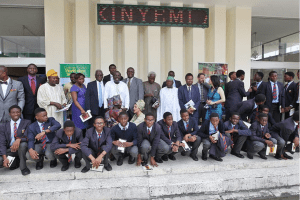
Prof. Bánjọ with students of mine during an event with the NLNG Nigeria Prize in March 2014
This one question I’ve asked you a number of times at the NLNG events. Let see if I get a different response this time.
It’s about creating an inclusive prize relating to language. NLNG’s Nigeria Prize every year awards for poetry, for drama, for prose, for children literature. But they were always in English as the language of entry. I understand it from the point of view that it’s the only language Nigeria recognizes as her official language. But also, I see it as a kind of limiting factor for the idea of the environment of literature we want.
We’ve spoken about how publishers usually don’t want to publish because they are afraid that they won’t find readers or people who want to buy it. But if there are prizes that award literature in these languages, there is a potential visibility in this work that can then create a market by itself.
Is there a possibility of creating widening criteria enough that work produced in Nigerian languages can stand a chance to compete?
Yes, in fact, it has been discussed several times at the board of the NLNG. You know in Nigeria, everything has a political attachment.
We got to the point of suggesting it, before we reversed it ourselves, that people can submit their work in any language. Just that we are interested in literature not in language. The question was then raised that do we have enough competent people to judge for instance an Ibibio scholar? How do we judge that and how do we compare it across languages?
Now we are dealing with one language, we can say this one is better than that one but if you are then comparing submissions from twelve languages, how do we deal with that?
If you do this again, Yorùbá would shoot forward. Lovely poetry, lovely novel in Yorùbá and people will complain that there’s preferential treatment. That’s why we left it as English literature.
Although, it’s not reflected in the title of the thing itself. It’s the Nigeria Prize for Literature. Why don’t we just be honest and say Nigeria Prize for English Literature?
Even the literature we did in secondary school is Literature-in-English. It doesn’t accommodate any other literature from any other part of the world or the country.
It’s a chicken and egg problem that somebody will have to find a way for African literature to thrive in. Maybe NLNG has to create another category. Who knows?
What the NLNG says in response to that is that amongst the other ethnic groups, they should have their own competition. A Yorùbá group should do prizes in Yorùbá.
The last question I have for you is this. What is retirement like for you and how do you spend your busy days?
Just as I was about to retire, I got drawn into all kinds of things. Immediately I was sent to Port Harcourt to be Pro-Chancellor and Chairman of Council. Immediately I finished that, I was asked to take over that post in Ìlọrin. I do that. And then, the first Anglican University, Àjàyí Crowther University.
I tell everybody (at Àjàyí Crowther University), even those who are old enough, that I’m the oldest person amongst you all. I was born here, my first ten years, I spent here. And then, I’ve been drawn into one thing or the other. The NLNG, Educare and now year before last year, I was chairmanship of the Nigerian Universities Commission.
A week ago, I was conducting the board meeting on Zoom.
You’ve been busy, you are not really retired then.
Sometimes I wonder whether it’s good.
We are glad to have you and contributing to Nigeria.
And one thing which I’m profoundly into is music. So, I started what we ambitiously called The Ibadan Philharmonic Society. We have an outing every six months.
Something ambitious, I’ll do it. The natural question has been when are you going to present music in the Nigerian Languages.
Very exciting
Thank You. I appreciate your time, thank you very much sir.
My pleasure.
_______
My earlier conversations with people, friends, and colleagues involved in language as professionals can be found on my medium page. This is the sixth in the series, preceded by Conversation with a Lecturer (Apr 1, 2022) Conversation with a Language Engineer (July 23, 2020), Conversation with a Polyglot (Feb 1, 2020), Conversation with a Philologist (February 19, 2020), and Conversation with a Conlanger (Jan 11, 2019).
[Interview transcribed by Precious Arinze]
- https://medium.com/@baroka/conversation-with-a-grammarian-prof-ay%E1%BB%8D%CC%80-ba%CC%81nj%E1%BB%8D-0db36cd71f41

