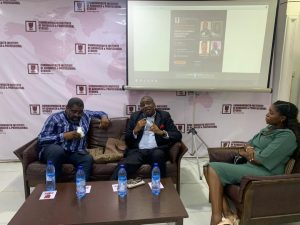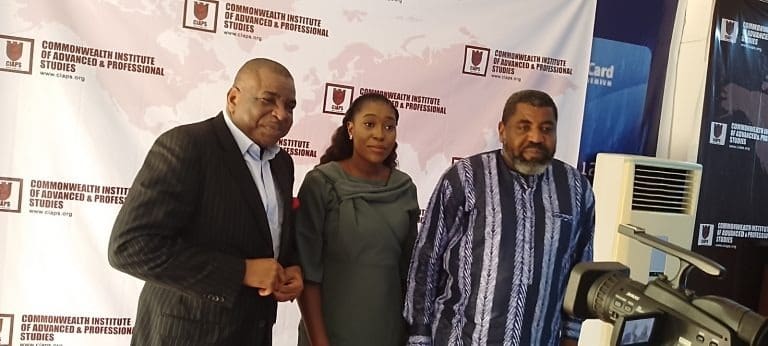
Caption: L:R, Onyibe, Vimbai Mutinhiri, a media personality and Prof Kila at the Trump 2.0 and Africa… in Lagos
MAGNUS Onyibe, an international public affairs analyst and Commonwealth Institute Scholar, has advised African countries and leaders to react positively to President Donald Trump’s policies.
He made the call in Lagos while delivering a lecture at the Commonwealth Institute of Advanced and Professional Studies titled “Trump 2.0 and Africa: Dangers and Prospects”. The hybrid event aimed at policymakers, business leaders, academics, and citizens from various African and Commonwealth countries who participated online and physically also featured Anthony Kila, a renowned political economist and Vimbai Mutinhiri, an International Broadcaster and Journalist.
Director of CIAPS, Anthony Kila, in his opening remarks, emphasised the Institute’s commitment to fostering meaningful dialogue on pressing global and regional issues. “This event forms part of our Roundtable Series and Open Lecture platform. “It reflects our dedication to shaping public discourse and influencing narratives to drive informed action,” Kila noted.

Onyibe, in his intervention, pointed out that the USA does not view Africa or Africans as a threat and that African leaders need to engage with the Trump administration to negotiate and reaffirm previous agreements with the USA. Donald Trump’s primary interest is to win back the lost ground that past administrations have ceded to countries like China. He urged African governments and businesses to position themselves to take advantage of the new realignment and world order that Trump was creating.
“Now is the time to reflect on Africa’s underwhelming role in global trade and find pragmatic ways to reposition the continent as a vital node in the evolving global value chain,” Onyibe stated. He added that President Trump’s sweeping tariff policies, while disruptive, are also catalytic, creating both risks and opportunities for economies willing to adapt.
The major problems Africa faces, according to Onyibe, are energy and infrastructure, and these are issues that limit Africa’s potential to succeed on the global stage. Onyibe, however, proposes that collaboration between African business and political leaders and their counterparts in the USA can help solve this issue, creating a win-win situation for both sides of the Atlantic. He pointed out that before China became a success story, it faced the same situation that Nigeria is currently in, adding that today China is a major producer of energy and the fastest-growing economy in the world.
Onyibe challenged US business magnates to consider Africa a frontier for economic expansion, paralleling President Nixon’s normalisation of US-China relations. “If Trump’s second term results in a decoupling from China, why shouldn’t Africa aspire to become America’s new strategic partner?” he questioned. To realise this vision, Onyeibe recommended that African governments prioritise: Trade facilitation – by simplifying customs procedures and eliminating bureaucratic red tape; Infrastructure development – investing in transport, energy, and digital infrastructure to support industrial growth and Business environment reform – enacting pro-investment policies and regulations to attract global capital.
Asked whether it is proper for the Trump-led administration to collect oil from Ukraine to prosecute the war with Russia, Onyibe stated that the practice did not start with the Trump administration. According to him, it was done when America defended Kuwait from being annexed by the late President of Iraq, Saddam Hussein, during the Gulf War.
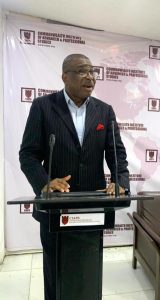
Onyibe speaking at the session