
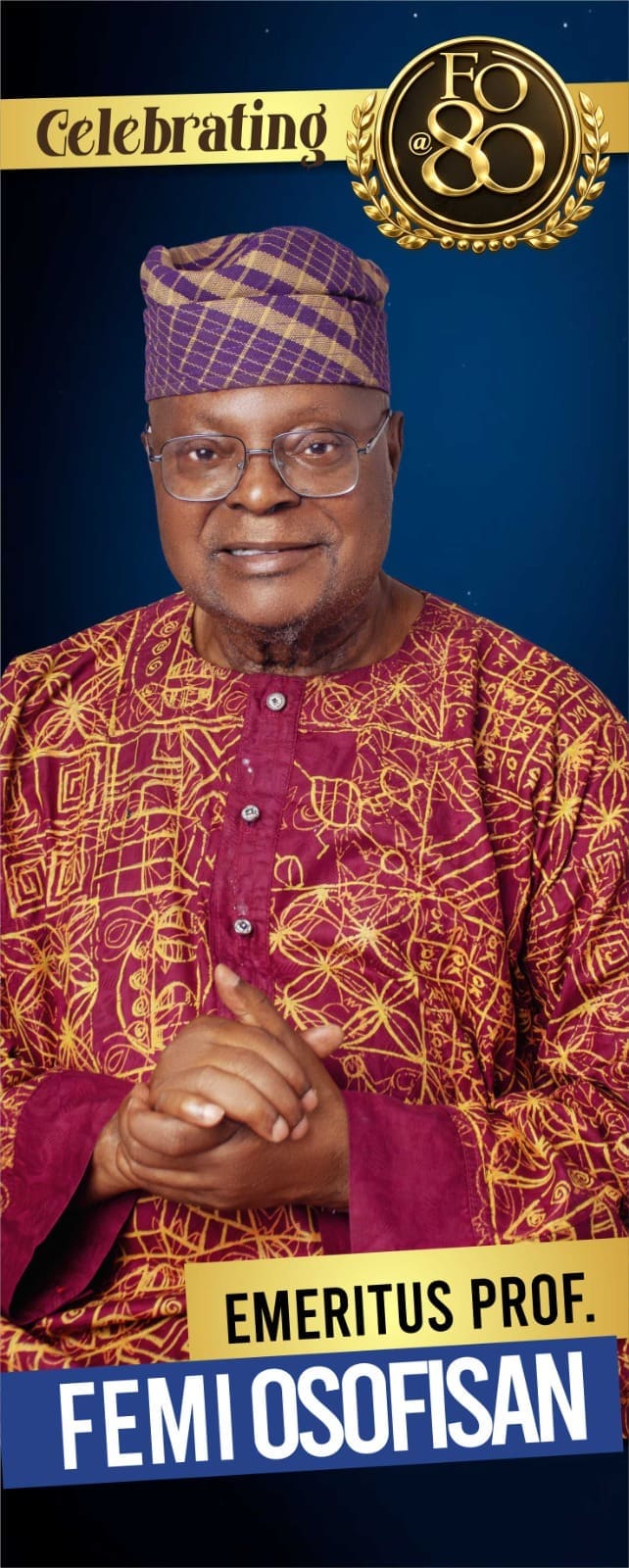
At 80, Femi Osofisan is not a relic to be admired from a distance but a living force, a restless imagination, and a conscience that refuses to be quiet. His legacy is not a single achievement but a way of being in the world. It is a way of thinking that is curious, critical, compassionate, and committed to the belief that Nigeria can still imagine itself anew. As we celebrate him, we are reminded that the work continues. The stage is still open. The story is still unfolding. The next generation, armed with his example, must now step forward to write the chapters he has prepared them for.
ON June 16, 2026, Femi Osofisan turns 80.
In a country where cultural memory is often fragile and where the arts struggle for institutional support, this milestone carries a significance that goes beyond personal celebration. It becomes a moment for national reflection. It becomes an opportunity to consider the meaning of a life spent in service to imagination, scholarship, and public conscience.

The phrase that best frames this moment comes from Osofisan himself. In 1982, he wrote a work titled Birthdays Are Not for Dying as part of The Visitors experimental television project for the Broadcasting Corporation of Oyo State Television in Ibadan and Ogun State Television in Abeokuta, in collaboration with the Unibadan Performing Company. The title is both a declaration and a philosophy. It suggests that a birthday is not a retreat into nostalgia but a renewal of purpose. It invites us to look at the living force of a writer who has shaped Nigerian theatre and letters for about six decades.
The question that naturally arises is simple. What is Femi Osofisan’s legacy at eighty? What is the one enduring gift he offers to younger Nigerians who must now navigate a world that is more fractured, more impatient, and more cynical than the one he inherited? The answer is not a single achievement or a single text. It is a way of thinking about art and society. It is the conviction that art is a civic instrument. It is the belief that theatre and literature are tools for social repair, ethical reflection, democratic accountability, and compassion. Everything he has written, taught, staged, or fought for flows from this belief.
A Life In Many Genres
Osofisan as a playwright has written more than sixty plays, a body of work that stands among the most extensive in modern African drama. His plays have travelled across continents. They have been staged in Europe, North America, Asia, and across Africa. They have interrogated power, mocked tyranny, mourned injustice, and celebrated the resilience of ordinary people. His versatility is not a matter of restless ambition. It is a deliberate strategy. Osofisan has always believed that the writer must reach different publics and speak in different registers.
But to describe Osofisan only as a playwright would be to diminish the scale of his achievement. He is a novelist, essayist, journalist, critic, and poet. Under the name Okinba Launko, he has published poetry that blends lyricism with political insight. Whilst his poems allow for meditation, his novels allow for introspection. The essays rope all these together in an enduring debate with other world writers.
Long before he became a household name, Osofisan was already a prodigy of the academy. In 1963, he won the 1st T. M. Aluko Prize for Literature as a secondary school student at Government College , Ibadan, and two years later, won the 1st Western Nigeria Broadcasting Service (WNBS) Independence Prize with the essay “Five Years Ago”. Little wonder then that he was awarded the Western State and Federal Government of Nigeria’s Scholarships to study French at the University of Ibadan.
His intellectual journey took him from the University of Ibadan to the Sorbonne in Paris, where he conducted research for his doctoral thesis before submitting it at Ibadan. His supervisors were Abiola Irele and Dapo Adelugba, two giants of African literary criticism. Their influence is visible in the rigour, cosmopolitanism, and cultural depth of his work. What is remarkable is the quality of his scholarship; Osofisan taught in three departments at the University of Ibadan – Modern European Languages, English Literature, and Theatre Arts. Few scholars have moved so fluidly across disciplinary boundaries, and fewer still have done so with such authority. In 1980, at the age of thirty-four, he became a full Professor. This achievement placed him among the youngest in the university’s history.
His academic career is a record of intellectual generosity. Generations of students have passed through his classrooms, with many of them now famous as playwrights, directors, critics, teachers, and cultural administrators. They carry with them the imprint of his discipline, his humour, and his insistence that art must always confront the world. His teaching style is remembered for its clarity, its energy, and its refusal to accept lazy thinking. He challenged students to read widely, to think critically, and to understand that the arts are not separate from society but deeply entangled with it.
The Theatre-Maker: Kakaun Sela Kompany
Before the fame and before the awards, there was the stage. In the 1970s, Osofisan founded Kakaun Sela Kompany, a performing troupe created to produce his plays with artistic independence and communal energy. It was a bold experiment in ensemble theatre long before such models became fashionable in Nigeria. The troupe brought together some of the most gifted performers of the era. Among them were Jimi Solanke, whose voice could fill a room with warmth, Demola Onibonokuta, a master of physical theatre, Yinka Ige, Demola Adeyemi, Didi Unu Odigie, Irene Orubo, and John (Johnny) Nwaobi, actors of rare emotional intelligence, and Tunji Oyelana, the musician whose compositions became inseparable from Osofisan’s dramaturgy.
Kakaun Sela Kompany was not simply a theatre group. It was a cultural movement. It staged plays in open spaces, experimented with music and dance, and treated theatre as a living civic ritual. Many of the ensemble practices now common in Nigerian theatre owe something to the innovations of this troupe. As Media and Public Relations guru Ohi Alegbe once remarked, the performance ethos was so simple that an entire play’s cast and crew, in 1984, toured universities in the Southeast with a Volkswagen beetle car. They performed The Oriki of a Grasshopper and The Engagement.
Osofisan’s relationship with journalism is often overshadowed by his literary fame, but it is central to his identity. He began his career as a journalist and later became one of the first board members of The Guardian when the newspaper was founded in 1983. His involvement helped shape the editorial ethos of a publication that would become a cornerstone of Nigerian public discourse. Throughout his life, he has used essays and columns to interrogate governance, democracy, corruption, and civic responsibility. He writes with the conviction that the intellectual must speak truth to power, even when power is indifferent or hostile. In a media landscape increasingly dominated by noise and sensationalism, Osofisan’s example is a reminder that journalism can still be a force for clarity and conscience.
Leadership in the Literary Community
Beyond his writing and teaching, Osofisan has played a crucial role in shaping Nigeria’s literary institutions. He served as President of the Association of Nigerian Authors and later as Vice President for West Africa of the Pan African Writers Association. These positions were not ceremonial. They allowed him to mentor younger writers, advocate for the arts, and strengthen the fragile infrastructure of literary production. His leadership style is quiet but firm. He does not seek the spotlight, yet he has been instrumental in creating spaces where others can shine. Many of today’s prominent Nigerian writers across drama, fiction, and criticism trace their early encouragement and mentoring to him.
Over the decades, Osofisan has received numerous awards both national and international. Among them is the Thalia Prize for Theatre Critics in 2016, which made him the first African to receive the honour. His plays have been staged in major theatres around the world. He has held visiting professorships, delivered keynote lectures, and been celebrated in festivals and conferences. Yet he remains characteristically modest about these achievements. For him, awards are acknowledgements rather than destinations. The work itself, the writing, the teaching, and the mentoring, is what matters.
The Yoruba Imagination
One of Osofisan’s most significant contributions is his transformation of Yoruba performance traditions into a global intellectual resource. His plays draw on Yoruba cosmology with its complex moral universe, on masquerade traditions with their fluidity between the living and the ancestral, on oriki with its celebration of identity through praise and memory, and on communal ethics where the individual is always accountable to the collective. He does not merely borrow from Yoruba culture. He reinterprets it and uses it to interrogate contemporary political realities. In his hands, Yoruba performance becomes a lens through which to examine corruption, tyranny, memory, and justice. This cultural grounding is not nostalgic. It is strategic. It allows him to speak to global audiences while remaining rooted in local histories.
The One Enduring Legacy: Theatre As A Civic Instrument
If we must identify one legacy that captures the essence of Osofisan’s contribution, it is the conviction that art is a civic instrument. In a society where the arts are often dismissed as entertainment or luxury, Osofisan insists that theatre is a public square. It is where citizens confront power, where communities negotiate memory, and where the nation rehearses its moral choices. His plays do not offer easy answers. They provoke and unsettle. They insist that ordinary people are not spectators in national life but actors who are responsible, implicated, and capable of change. This is the legacy he leaves to younger Nigerians. It is a theatre of conscience. It is a literature of resistance. It is a belief that storytelling can rebuild society. It is a commitment to truth, however uncomfortable. It is a refusal to surrender imagination to despair.
Influence On Younger Generations
Osofisan’s influence on younger writers and artists is profound. His students populate universities, theatres, media houses, and cultural institutions across Nigeria and beyond. His dramaturgical techniques, including satire, adaptation, mythic reframing, and ensemble performance, have shaped contemporary Nigerian theatre. But his influence is not merely technical. It is ethical. He has taught generations to see art as responsibility rather than ornament, as engagement rather than escape. He has shown that creativity is a form of citizenship.
At 80, The Work Continues
And so we return to the line that opened this reflection: birthdays are not for dying. At eighty, Femi Osofisan is not a relic to be admired from a distance but a living force, a restless imagination, and a conscience that refuses to be quiet. His legacy is not a single achievement but a way of being in the world. It is a way of thinking that is curious, critical, compassionate, and committed to the belief that Nigeria can still imagine itself anew. As we celebrate him, we are reminded that the work continues. The stage is still open. The story is still unfolding. The next generation, armed with his example, must now step forward to write the chapters he has prepared them for.
- https://guardian.ng/art/femi-osofisan-at-80-birthdays-are-not-for-dying/