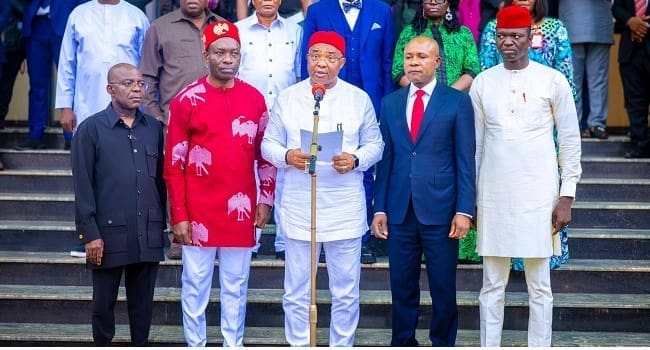
THE governor of Imo State and Chairman of the South-East Governors’ Forum, Hope Uzodimma, has announced that the five governors of the South-East have agreed to support President Bola Tinubu’s re-election in the 2027 presidential election.
Uzodimma said the decision followed a review of the Tinubu administration’s performance in the region, particularly its infrastructure and economic development initiatives.
According to him, the governors unanimously resolved to continue supporting the President and his Renewed Hope Agenda because of what they described as tangible developmental achievements.
Speaking during a meeting with the Imo State Elders Council and traditional rulers in Owerri, the governor stated that the South-East could no longer be influenced by political rhetoric when visible federal projects were already making an impact across the region.

He disclosed that the governors would soon pay a joint courtesy visit to President Tinubu to further strengthen their collaboration with the Federal Government.
Uzodimma noted that one of the major factors behind the endorsement was the establishment of the South East Development Commission (SEDC), describing it as a long-awaited intervention that had remained unrealised since the end of the Nigerian Civil War.
He recalled that President Tinubu signed the SEDC Act into law in July 2024, inaugurated its governing board in February 2025, and ensured the commission commenced operations with funding.
The governor also highlighted several infrastructure projects undertaken by the Federal Government, including the rehabilitation and commercial operation of the Port Harcourt–Aba rail line, as well as the approved $3 billion reconstruction of the Eastern Rail Corridor linking Port Harcourt, the South-East, and Maiduguri.
On road infrastructure, he praised the ongoing construction of the Second Niger Bridge access roads and other major highway projects, including the Otuocha–Anam–Abaji Road and the Oba–Nnewi–Uga–Ihube/Okigwe Junction Road, noting that they would improve transportation, trade, and regional connectivity.
Uzodimma further argued that the South-East had also benefited from nationwide policies introduced by the Tinubu administration, including increased allocations to states, student loan initiatives, improved security efforts, and fiscal reforms aimed at enhancing economic growth.
Turning to state affairs, the governor urged the Imo State Elders Council and traditional rulers to support the implementation of the state’s Charter of Equity, which he described as a framework for ensuring fairness, political inclusion, and lasting stability.
He explained that the Charter of Equity was enacted to institutionalise the rotation of political power among the state’s zones and ensure every part of Imo has a sense of belonging.
Uzodimma maintained that his successor must emerge in line with the Charter of Equity and possess the integrity, fairness, and leadership qualities needed to sustain the progress made by his administration.
He also warned against any attempts to undermine the Charter of Equity for personal political gain, vowing to defend the law in the interest of the state’s future.
The governor concluded by advocating increased investment in vocational training and skills acquisition programmes, describing them as essential tools for reducing unemployment, curbing crime, and promoting sustainable economic development in Imo State.