

TODAY at 7.30pm, HERITAGE, written, directed and produced by Ladi Ladebo rules the big screen at the ongoing 7th Realtime International Film Festival, RTF – the 8-day (August 19-27) feast of images and sound holding at various venues in Lagos.
Though released in 2003, Heritage, the 89 minutes film, has remained evergreen because of the emotive subject of cultural preservation it treats in its well-structured plot, a signature that is known with the late Ladebo.
In the storyline and plot, David, a young Métis researcher arrives from England to study the archaeological treasures of Nigeria at the University of Ibadan. He tries to get in touch with the old professor Fatu, imprisoned following the theft of sacred objects from the tomb of the Yoruba hero Oduduwa. Professor Fatu refuses to deliver the heavy secret because of which traffickers of works of art succeeded in having him imprisoned by corrupting judges and policemen.
When it was released nearly two decades ago, Heritage became a main subject of conversation among cultural intelligentsia in Nigeria, around Africa and the West, with many international mediums doing special reports on the impact of the film on the then strident moves to ensure reparation and retrieval of looted African treasures from several European countries to the continent.

Last year, following the passing of Ladebo, whose other works include the famous Bisi Daughter of the River, Vendor, Countdown to Kusini, among others, Heritage again became a focus of discourse in culture circuits around the world, especially as there has been increased activities around the campaign to ensure return of the many artifacts to the continent.

The film is being screened on the platform of the ‘Nollywood Classics’ segment of the RTF 2022. The segment, according to the founder/director of the festival, Stanlee Ohikhuare, “has been designed to act as a “connector between generations of filmmakers”, and as well as “bridge the gaps often seen within several film traditions and, Nigerian cultures.”
****
Profile of the filmmaker

BORN Raymond Oladipupo Ladebo, May 7 1942, the prolific filmmaker who passed on April 16, 2021, is described on Wikipedia as one of the pioneers of Golden Age of yesteryear Nigerian cinema, especially during the celluloid-era optimism of the 1970s. He previously worked as a media analyst and accountant before entering the film industry.
Popularly called Uncle Ladi by younger artists and associates, he worked as a media analyst and accountant executive for the international advertising agency of Ogilvy and Mather between 1969 and 1972. His experience working for an international advertising agency earned him the opportunity of working as a production assistant on American feature films and also as a line producer for American television programs.
He wrote the screenplay and was the producer of the 1976 American film Countdown at Kusini, which was directed by the African-American actor, Ossie Davis. Countdown at Kusini was regarded as the first film to be made by Black Americans. It also marked the first collaboration between Ossie Davis and Ladi Ladebo in films. He also directed few films including Bisi, Daughter of the River (1977) and Silent Sufferer, which was a collaboration with UNESCO and UNPFA. He began making advocacy films post 1977 often collaborating with funder organisations such as the UNESCO and UNPFA.
His Vendor, released in 1992 garnered four awards including Best Director and Best Feature Film during the inaugural edition of the Nigerian Film Festival of same year. His last directorial film Heritage was released in 2003, and it also had its UK premiere in 2004 at the Khalili Theatre of the School of Oriental and African Studies.
He also produced television programs and his television serial production Thrift Collector was one of three productions selected by the Rotterdam Museum of Ethnology as Best TV Soaps on Population and Development.
*****
THE screening of Heritage is a tribute to Ladebo’s contribution to the journeys of Nigerian cinema, according to founder/director of Realtime Film Festival, Stanlee Ohikhuare, who also disclosed that he would be formally conferred with a Lifetime Achievement Award during the closing ceremony of the festival on Saturday, August 27.
The ‘Nollywood Classics’ segment of the RTF, is designed to recognise the works done by veteran filmmakers, which gave birth to the current shape and character of the films being produced today, stated Ohikhuare.
He continued: “The films showing in the segment have been specially selected to show the various tendencies of the basis of what is today known as the Nollywood film production aesthetics.”
Added the multi-skilled filmmaker and festival director, “Importantly, the selected films will serve as educational and mentoring tools for the pool of young filmmakers who may never have encountered them or their makers, and who form the bulk of the festival’s participants and patrons.
Continued Ohikhuare: “The plan is to use the edition to pay tribute to the “labour of the heroes past” by showcasing high points of the glorious moments in the chequered journeys of the Nigerian cinema. “This will be done through the showcasing of some of the films that made a huge and impactful impression in the 1990s through the 2000s before the now famous ‘Nollywood’ came to formally acquire its name and current character.”
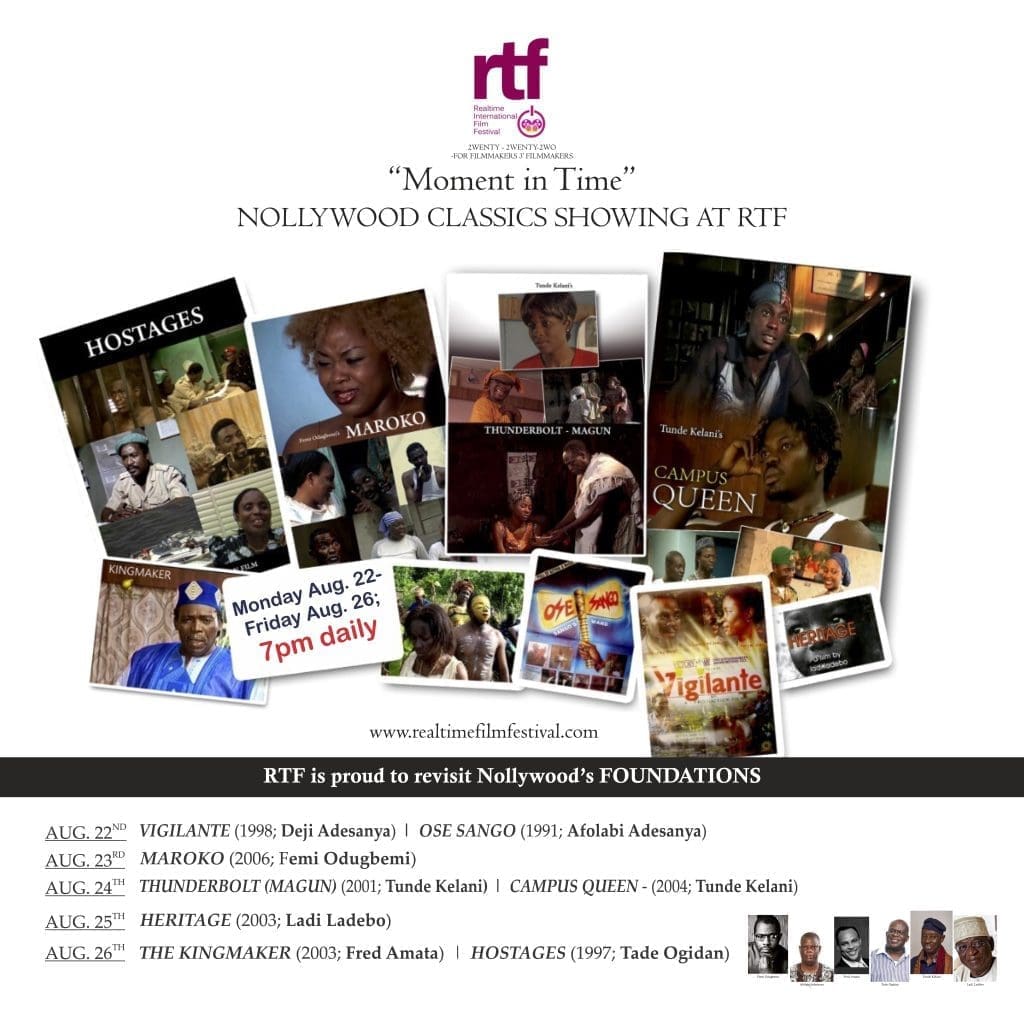
The “Nollywood Classics Showcase” was launched Monday, August 22, with ‘Vigilante’ (1988) and Ose Sango (1991) produced by the filmic Adesanya brothers – Adedeji and Afolabi, the former Managing Director of Nigerian Film Corporation, NFC, who after the screening, had a riveting engagement with the audience, comprising fellow Nigerian filmmakers and a few of the international participants in the festival.
Tuesday, August 23 was the turn of the master storyteller and content creator, Femi Odugbemi, whose socially-conscious film, Maroko (1998) reflecting on State-backed oppression of the poor masses by land grabbing greed of the elites, which was screened to loud applause and intense engagement with the audience.
On Wednesday, August 24, were shown two of the films from the repertory of the ace Cineaste, Tunde Kelani – Thunderbolt (2001) and The Campus Queen (2004).
Five films have featured so far in the “Nollywood Classics” segment, which ends tomorrow, with qs outlined below:
Friday, August 26: Hostages (1 hr. 56 mins; 1997), directed by Tade Ogidan for OGD Pictures;
Friday August 26: The Kingmaker (2002), directed by Fred Amata, produced by Olu and Joke Jacobs, for Lufodo Productions.
Further details on the full programming content of the festival can be seen at www.realtimefilmfestival.com.