
The Committee for Relevant Art (CORA), Nigeria’s foremost cultural advocacy platform founded on June 2, 1991, continues to create an enabling environment for contemporary African arts to flourish.
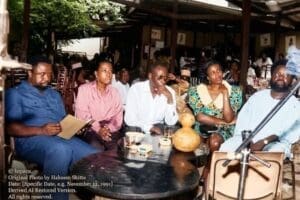
Lead Photo: Participants at the CORA Arts Stampede on Sunday 1st September 1991 at Jazzville, Yaba. From left: Painter-art teacher, Dr Kolade Oshinowo, painter-sculptor, Ndidi Dike, writer-medical doctor, Tolu Ajayi, painter-culture administrator, Chinwe Uwatse, painter-art historian, Dr dele Jegede.
NB: Original Photo by Hakeem Shitta, Derivative Copyright: HSPACA. All rights reserved. Note on images: Original photograph taken by Hakeem Shitta, 1991. Digital Restoration: AI-restored version of the original negative. copyright to both the original work and this derived restoration is strictly held by HSPACA.

JUNE 2 every year marks a milestone in the history of African arts and culture. It was on this day in 1991 that a small group of visionary artists, writers, and critics sat together, with a radical goal to make culture the primary investment destination for Nigeria and the continent. We know them as the Committee for Relevant Art (CORA).
As CORA marks its 35th anniversary, it is difficult to imagine the landscape of Nigerian literature, cinema, theatre, and visual arts without their relentless advocacy.
CORA has evolved from a club of ‘cultural landscapists’ into the most sustained, open-access platform for intellectual and artistic engagement in West Africa.
Blueprint of Relevance: From 1991 to the Future
When Messrs Toyin Akinosho, Yomi Layinka, Josey Ogbuanoh, Tunde Lanipekun, and Chika Okeke-Agulu birthed CORA during military dictatorship, anchoring the official headquarters at 22 Road, A Close Block 4, Festival Town (Festac), Lagos, Nigeria’s artistic community desperately needed an independent, democratic breathing room.
Today, this nomadic journey has found its permanent modern sanctuary at Freedom Park, Lagos (the old colonial prison yard on Broad Street).
There is a profound historical poetry to this relocation: a movement that began by gathering inside a residential Festac flat now holds court in a space transformed from a symbol of colonial captivity into a playground of creative freedom.
It is here, within the designated “Kongi’s Harvest” spaces and amphitheaters, that CORA runs its expansive infrastructure far beyond single meetings, there is a continuous cycle of public literary interventions through its core pillars: the Lagos Book & Art Festival (LABAF), the quarterly Art Stampede fora, the CORA Library & Resource Centre (CL &RC), and the monthly CORA BookTrek.
The word “Relevant” in their name was not just a label but a mandate to use art as a tool for public discourse, social involvement, and policy transformation and CORA has over the years birthed structural pillars that have redefined our creative industries:
Art Stampedes: Fondly known as the “parliament of artists,” this quarterly, open-air town hall has spent decades interrogating cultural policies, shaping early Nollywood critiques, and defending creative freedom. It is within this very forum that the definition of Nigerian cinema has been constantly expanded
CORA has long asserted that the industry is not merely defined by fictional entertainment, but by the vital, non-fiction visual literature and historical documentation championed by master filmmakers and historians like Femi Odugbemi and Ed Keazor.
Their documentaries utilize the cinematic canvas of Nollywood to publish essential chapters of national memory, bridging the gap between screen infrastructure and deep archival research.
CORA is however not just a platform for the living; it is a community that remembers its own. Over the decades, a solemn and powerful tradition emerged:
When an iconic figure in Nigeria’s creative ecosystem transitions to the great beyond CORA swiftly rallies the community for an emergency Stampede to celebrate, critique, and document their departed peer’s legacy.
Countless emergency stampedes have been staged over the decades, serving as critical moments of collective memory whenever the vanguard loses a titan.
For example when Hakeem Shitta passed on, his camera silenced too soon, an Emergency Stampede kept his memory ablaze.
More recently, the community gathered in the same collective grief and celebration for a powerful Emergency Stampede held in honour of the legendary literary theorist, Marxist scholar, and radical intellectual, Professor Biodun Jeyifo, staging a razor-sharp intervention during the iREP International Film Festival in March 2026 under the theme “The Role of the Critic/Scholar in Archiving & Preservation of Memory.”
Through these urgent gatherings, CORA ensures that the giants upon whose shoulders we stand are never forgotten.
Lagos Book & Art Festival (LABAF): Celebrated globally as Africa’s biggest culture picnic, LABAF has transformed spaces like Freedom Park into thriving hubs of literacy, drama, and youth empowerment.
The Book Party: Organized in tandem with the Nigeria Prize for Literature, this event has elevated the work of Nigeria’s finest writers and publishers for decades.
The raw political teeth of CORA are laid bare in the full length of the 15th Arts Stampede resolutions from September 4, 1994.
Staged at the JIRAJ Art Gallery in Maryland, Lagos, the gathering assembled creative practitioners to demand the validation of the “June 1993 presidential elections and installing the winner to the said election.”
The document also stated that “the sectional genocide being visited on the Ogoni people and other minority Nigerians whose only crime is a quest for improvement in their lives should be stopped,” demanding that “Ken Saro-Wiwa and other Ogoni leaders be released immediately.”
The reverse side of the manifesto features a handwritten note penned by CORA co-founder Toyin Akinosho, confirming that this text operated as an underground circular distributed by hand to keep the artistic vanguard aligned for the next meeting on December 4 at the open front lawn at the National Theatre at 12 noon.
Preserving the Spaces: AYOTA, Jazzville, Jazz 38 and Abe Igi
To truly understand CORA is to understand the historic physical sanctuaries where these early creative explosions took place. From inception, its identity was forged in a beautiful, necessary friction between raw, street-level rebellion and structured cultural curation.
This ideological tug-of-war was personified by the Hakeem Shitta Photography and Cultural Archive’s (HSPACA) namesake. When CORA’s second official Art Stampede moved from an unconventional, gritty bus stop in Ojuelegba to Muyiwa Majekodunmi’s iconic venue, Jazzville, at 21 Majaroh Street in Yaba, Shitta was said to have been furious that the group had “given in to the Ajebutters” and stripped the gathering of its raw edge.
Yet, it was precisely this creative tension, the bridge between the pavement and the pavilion, that allowed CORA to survive, thrive, and reshape the landscape of cultural advocacy for decades.
The early Art Stampedes found their rhythm inside AYOTA Arts Centre at 9/11, Olowojeunjeje Street in Ajegunle, where public assembly notices in the “Snippets” column on page 2 of Arts Illustrated Weekly (Issue №51, Feb 24 — Mar 1, 1992) announced:
“CORA MEETS AT AYOTA: The first 1992 quarterly meeting of Committee For Relevant Arts (CORA) will be holding at Ayota Arts Centre, Ajegunle. Calltime 12 noon.”
Guided by its late Artistic Director and Proprietor, Segun Taiwo (A.Y.O.T.A), who ran a weekend variety entertainment package tagged “AJEGUNLE ‘92” featuring drama, dance, comedy, and music, the space aligned its intellectual weight with the raw energy of popular performance.
Beyond Ajegunle, these gatherings occupied live-music sanctuaries like Muyiwa Majekodunmi’s Jazzville in Yaba and Tunde and Frances Kuboye’s Jazz 38 at 38 Awolowo Road in Ikoyi during the tense stretch of June 1994, where jazz, theatre, and radical politics collided under military rule, backed by the brass lines of the Extended Family Band.
An unidentified participant with Moses Ekpo, Director General, Nigeria Copyright Council (NCC) at the CORA Art Stampede at Jazz 38 on 4th June 1995. Photo by Hakeem Shitta. Copyright HSPACA
Thanks to the dedication of visual guardians, this crucial visual history endures. CORA’s blueprint is preserved across distinct historical layers: rare 1992–1994 archival editions of Arts Illustrated Weekly, original typewritten stampede communiqués, and extensive visual documentation preserved within the Hakeem Shitta Photography and Cultural Archive (HSPACA). Shitta’s lens immortalized the atmosphere, the debates, and the performances at those venues.
Beyond Ayota and the music clubs, CORA’s heart beat fiercely at Abe Igi (Under the Tree), the legendary open-air creative sanctuary outside the National Arts Theatre (now known as the Wole Soyinka Centre for Culture and Creative Arts) in Iganmu.
Vol. 2 №8 (May 16 — May 22, 1994) of Arts Illustrated Weekly detailed how the Unofficial Actors Club (UAC) situated around the Box Office kiosks operated as a standard “Information Bureau” where you were “bound to meet a cross-section of the art community, actors/actresses, directors, producers, journalists, culture bureaucrats and critics alike… hanging out there, rubbing minds, jaw-jawing… trading tackles or outright quarrelling over ‘Relevant’ issues.”
Abe Igi was the ultimate informal parliament where artists gathered to drink, debate, and strategize. When the economic downturn meant artists could no longer even afford the price of “liquid content”(a witty nod to the ubiquitous 1980s bottling advertisements where prices were quoted for the beverage alone to show it excluded the bottle deposit), causing the village square to thin out, CORA stepped in to keep the flame of discourse alive by staging the Art Stampede on the very lawns surrounding it.
A Legacy Measured in Impact
Part of CORA’s genius lies in its ability to build communities. When the Federal Government of Nigeria tried to sell off the National Arts Theatre some years ago, CORA rose to the frontline of advocacy to preserve it.
When highlife maestro Fatai Rolling Dollar was nearly forgotten by history, it was CORA’s highlife-expo that brought him back into public consciousness.
CORA’s footprint is everywhere.
From the birth of modern professional dance structures in Nigeria to the intellectual grooming of the next generation of authors through permanent infrastructural frameworks like the CORAVille Library and the CORA Book Trek, a nomadic literary roadshow that takes public book readings and author reviews directly into community spaces year-round.
Their international recognition, including the prestigious Prince Claus Award in 2006 only confirmed what was already known on the streets of Lagos: CORA is the lifeblood of our contemporary arts scene.
As our creative industries continue to dominate the global stage through Afrobeats, Nollywood, and literature, CORA’s foundational vision remains more vital than ever.
To the founders, the tireless volunteers, the archivists keeping the visual memory alive, and every creative and enthusiast who has ever sat at an Art Stampede or walked through the gates of Freedom Park: Happy 35th Anniversary. Thank you for keeping the art relevant.
Archival and Aesthetic Disclosure
NB:This article draws on original research, personal interviews with Nigerian artistes, and my ongoing work assisting in the curation of the Hakeem Shitta Photography and Cultural Archive (HSPACA). Artificial Intelligence was used for polishing language, structure, and flow. The restored photograph featured at the beginning of the article is a derived, AI-colorized version of an original film negative taken by Hakeem Shitta in 1991. The original physical assets and the resulting digital restorations are the exclusive copyright of the Hakeem Shitta Photography and Cultural Archive(HSPACA). While our archival mandate strictly prioritizes the preservation of unaltered historical records, we have deliberately chosen to present this restored version here. For younger readers and contemporary audiences accustomed to modern high-definition media, the vivid color palette serves as an aesthetic entry point — making the immense energy, intellectual vibrancy, and cultural weight of Nigeria’s 1990s art scene feel immediate, accessible, and alive.

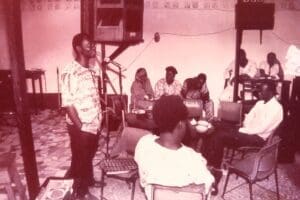
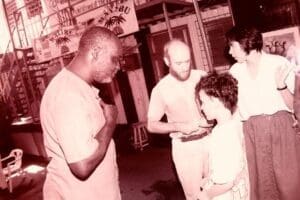
Jazz Bassist, Eletronic engineer, Tunde Kuboye and guests at the CORA Art Stampede held at Jazz 38, Ikoyi, Lagos on 4th June 1995, Photo by Hakeem Shitta. Copyright HSPACA.
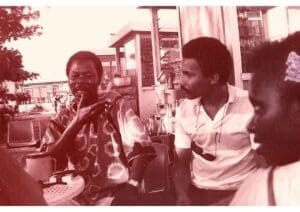
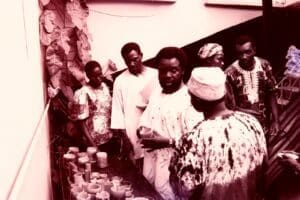
Veteran actor, Sam Loco Efe(late) and other artistes relaxing under the tree (Abe Igi) after a CORA Art Stampede held at the National Arts Theatre in the 90s., Photo by Hakeem Shitta. Copyright HSPACA
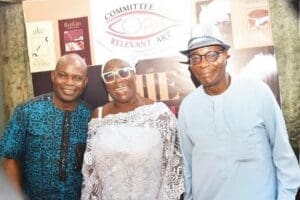
Photo of Jahman Anikulapo with Bola Ashaolu of Nigeria Copyright Commission and Segun Carew Oladimeji at the CORA Library, Freedom Park.
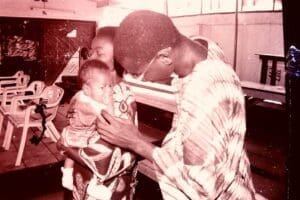
Writer, literary activist, Sola Osofisan admires a baby at CORA Art Stampede held at Jazz 38 Ikoyi, Lagos 4th June 1995. Photo by Hakeem Shitta. Copyright HSPACA.
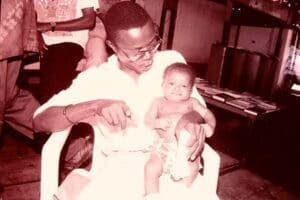
Journalist, historian, Dr Gbile Oshadipe (then of The Guardian newspaper), with a baby at CORA Art Stampede held at Jazz 38 Ikoyi, Lagos 4th June 1995. Photo by Hakeem Shitta. Copyright HSPACA.
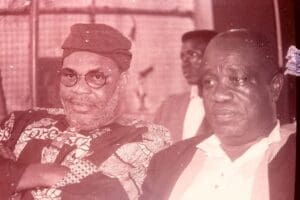
Federal Director of Information, Art Patron, later board member of CORA, Chief Frank Okonta (late) with Dr Moses Ekpo, Director General, Nigeria Copyright Council (NCC) at the CORA Art Stampede at Jazz 38 on 4th June 1995. Photo by Hakeem Shitta. Copyright HSPACA
- https://medium.com/write-your-world/thirty-five-years-of-cultural-landscaping-celebrating-coras-legacy-in-nigeria-s-creative-67efc9d7c204

